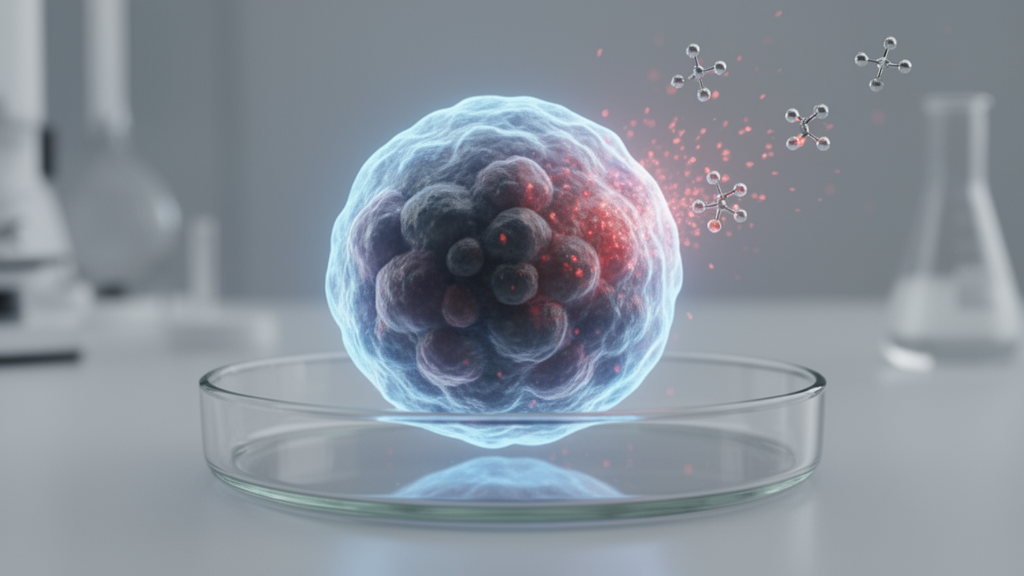
Glioblastoma remains one of the most lethal cancers in medicine, and one of the hardest to treat for a deceptively simple reason: the very barrier that protects the brain from harm also protects the tumor from drugs. The blood–brain barrier, a dense network of tightly sealed endothelial cells lining brain capillaries, blocks the vast majority of molecules from entering brain tissue. In glioblastoma, this barrier becomes a pathological variant known as the blood–brain–tumor barrier, which is leakier than its healthy counterpart but still formidable enough to keep most chemotherapies out. Now, a team of researchers has built a three-dimensional bioprinted model of that barrier that fits in a microwell, and used it to evaluate a ruthenium-based compound that kills tumor cells by flooding them with reactive oxygen species.
The new platform, described in Advanced Science, addresses a long-standing gap in preclinical cancer research. The standard approach of growing tumors under the skin of mice fails to reproduce the brain’s unique extracellular matrix, immune environment, and drug delivery constraints, because the blood–brain barrier simply is not present in a subcutaneous model. Orthotopic models, in which tumor cells are surgically implanted into the brain, offer better predictive value but demand advanced surgical skill, specialized imaging such as MRI or CT to track tumor growth, and raise significant ethical concerns. In vitro models have improved considerably in recent years, particularly as regulatory agencies have begun approving animal-free alternatives for preclinical testing, but most existing blood–brain barrier models either separate their cellular compartments behind scaffolds or lack tumor cells entirely.
The team used an extrusion-based 3D bioprinter to fabricate polylactic acid microwell chambers coated with agarose, into which they printed mixtures of human cerebral microvascular endothelial cells, human brain vascular pericytes, and U-87 MG glioblastoma cells at a one-to-one-to-one ratio. Within twenty-four hours, the cells spontaneously assembled into compact spheroids roughly 300 micrometers in diameter. Confocal microscopy of spheroids labeled with distinct fluorescent cell trackers revealed a striking self-organized architecture: endothelial cells formed the outermost layer, pericytes occupied an intermediate position, and glioblastoma cells comprised the core. Critically, a substantial fraction of pericytes migrated into the tumor core, and follow-up co-culture experiments demonstrated cytoplasmic mixing between pericytes and tumor cells, a phenomenon documented in real glioblastoma tumors in which cancer cells exploit pericyte interactions to drive progression. Because earlier scaffold-based models physically separated their compartments, they could not reproduce this direct cellular intimacy.
Functionally, the spheroids behaved like the barrier they were meant to mimic. Immunofluorescence imaging showed robust expression of the tight junction proteins ZO-1, occludin, and claudin-5, along with the efflux transporter P-glycoprotein, with more than ninety percent of outer-layer endothelial cells expressing all four proteins. When the researchers applied a 40-kilodalton fluorescent dextran tracer, the blood–brain–tumor barrier spheroids proved less permeable than bare tumor spheroids but slightly more permeable than tumor-free blood–brain barrier spheroids assembled with astrocytes in place of tumor cells. That intermediate, leaky phenotype is precisely what clinicians observe in glioblastoma patients, where tumor-induced vascular changes compromise barrier integrity without eliminating it.
With the model validated, the researchers turned to their candidate drug: a ruthenium(II) polypyridyl complex with a molecular weight of 871.9 grams per mole. Unlike most chemotherapy agents, which target DNA directly, ruthenium compounds kill cancer cells by generating reactive oxygen species such as singlet oxygen and hydroxyl radicals. Cancer cells already operate at elevated oxidative stress levels due to their rapid metabolism and survive only by leaning heavily on antioxidant systems like glutathione. An additional burst of ROS tips that balance into catastrophe, damaging DNA, proteins, and lipids until the cell dies. Confocal imaging showed the ruthenium compound accumulating in mitochondria and the endoplasmic reticulum of U-87 MG cells, and dose-dependent ROS generation was confirmed with a fluorescent probe. The compound triggered mitochondrial permeability transition, disrupted calcium homeostasis, and reduced U-87 MG viability by half at a concentration of 22.3 micromolar.
The most intriguing finding concerned how the compound interacts with the barrier itself. Treatment with the ruthenium complex increased expression of alpha-smooth muscle actin and F-actin in pericytes, promoting contractile changes that loosen barrier structure. It also elevated secretion of matrix metalloproteinase-9, an enzyme that degrades extracellular matrix and erodes tight junctions, and endothelin-1, a vasoconstrictor associated with increased barrier permeability. Tight junction protein levels in endothelial cells dropped significantly at 20 micromolar. When cells were pretreated with the antioxidant N-acetylcysteine, these effects were largely abolished, with the scavenger suppressing 69 to 77 percent of the drug-induced increases in MMP-9 and endothelin-1 and restoring tight junction protein expression nearly to baseline. In other words, the compound appears to open its own path through the barrier via the very reactive oxygen species it generates, facilitating paracellular transport in addition to partial passive diffusion across endothelial cells.
Permeability experiments confirmed this dual mechanism. While the dextran tracer showed roughly 3.5-fold higher fluorescence in tumor-only spheroids than in blood–brain barrier spheroids, the ruthenium compound distributed nearly equally across all three spheroid types, with ratios hovering near 1.0. Transwell assays using endothelial monolayers further showed that the compound is only a partial P-glycoprotein substrate, with an efflux ratio of 1.7-fold upon inhibition, far lower than the 4.4-fold ratio observed for osimertinib, an approved cancer drug that proved unsuitable for brain delivery due to both strong efflux and a narrow therapeutic window. Temozolomide, the current standard of care for glioblastoma, showed no P-glycoprotein involvement at all, crossing exclusively by passive diffusion.
The head-to-head comparison inside the bioprinted spheroids delivered the study’s most striking result. Using a fluorescent cell death probe that itself penetrates the barrier, the researchers quantified tumor cell killing at single-cell resolution within intact spheroids. Paclitaxel and cisplatin, both established chemotherapies, produced negligible cell death, consistent with their inability to cross the blood–brain–tumor barrier. Temozolomide and the ruthenium compound both induced significant tumor cell death, but after normalizing for dose and potency, the ruthenium compound achieved a relative permeability of 14.2 compared with 10.6 for temozolomide, despite being administered at a concentration slightly below its own IC50. Flow cytometry cross-validated these imaging results, showing roughly 21.7 percent tumor cell death for the ruthenium compound versus 19.9 percent for temozolomide, while controls and the two non-penetrant drugs remained near baseline.
The platform also proved adaptable beyond a single laboratory cell line. When the researchers rebuilt the spheroids using two patient-derived glioblastoma cell lines, SNU-4210 and SNU-5026, the same layered architecture emerged, and the ruthenium compound again outperformed temozolomide, generating roughly 2.1 to 2.3 times higher cell death signal across the tumor core. This patient-derived validation matters because glioblastoma is notoriously heterogeneous, and models that only work with established cell lines often fail to predict clinical responses.
The authors are careful to note the caveats. The model measures relative rather than absolute permeability, the 48-hour exposure window may not suit every compound, and barrier opening driven by ROS-mediated tight junction damage is mechanistically distinct from favorable intrinsic penetration, raising questions about the balance between drug delivery and neurovascular safety that will require in vivo evaluation. MMP-9 and endothelin-1 are also pleiotropic mediators involved in tumor invasion and treatment resistance, not simple barrier biomarkers. Even so, the study delivers two significant contributions at once: a bioprinted, scaffold-free model that captures the cellular crosstalk of the tumor-barrier interface, and the first ruthenium-based ROS-generating agent evaluated within such a system, one that killed glioblastoma cells more efficiently per dose than the standard-of-care drug while tolerating concentrations that left endothelial cells unharmed. For a disease where nearly every drug candidate dies at the barrier, both advances deserve close attention.
Subject of Research: A 3D bioprinted blood–brain–tumor barrier spheroid model for evaluating ROS-generating ruthenium anticancer compounds against glioblastoma
Article Title: 3D Bioprinted Blood–Brain–Tumor Barrier Spheroid‐Based In Situ Evaluation of Anticancer Compounds Against Glioblastoma: ROS‐Producing Ruthenium as a Potential Therapeutic Candidate
Article References: Lee, H., Jeon, C. H., Kim, D., Lee, M., Kwon, M., & Song, J. M. (2026). 3D Bioprinted Blood–Brain–Tumor Barrier Spheroid‐Based In Situ Evaluation of Anticancer Compounds Against Glioblastoma: ROS‐Producing Ruthenium as a Potential Therapeutic Candidate. Advanced Science, Article e78150. https://doi.org/10.1002/advs.78150
Image Credits: AI Generated
DOI: 10.1002/advs.78150
Keywords: glioblastoma, blood-brain barrier, 3D bioprinting, spheroid model, ruthenium compound, reactive oxygen species, blood-brain-tumor barrier, temozolomide, P-glycoprotein, tight junctions, pericytes, drug permeability
News Source: Nathaniel Bowman. (October 9, 2026). Bioprinted Blood–Brain–Tumor Barrier Spheroids Put a ROS-Producing Ruthenium Drug to the Test Against Glioblastoma. Scienmag.