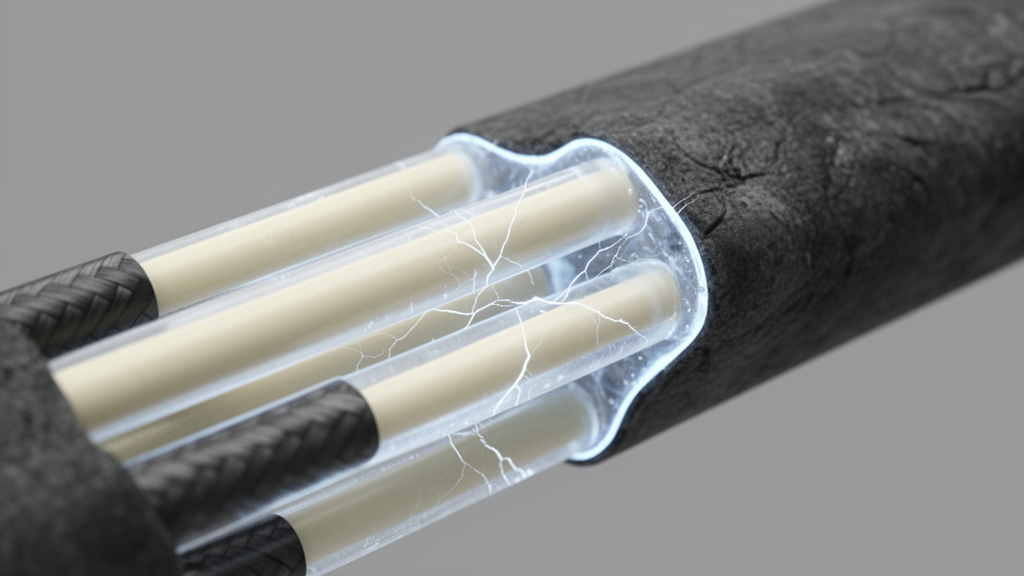
Deep inside every carbon-fiber aircraft wing, every wind-turbine blade, and every lightweight fuselage panel lies a region so thin that no human eye can see it, yet so consequential that it effectively decides whether the entire structure succeeds or fails. This region is the interface between the reinforcing fiber and the surrounding polymer matrix, and a new open-access review published in Advanced Composites and Hybrid Materials argues that it is precisely here that the future of fiber-reinforced polymer composites will be won or lost. The review, authored by Xinjie Mao, Zhiyong Zhao, and Ruobin Yan of Shandong University, surveys the state of interface science across three intertwined fronts: the fundamental physicochemical mechanisms that govern bonding and failure, the modification strategies engineers use to strengthen and tune that bonding, and the emerging ambition of turning the interface from a passive mechanical link into an active, multifunctional platform.
The central premise of the review is deceptively simple. The performance of a fiber-reinforced polymer composite is highly contingent on the properties of the interfacial region between fiber and matrix. The interface is not merely glue holding two constituents together; it is the critical medium through which loads are transferred from the relatively compliant matrix into the stiff, strong fibers that give composites their remarkable specific strength and stiffness. When that load-transfer medium behaves well, the composite can approach the theoretical performance of its constituents. When it behaves poorly, cracks find the interface an easy highway, and damage propagates through the material in ways that can be catastrophic. The authors emphasize that the interface fundamentally governs the damage evolution mechanisms and the resultant macroscopic performance of the material, which means that understanding interfacial behavior is inseparable from understanding composite behavior as a whole.
What makes the interface such a rich subject of study is the sheer complexity of the bonding that occurs there. Interfacial adhesion arises from a combination of physical and chemical mechanisms operating simultaneously: mechanical interlocking between fiber surface irregularities and the matrix, weak but ubiquitous van der Waals interactions, hydrogen bonding, and, where surface chemistry permits, covalent chemical bonds formed between functional groups on the fiber and reactive species in the resin. The relative contributions of these mechanisms depend on the fiber type, the sizing chemistry applied during fiber manufacture, the matrix formulation, and the processing conditions used to consolidate the laminate. Because no single bonding mechanism dominates in all systems, the review stresses that interfacial design cannot be reduced to a one-size-fits-all prescription; instead, researchers must map which mechanisms are active in a given material system and tailor their strategies accordingly.
Equally important is the way the interface fails. The review analyzes typical failure modes and their relationship to macroscopic performance, drawing a direct line between microscopic interfacial behavior and engineering outcomes. When the interface is too weak, debonding occurs at low stress, fibers pull out of the matrix without contributing their full strength, and the composite underperforms. When the interface is excessively strong, cracks that enter the material propagate straight through both fiber and matrix with little energy dissipation, producing brittle failure that is dangerous in structural applications. The most desirable behavior often lies in a carefully engineered middle ground, where the interface is strong enough to transfer load efficiently but structured so that advancing cracks are deflected, branched, or blunted, dissipating energy and giving the material damage tolerance. This nuanced view marks a decisive shift in the field: the goal is no longer simply the strongest possible bond, but the deliberately designed bond.
That shift is reflected in the modification strategies the review compares. Chemical treatment remains one of the most widely used levers, encompassing oxidation, sizing formulations, grafting of functional molecules, and coupling agents that create bridges between fiber and matrix at the molecular scale. These approaches can dramatically increase interfacial shear strength by raising surface energy, introducing reactive groups, or improving wetting, but they carry limitations, including the risk of degrading the fiber itself through aggressive treatment and the difficulty of achieving uniform chemistry across kilometers of fiber tow. Physical methods, by contrast, modify the fiber surface through energy-based processes such as plasma treatment, which can clean, activate, and roughen the surface without chemical reagents, offering environmental and controllability advantages. Coating techniques occupy a third category, depositing thin interlayers that act as buffers, graders of modulus, or crack deflectors between fiber and matrix, effectively engineering a third phase into what was once considered a two-phase problem.
Each of these strategies involves trade-offs, and the review is explicit in comparing their working mechanisms and limitations rather than presenting any single method as a universal solution. Chemical treatments offer molecular precision but can compromise fiber integrity and raise environmental concerns. Plasma and other physical treatments are clean and fast but may struggle with penetration into dense fiber bundles and with long-term stability of the activated surface. Coatings provide unmatched design freedom, allowing researchers to tune thickness, stiffness, and chemistry independently, but they add processing steps and cost, and their durability under service conditions must be demonstrated. The practical challenge, the authors note, is that laboratory-scale successes in interfacial engineering frequently fail to translate into industrial practice because the methods cannot be scaled economically or cannot guarantee the consistency that aerospace certification demands.
A particularly active frontier involves nanoparticles and nanofilms deployed at or near the interface to enhance interlaminar performance, the resistance of a laminate to delamination between plies, which is historically the Achilles heel of laminated composites. By positioning carbon nanotubes, graphene-based sheets, or other nanoscale reinforcements in the interlaminar region or grafted onto fiber surfaces, researchers create dense networks of nanostructures that bridge cracks, pull out under load, and force advancing delamination fronts to follow tortuous paths. The review discusses the toughening mechanisms behind these effects, which include crack bridging, nanotube pull-out, matrix ligament deformation between nanostructures, and crack deflection at nano-reinforced boundaries. The result can be substantial improvements in interlaminar fracture toughness without the weight penalty of traditional mechanical fastening or the through-thickness disruption caused by stitching.
Perhaps the most forward-looking section of the review concerns the transformation of the interface from a purely mechanical link into a multifunctional platform. Because the interface is distributed throughout the entire volume of a composite, it represents an enormous amount of engineered surface area that currently does nothing beyond transferring load. Researchers are now exploring whether that same region can simultaneously serve additional functions: sensing damage through changes in the electrical conductivity of carbon nanostructure networks embedded at the interface, dissipating static charge or lightning strike energy, providing thermal pathways for heat management, or even enabling self-healing chemistry that responds to the early stages of debonding. In this vision, the interface becomes the nervous system of the composite, a built-in network that monitors, protects, and reports on the structure throughout its service life. For aerospace and advanced equipment applications, where structural health monitoring is a persistent challenge, the appeal of a material that senses its own damage is obvious.
The review does not shy away from the obstacles standing between this vision and routine practice. Scalable fabrication remains the foremost challenge: techniques that produce exquisitely engineered interfaces on laboratory coupons often cannot be extended to the industrial production of large primary structures at acceptable cost and throughput. Long-term reliability is the second great unknown, since interfaces modified with novel chemistries or nanostructures must survive decades of fatigue, moisture, temperature cycling, and ultraviolet exposure without degradation, and the certification frameworks for such materials are still maturing. The authors also point to the need for better characterization and modeling tools capable of probing interfaces at their true length scales, since the region of interest is often only tens to hundreds of nanometers thick, sandwiched between constituents whose properties differ enormously.
Supported by the National Natural Science Foundation of China and the Aviation Science Funds of China, the review distills a field in transition. The trajectory it describes, from pursuing strong bonding to deliberately designing interfacial structure and functionality, mirrors the broader maturation of composites from replacement materials to engineered systems whose every region is optimized for purpose. For an industry racing toward lighter aircraft, longer blades, and structures that can tell engineers when they are hurt, the nanometer-thin region between fiber and matrix has never mattered more. The message of the review is that the era of treating the interface as an afterthought is over; it is now the design space where the next generation of composite performance will be created.
Subject of Research: Interfacial bonding mechanisms, modification strategies, and multifunctional design in fiber-reinforced polymer composites
Article Title: Fiber-reinforced polymer composite interfaces: research progress on mechanisms, modification, and multifunctionalization
Article References: Mao, X., Zhao, Z., & Yan, R. (2026). Fiber-reinforced polymer composite interfaces: research progress on mechanisms, modification, and multifunctionalization. Advanced Composites and Hybrid Materials. https://doi.org/10.1007/s42114-026-02114-w
Image Credits: AI Generated
DOI: 10.1007/s42114-026-02114-w
Keywords: fiber-reinforced composites, polymer matrix, interfacial bonding, surface modification, plasma treatment, coatings, nanoparticles, carbon nanotubes, interlaminar toughness, delamination, structural health monitoring, aerospace materials
News Source: Denise Maddox. (October 9, 2026). The Invisible Layer That Decides How Composites Fail: Interface Science Comes of Age. Scienmag.