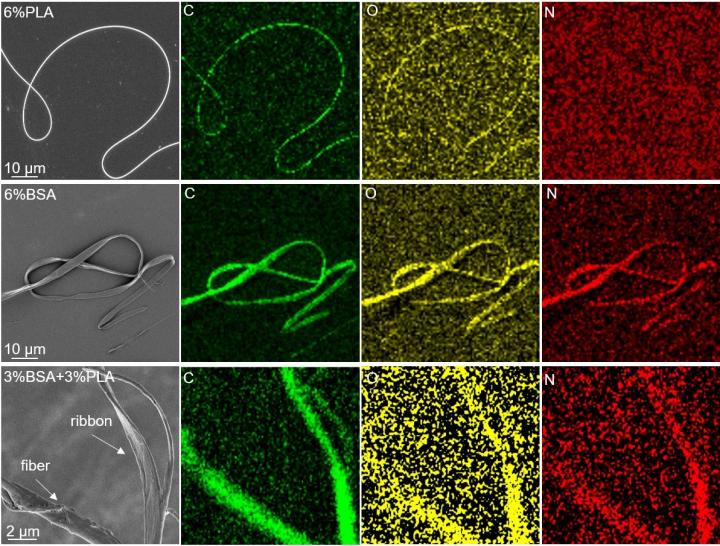
Credit: Elizaveta Pavlova et al./RSC Advances
Russian researchers from the Federal Research Clinical Center of Physical-Chemical Medicine, the Moscow Institute of Physics and Technology, and Lomonosov Moscow State University showed the possibility of blending two incompatible components — a protein and a polymer — in one electrospun fiber. Published in RSC Advances, the study also demonstrates that the resulting mat can gradually release the protein. Blended mats containing proteins are promising for biomedical applications as burn and wound dressings, matrices for drug delivery and release, and in tissue engineering.
Electrospinning
Electrospun mats consisting of ultrafine fibers have numerous applications. They can be used for liquid and gas filtering, cell culturing, drug delivery, as sorbents and catalytic matrices, in protective clothing, antibacterial wound dressing, and tissue engineering.
Electrospinning is a method for fabricating micro- and nanofibers from polymers that involves the use of an electrostatic field. Under a high voltage of about 20 kilovolts, a drop of polymer solution becomes electrified and stretches out into a thin fiber once the Coulomb repulsion overcomes surface tension.
The technique is fairly flexible and enables a range of components to be incorporated into electrospun mats: micro- and nanoparticles of different nature, carbon nanotubes, fluorescent dyes, drugs and antibacterial agents, polymer and biopolymer mixtures. That way the properties of the mats can be fine-tuned to fit a specific practical application.
Polymer-protein mats
An electrospun mat is often manufactured with a carrier polymer, which ensures stable fiber formation and can incorporate additional components. For biomedical applications, biodegradable and biocompatible polymers are usually required, and polylactic acid is among the most common ones. PLA is used to produce degradable packaging, surgical threads, screws, and pins.
The main problem with using PLA in biology and medicine is its hydrophobic nature, and therefore poor cell adhesion. To address this, the polymer is blended with proteins, because they are nontoxic, hydrophilic, naturally metabolized, and can act as therapeutic agents.
The researchers studied blended mats consisting of the water-insoluble PLA and a water-soluble globular protein called bovine serum albumin, or BSA. Experiments in a water medium showed the protein component to be released from the mat into the solution gradually. Specifically, about half of the protein in the mat was dissolved over a week. This effect suggests possible applications in prolonged release of protein-based drugs.
To predict the properties of the blended mats, the team had to study protein distribution in them. The caveat is that most polymers do not mix well. In a polymer-protein-solvent system, the components tend to separate into two solutions. Although this does apply to PLA and BSA solutions, electrospinning allowed the researchers to overcome phase separation in mats. They showed both components to be present in every fiber (fig. 1) with three independent analytic methods: fluorescence microscopy, EDX spectroscopy, and Raman spectroscopy.
“Electrospun polymer-protein blended mats have many possible applications. By varying the amount of protein, you can tune how fast mat biodegradation happens. The protein’s numerous functional groups enable us to modify the mat surface by attaching chemical compounds to it. Protein-based blended mats could also be used as selective filters or for prolonged drug release, for example, in burn and wound dressings,” study co-author Dmitry Klinov commented. He is a researcher at MIPT’s Molecular and Translational Medicine Department and the head of the Laboratory of Medical Nanotechnologies at the Federal Research Clinical Center of Physical-Chemical Medicine of the Federal Medical and Biological Agency of Russia.
###
The paper reported in this story was supported by the Russian Science Foundation (Grant No. 19-74-00037).
Media Contact
Varvara Bogomolova
[email protected]
7-916-147-4496
Original Source
https:/
Related Journal Article
http://dx.