• HOME
  • NEWS
  • EXPLORE
    • CAREER
      • Companies
      • Jobs
    • EVENTS
    • iGEM
      • News
      • Team
    • PHOTOS
    • VIDEO
    • WIKI
  • BLOG
  • COMMUNITY
    • FACEBOOK
    • INSTAGRAM
    • TWITTER
Monday, May 11, 2026
BIOENGINEER.ORG
No Result
View All Result
  • Login
  • HOME
  • NEWS
  • EXPLORE
    • CAREER
      • Companies
      • Jobs
        • Lecturer
        • PhD Studentship
        • Postdoc
        • Research Assistant
    • EVENTS
    • iGEM
      • News
      • Team
    • PHOTOS
    • VIDEO
    • WIKI
  • BLOG
  • COMMUNITY
    • FACEBOOK
    • INSTAGRAM
    • TWITTER
  • HOME
  • NEWS
  • EXPLORE
    • CAREER
      • Companies
      • Jobs
        • Lecturer
        • PhD Studentship
        • Postdoc
        • Research Assistant
    • EVENTS
    • iGEM
      • News
      • Team
    • PHOTOS
    • VIDEO
    • WIKI
  • BLOG
  • COMMUNITY
    • FACEBOOK
    • INSTAGRAM
    • TWITTER
No Result
View All Result
Bioengineer.org
No Result
View All Result
Home NEWS Science News Chemistry

Big energy savings for tiny machines

Bioengineer by Bioengineer
May 22, 2019
in Chemistry
Reading Time: 2 mins read
0
IMAGE
Share on FacebookShare on TwitterShare on LinkedinShare on RedditShare on Telegram

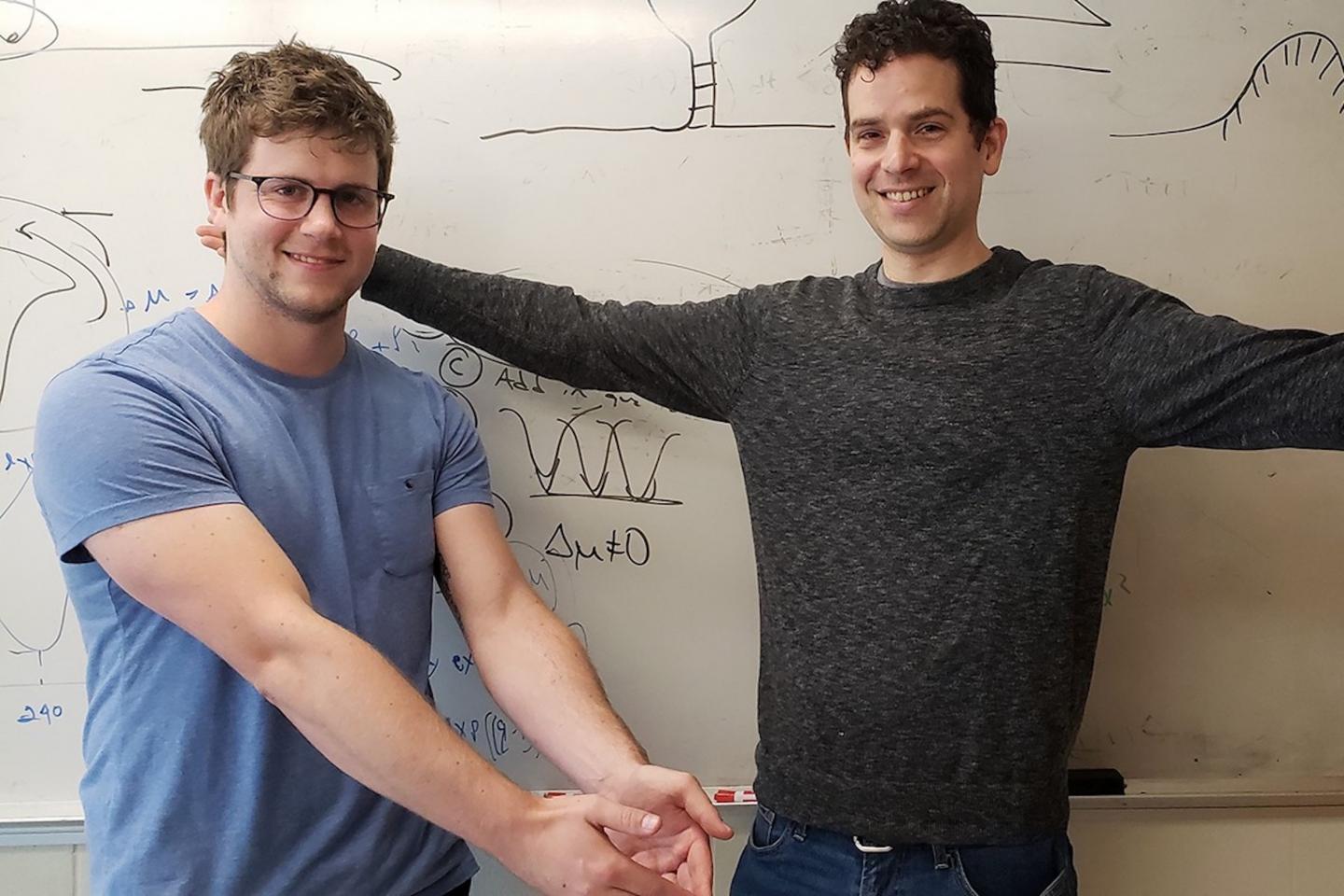
IMAGE

Credit: SFU

Inside all of us are trillions of tiny molecular nanomachines that perform a variety of tasks necessary to keep us alive.

In a ground-breaking study, a team led by SFU physics professor David Sivak demonstrated for the first time a strategy for manipulating these machines to maximize efficiency and conserve energy. The breakthrough could have ramifications across a number of fields, including creating more efficient computer chips and solar cells for energy generation.

Nanomachines are small, really small — a few billionths of a meter wide, in fact. They’re also fast and capable of performing intricate tasks: everything from moving materials around a cell, building and breaking down molecules, and processing and expressing genetic information.

The machines can perform these tasks while consuming remarkably little energy, so a theory that predicts energetic efficiency helps us understand how these microscopic machines function and what goes wrong when they break down, Sivak says.

In the lab, Sivak’s experimental collaborators manipulated a DNA hairpin, whose folding and unfolding mimics the mechanical motion of more complicated molecular machines. As predicted by Sivak’s theory, they found that maximum efficiency and minimal energy loss occurred if they pulled rapidly on the hairpin when it was folded but slowly when it was on the verge of unfolding.

Steven Large, an SFU physics graduate student and co-first author on the paper, explains that DNA hairpins (and nanomachines) are so tiny and floppy that they are constantly jostled by violent collisions with surrounding molecules.

“Letting the jostling unfold the hairpin for you is an energy and time saver,” Large says.

Sivak thinks the next step is to apply the theory to learn how to drive a molecular machine through its operational cycle, while reducing the energy required to do that.

So, what is the benefit from making nanomachines more efficient? Sivak says that potential applications could be game-changing in a variety of areas.

“Uses could include designing more efficient computer chips and computer memory (reducing power requirements and the heat they emit), making better renewable energy materials for processes like artificial photosynthesis (increasing the energy harvested from the Sun) and improving the autonomy of biomolecular machines for biotech applications like drug delivery.”

The study was published in Proceedings of the National Academy of Sciences.

###

Media Contact
David Sivak
[email protected]

Original Source

http://www.sfu.ca/sfunews/stories/2019/05/big-energy-savings-for-tiny-machines.html

Related Journal Article

http://dx.doi.org/10.1073/pnas.1817778116

Tags: Biomechanics/BiophysicsChemistry/Physics/Materials SciencesMolecular PhysicsNanotechnology/Micromachines
Share12Tweet8Share2ShareShareShare2

Related Posts

Miniature Sensor Uses Light to Detect Touch — Chemistry

Miniature Sensor Uses Light to Detect Touch

May 8, 2026
Iron Minerals Determine Whether Dissolved Organic Matter Fuels Microbes or Becomes Long-Term Carbon Storage — Chemistry

Iron Minerals Determine Whether Dissolved Organic Matter Fuels Microbes or Becomes Long-Term Carbon Storage

May 8, 2026

Kate Evans Appointed Associate Lab Director for Biological and Environmental Systems Science at ORNL

May 8, 2026

Advancing Multiscale Modeling and Overcoming Operational Challenges in Autothermal COâ‚‚-to-Methanol Reactors

May 8, 2026
Please login to join discussion

POPULAR NEWS

  • Research Indicates Potential Connection Between Prenatal Medication Exposure and Elevated Autism Risk

    840 shares
    Share 336 Tweet 210
  • New Study Reveals Plants Can Detect the Sound of Rain

    728 shares
    Share 290 Tweet 182
  • Salmonella Haem Blocks Macrophages, Boosts Infection

    62 shares
    Share 25 Tweet 16
  • Breastmilk Balances E. coli and Beneficial Bacteria in Infant Gut Microbiomes

    57 shares
    Share 23 Tweet 14

About

We bring you the latest biotechnology news from best research centers and universities around the world. Check our website.

Follow us

Recent News

NELA, P-POSSUM, Muscle Index Predict Elderly Surgery Risk

PeroCycle Partners with Jindal Steel (Oman) to Pioneer Low-Carbon Steel Innovation

Widely Used Cholesterol Medication Could Disrupt Ovarian Cancer’s Stealth Defense

Subscribe to Blog via Email

Enter your email address to subscribe to this blog and receive notifications of new posts by email.

Join 82 other subscribers
  • Contact Us

Bioengineer.org © Copyright 2023 All Rights Reserved.

Welcome Back!

Login to your account below

Forgotten Password?

Retrieve your password

Please enter your username or email address to reset your password.

Log In
No Result
View All Result
  • Homepages
    • Home Page 1
    • Home Page 2
  • News
  • National
  • Business
  • Health
  • Lifestyle
  • Science

Bioengineer.org © Copyright 2023 All Rights Reserved.