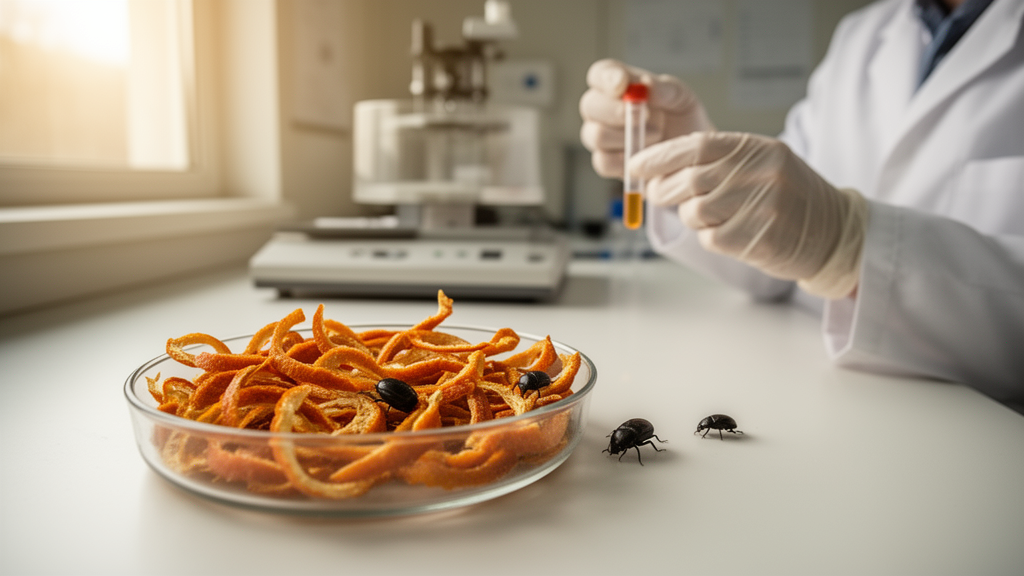
Dried tangerine peel, known in Chinese as Chenpi, is one of the most widely used medicine-food homology materials in China, prized for its flavonoids, phenolics, volatile oils, and its traditional roles in easing indigestion, reducing phlegm, and supporting gastrointestinal health. But Chenpi must be stored for more than three years to reach its best quality, and that long storage window leaves it vulnerable to an enemy few consumers ever see: the red flour beetle, Tribolium castaneum. A new study reports that this beetle leaves behind a measurable chemical fingerprint in infested peel, one that researchers say could eventually be used to detect contaminated samples that look perfectly normal to the eye.
The research, published in Food Chemistry: X, was led by Yunxia Cheng and colleagues, who set out to answer two linked questions: how badly does Tribolium castaneum infestation degrade the quality of Chenpi, and can the metabolic damage be turned into a reliable detection signal? Previous work had shown that Chenpi can be infested by as many as sixteen insect species during storage, and that volatile oil yields drop markedly as infestation severity increases. Traditional detection methods, such as visual inspection and microscopic observation, are highly subjective and can only catch severely infested samples with obvious boreholes and abundant excretion. Mild or concealed infestation, and infestation in processed Chenpi products, largely escapes them.
The team worked with Chuanhongju ‘Dahongpao’ (Citrus reticulata ‘Dahongpao’), the main Chenpi variety in Sichuan Province. Mature fruits were harvested on December 10, 2024, and the peels were shredded and sun-dried to a moisture content below 13 percent under strict insect-control and contamination-prevention measures. One portion went into an ambient-temperature aging study, where natural infestation by Tribolium castaneum was observed in September and October 2025; that observation motivated the present experiment. The Chenpi used in the actual study came exclusively from a second portion kept continuously in cold storage at 4 degrees Celsius for about ten months, conditions unfavorable to beetle development and mold growth. Before the experiment began, all samples were inspected under bright light, and no boreholes, excretion, live insects, or mold were found.
For the infestation trial, the researchers placed 35 grams of shredded Chenpi into breathable culture jars and inoculated them with two-week-old adult beetles at densities of 50 or 100 individuals per jar. The infestation ran for 30 days at 28 degrees Celsius and 65 percent relative humidity, conditions chosen to match the biological requirements of the beetle and the actual temperature and humidity records from the aging warehouse. A control group underwent the identical procedure without insects. Afterward, the infested samples were gently brushed and sieved to remove insect bodies and loose frass, a step designed to attribute detected metabolites to the Chenpi matrix itself rather than to surface deposits, and to mimic routine post-infestation handling of marketed products. All groups were prepared in triplicate and monitored throughout; no mold growth appeared in any group, and no pupae or newly emerged adults were observed, indicating that infestation pressure came mainly from the inoculated adults.
The physical and chemical toll of infestation was substantial. Sample weight losses over the 30 days were 1.12 percent in the control, 6.05 percent at 50 beetles, and 10.01 percent at 100 beetles, showing that Chenpi consumption rose with insect density. Color measurements told a subtler story: no significant differences appeared in any color parameter among the three groups, and total color differences relative to the control were small, at 0.89 for the 50-beetle group and 1.03 for the 100-beetle group. Yet exploratory hierarchical clustering still grouped samples by infestation status, hinting that the color vector carries weak infestation-related information, a trend the authors stress should be regarded as exploratory rather than diagnostic given the small sample size. Visually, infested samples were softer, contained insect-generated powder and excretion, had lost more of their citrus aroma, and emitted an unusual odor detectable by direct smell.
Chemical analysis revealed clear degradation of Chenpi’s valued constituents. Using a validated HPLC method, the team quantified five active compounds: chlorogenic acid, cryptochlorogenic acid, caffeic acid, nobiletin, and tangeretin. The uninfested control samples held the highest concentrations of all five. As beetle density increased, chlorogenic acid and cryptochlorogenic acid declined continuously and significantly, while caffeic acid, nobiletin, and tangeretin initially decreased before partially recovering, though never returning to control levels. Total flavonoids fell significantly with increasing beetle density, and total phenolics showed no significant change at the lower density but dropped significantly at the higher one. The authors attribute these declines to direct consumption of flavonoid- and phenolic-rich tissues by the insects and to oxidative degradation following cell damage.
Antioxidant activity, a key quality indicator for Chenpi, followed the same downward path. DPPH radical scavenging activity fell from 20.55 micromolar Trolox equivalents per gram in the control to 15.82 at the highest beetle density. FRAP reducing power dropped significantly from 75.30 to as low as 52.60 micromolar Trolox equivalents per gram, and ABTS radical scavenging activity fell significantly from 125.57 to 79.72 micromolar Trolox equivalents per gram. Across all three assays, the uninfested samples showed the greatest antioxidant capacity, with a general decline as insect density rose, a pattern consistent with previous reports on infested medicinal plants.
The most striking findings came from untargeted UPLC-MS metabolomics, which annotated 1,162 metabolites across the samples. Principal component analysis separated the control, 50-beetle, and 100-beetle groups into distinct clusters, and validated OPLS-DA models confirmed significant metabolic differences. In the 50-beetle comparison, 53 differential metabolites were detected, 42 up-regulated and 11 down-regulated; at 100 beetles, the count rose to 134, with 83 up-regulated and 51 down-regulated, suggesting a dose-dependent metabolic response. Organoheterocyclic compounds showed the largest number of differential metabolites in both comparisons, and pathway enrichment analysis flagged purine metabolism and caffeine metabolism as consistently positively enriched, with purine metabolism showing the highest perturbation of all pathways. Within that pathway, three compounds stood out: uric acid, hypoxanthine, and xanthine, all markedly up-regulated as beetle density increased. Their logarithmic fold changes reached 5.43, 4.51, and 3.96 respectively at the lower density, and 7.75, 6.48, and 5.85 at the higher one.
The authors interpret this purine surge as a chemical fingerprint of insect nitrogen metabolism. Beetles excrete nitrogenous waste predominantly as uric acid, and the accumulation of uric acid, hypoxanthine, and xanthine, together with other nitrogenous organoheterocycles such as xanthurenic acid and N-acetyldopamine, compounds tied to beetle cuticle tanning and ommochrome metabolism, is unlikely to originate from the Chenpi itself. Meanwhile, the down-regulated metabolites were dominated by phosphatidylcholines and flavonoids, consistent with selective feeding on lipid- and polyphenol-rich tissues. Spearman correlation analysis then tied the three candidate markers to quality: all three showed significant negative correlations with total flavonoids, total phenolics, and all three antioxidant assays, as well as with chlorogenic acid and cryptochlorogenic acid, and hypoxanthine and xanthine correlated significantly with lightness and total color difference. The authors emphasize that with only nine observations from a single experiment, these correlations are exploratory and may partly reflect the shared dose-dependence of all parameters on insect density.
The researchers are careful about the limits of their work. The three compounds were proposed as candidate markers based on relative abundance in untargeted metabolomics, without absolute quantification, method validation, independent cohorts, or diagnostic performance analysis, and raw P values without false-discovery-rate correction were used given the small sample size. The control group itself was stored at 28 degrees Celsius and 65 percent humidity, so the design captured the additional effect of infestation under those conditions rather than its independent effect under conventional storage. No microbiological analyses were performed, and sensory traits were assessed only by sight and smell. Future work, the team says, will validate the candidate markers through targeted quantification in larger cohorts, under conventional storage, at early and concealed infestation stages, and in real market samples. If those validations succeed, the purine fingerprint left by Tribolium castaneum could become a practical tool for protecting one of China’s most treasured stored products from a pest that consumers would otherwise never detect until it is too late.
Subject of Research: Metabolomic screening for candidate markers of Tribolium castaneum infestation in stored Chenpi (dried citrus peel)
Article Title: Metabolomic screening integrated with quality evaluation to pinpoint candidate markers in Chenpi infested by Tribolium castaneum
Article References: Cheng, Y., Li, M., Ma, Q., & Tang, J. (2026). Metabolomic screening integrated with quality evaluation to pinpoint candidate markers in Chenpi infested by Tribolium castaneum. Food Chemistry: X, 40, Article 104686. https://doi.org/10.1016/j.fochx.2026.104686
Image Credits: AI Generated
DOI: 10.1016/j.fochx.2026.104686
Keywords: Chenpi, Tribolium castaneum, red flour beetle, food quality, metabolomics, UPLC-MS, purine metabolism, uric acid, hypoxanthine, xanthine, antioxidant activity, food safety
News Source: Daisy Hatcher. (October 29, 2026). Beetle Infestation Leaves a Purine Fingerprint in Stored Chenpi, Study Finds. Scienmag.