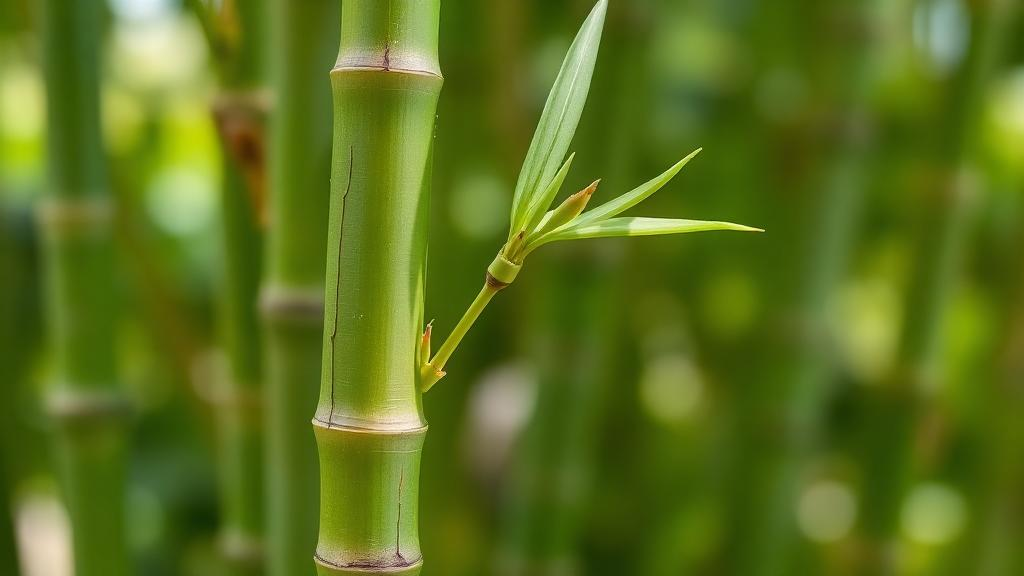
Bamboo shoots grow with astonishing speed, and the chemistry inside them changes just as fast. A new study of Fargesia yunnanensis, an alpine bamboo valued in Sichuan and Yunnan provinces of China for its tender shoots, has mapped how nutrients and metabolites shift across three developmental stages, from underground buds to edible shoots to aged stems. The same research also tested what happens when jasmonic acid, a plant signaling molecule, is applied to the sheath surface of growing shoots before harvest. The results, published in Food Chemistry: X, reveal a striking concentration-dependent tug of war between growth and quality-related compounds.
They defined three natural stages: shoot buds, intact underground buds still attached to rhizomes before emergence; edible-stage shoots measuring 30 to 50 centimeters tall; and aged shoots reaching 100 centimeters, whose first internode had completed elongation. Nine bamboo clumps were sampled, with material from every three clumps pooled into one biological replicate, yielding three replicates per stage. The researchers combined classical physiological and biochemical assays with untargeted liquid chromatography-tandem mass spectrometry metabolomics and targeted quantification of 18 soluble sugars, 25 amino acids, and 40 phenolic compounds.
The developmental story that emerged is one of decline and partial recovery. Moisture content rose to a peak at the edible stage and then fell. Cellulose, hemicellulose, and lignin, the structural components of cell walls, dipped to their lowest levels at the edible stage before climbing again as shoots aged, a pattern consistent with progressive lignification that can harden tissue and coarsen texture. Starch and soluble sugars were most abundant in shoot buds and dropped significantly as shoots grew, with soluble sugars declining throughout development. Total protein and total amino acid contents followed a similar downward trend, both highest in buds. Total flavonoid and total phenolic contents also fell to their minimum at the edible stage and rebounded in aged shoots. The authors suggest the lower measured levels at the edible stage may reflect nutrient consumption during rapid growth and dilution by the high moisture content at that stage.
Untargeted metabolomics detected 684 differential metabolites across the stage comparisons, with the largest set of differences appearing between shoot buds and edible shoots. Principal component analysis separated the stages clearly, with the first two components explaining 48.14 percent and 21.80 percent of total variance. Pathway enrichment pointed to amino acid metabolism and flavonoid biosynthesis in the transition from buds to edible shoots, and to arginine, proline, and tryptophan metabolism plus energy-related pathways such as oxidative phosphorylation in the transition to aged shoots. Quality control samples showed good analytical stability, with roughly two-thirds of detected features having relative standard deviations below 30 percent.
Targeted analyses sharpened the picture. Raffinose, sucrose, and fructose peaked in shoot buds, while glucose reached its highest level in aged shoots; most soluble sugars fell and then partially recovered during development. Of the 20 amino acids detected, including six essential ones, most were more abundant in buds, with citrulline peaking at the edible stage and glutamate rising steadily to its highest level in aged shoots. Among flavonoids, quercetin and isorhamnetin increased continuously during aging, while genistin, apigenin, rutin, vitexin, and quercetin were the main components overall. Among the 15 phenolic acids identified, p-hydroxycinnamic acid, vanillic acid, trans-ferulic acid, and syringic acid dominated, and most declined from buds to edible shoots before rising again. Resveratrol appeared only in aged shoots, and gossypol increased significantly during aging.
The second half of the study addressed preharvest jasmonic acid treatment, an approach in which exogenous active substances are applied before harvest to modify quality. Jasmonic acid dissolved in ethanol was mixed into lanolin, and each roughly 50-centimeter shoot received a single 25-gram application to its middle-to-upper sheath surface. Screening concentrations of 0, 10, 50, 100, and 150 micromoles per liter over five days showed that 10 micromoles per liter significantly promoted shoot height growth, an effect that weakened as concentration rose and reversed into significant growth inhibition at 150 micromoles per liter. The researchers therefore selected 10 and 150 micromoles per liter as low and high treatments, sampling shoots 24 hours after application alongside untreated shoots at 0 hours and a lanolin vehicle control at 24 hours.
The metabolic consequences diverged sharply by dose. Low-concentration jasmonic acid significantly reduced moisture content, increased cellulose and hemicellulose, only slightly increased lignin, slightly reduced starch, and significantly increased soluble sugar content, while significantly reducing total protein. High-concentration treatment raised moisture, slightly reduced cellulose but increased lignin, and significantly boosted both starch and soluble sugars, with no significant effect on protein or amino acid levels. Both doses significantly increased total flavonoid and total phenol contents relative to the vehicle control after 24 hours, although the authors note that the moisture reduction under low concentration may itself have contributed to the higher metabolite concentrations measured.
Targeted metabolomics after treatment added compound-level detail. Low-concentration jasmonic acid significantly increased raffinose, trehalose, glucose-6-phosphate, glucuronic acid, and xylose while decreasing maltose, inositol, galactose, arabinose, mannose, rhamnose, and fucose. High-concentration treatment elevated most soluble sugars, particularly sucrose, trehalose, glucose-6-phosphate, glucuronic acid, and xylose. For amino acids, low concentration increased GABA, hydroxyproline, citrulline, methionine, phenylalanine, and tyrosine but decreased alanine, aspartate, glutamate, glutamine, and lysine, whereas high concentration significantly increased nearly all amino acids except GABA and hydroxyproline. On the phenolic side, low concentration significantly increased gallic acid, 3,4-dihydroxybenzoic acid, caffeic acid, syringaldehyde, sinapic acid, benzoic acid, and trans-cinnamic acid but decreased eight others including syringic and vanillic acids, while high concentration significantly increased 4-hydroxybenzoic acid, vanillic acid, vanillin, caffeic acid, p-hydroxycinnamic acid, trans-ferulic acid, and benzoic acid. Most individual flavonoids declined under treatment, but rutin rose significantly under high concentration, and both JA treatments significantly reduced gossypol compared with the 24-hour control.
Correlation analysis across the treated groups linked rising jasmonic acid concentration with significant positive associations for caffeic acid, trans-ferulic acid, vanillin, starch, and several amino acids, and significant negative associations for syringaldehyde and vitexin. Lignin content correlated positively with JA concentration while cellulose correlated negatively. The authors are careful about interpretation here: the correlation analysis did not demonstrate that jasmonic acid directly induced lignin deposition, and because lignin accumulation is associated with tissue hardening, any influence on shoot texture requires further physiological validation. They likewise caution that enzyme activities, gene expression, lignin monomer composition, and metabolic fluxes were not measured, so the regulatory mechanisms behind these changes cannot be pinned down from metabolomic data alone.
The practical takeaway is nuanced rather than a simple quality boost. Low-concentration jasmonic acid promoted growth while reducing some soluble sugars, amino acids, phenolic compounds, and protein; high concentration inhibited growth while increasing most soluble sugars, amino acids, rutin, and major phenolic acids, but also reduced most flavonoids and increased lignin. Because textural properties, sensory attributes, and shelf life were not assessed in this study, the authors state that the effects on edible quality require further evaluation, and that preharvest application would need testing across treatment concentration, postharvest quality, shelf life, and food safety before any practical use.
Subject of Research: Metabolic profiling of Fargesia yunnanensis bamboo shoots across developmental stages and their responses to preharvest jasmonic acid treatment
Article Title: Metabolic profiling of Fargesia yunnanensis shoots across developmental stages and responses to preharvest jasmonic acid treatment
Article References: Liu, J., Yan, Y., Shi, W., Zhu, F., Zheng, B., Li, L., Chen, Y., Ran, J., Yu, L., Fan, H., Pei, J., & Wang, S. (2026). Metabolic profiling of Fargesia yunnanensis shoots across developmental stages and responses to preharvest jasmonic acid treatment. Food Chemistry: X, 40, Article 104669. https://doi.org/10.1016/j.fochx.2026.104669
Image Credits: AI Generated
DOI: 10.1016/j.fochx.2026.104669
Keywords: bamboo shoots, Fargesia yunnanensis, jasmonic acid, metabolomics, lignification, preharvest treatment, phenolic compounds, flavonoids, soluble sugars, amino acids, plant hormones, food chemistry
News Source: Beatrice Stafford. (October 29, 2026). Bamboo Shoot Metabolism Tracked From Bud to Aging, Plus Jasmonic Acid Effects. Scienmag.