• HOME
  • NEWS
  • EXPLORE
    • CAREER
      • Companies
      • Jobs
    • EVENTS
    • iGEM
      • News
      • Team
    • PHOTOS
    • VIDEO
    • WIKI
  • BLOG
  • COMMUNITY
    • FACEBOOK
    • INSTAGRAM
    • TWITTER
Wednesday, November 11, 2026
BIOENGINEER.ORG
No Result
View All Result
  • Login
  • HOME
  • NEWS
  • EXPLORE
    • CAREER
      • Companies
      • Jobs
        • Lecturer
        • PhD Studentship
        • Postdoc
        • Research Assistant
    • EVENTS
    • iGEM
      • News
      • Team
    • PHOTOS
    • VIDEO
    • WIKI
  • BLOG
  • COMMUNITY
    • FACEBOOK
    • INSTAGRAM
    • TWITTER
No Result
View All Result
Bioengineer.org
No Result
View All Result
Home NEWS Science News Technology

Atomic Origins of Anomalous Crack Relocation in High-Temperature Solder Interconnects

by
November 5, 2026
in Technology
Reading Time: 2 mins read
0
Atomic Origins of Anomalous Crack Relocation in High-Temperature Solder Interconnects

Atomic Origins of Anomalous Crack Relocation in High-Temperature Solder Interconnects

Share on FacebookShare on TwitterShare on LinkedinShare on RedditShare on Telegram

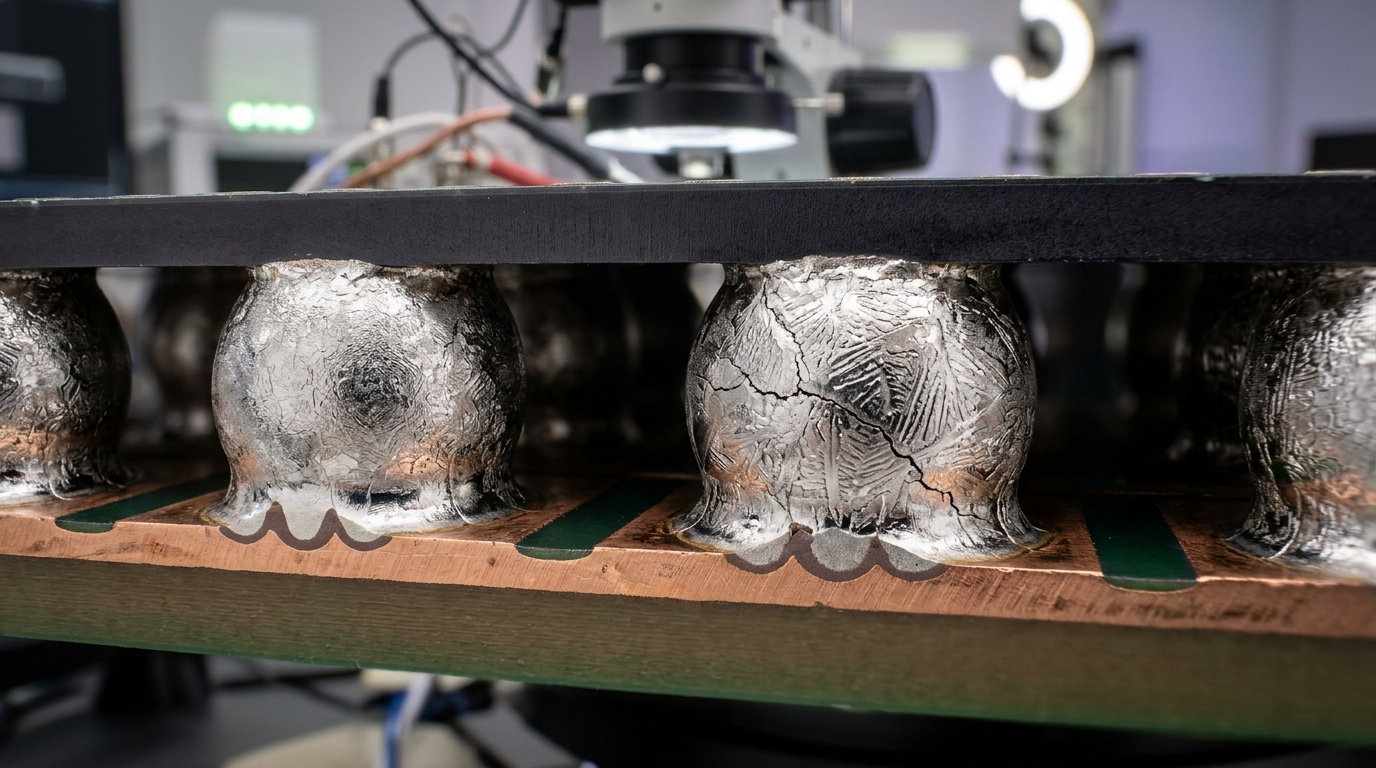
Cracking in high-temperature solder joints anomalously relocates to heterophase intermetallic interfaces rather than conventional solder-intermetallic boundaries, despite the pronounced stress-buffering capability of the lead-rich matrix. Using double spherical aberration-corrected scanning transmission electron microscopy and first-principles calculations, researchers resolved the atomic-scale origins of this cracking behavior under thermal excursions associated with high computational density and elevated operating temperatures in microelectronics.

Investigations of the solder-and-pad interface identified a two-layered intermetallic compound architecture. This structure consists of a Layer I Ni3Sn phase with trace gold incorporation adjacent to the pad, beneath an overlying Layer II composed of (Ni, Au)3Sn2 and (Ni, Au)Sn phases. First-principles calculations revealed that among substitutional configurations, gold atoms occupying Ni1 sites display the lowest relaxed total energy. During experimental thermal cycling, interlayer cracking was first detected after 700 cycles and propagated further following 1000 cycles.

Thermomechanical mismatch between the two intermetallic layers generates an estimated thermal stress of approximately 40 MPa, acting as the driving force for interlayer cracking. Triple junctions connecting grains from both layers function as preferred sites for defect accumulation. Y-type triple junctions demonstrate disconnection activity and pile-up that induce strain concentration and mobility depletion, whereas T-type triple junctions experience stagnation alongside lattice distortion, atomic shuffling, and disordering, establishing structurally weakened pathways for crack propagation.

Subject of Research: Atomic-scale origins of anomalous crack relocation at heterophase intermetallic interfaces in solder interconnects

Article Title: Atomic-scale origin of anomalous crack relocation at heterophase intermetallic interfaces in high-temperature solder interconnects

Article References: Bi, N., Liu, J., Fang, X., Nie, Q., & Wu, Y. (2026). Atomic-scale origin of anomalous crack relocation at heterophase intermetallic interfaces in high-temperature solder interconnects. Advanced Composites and Hybrid Materials. https://doi.org/10.1007/s42114-026-02165-z

Image Credits: AI Generated

DOI: 10.1007/s42114-026-02165-z

Keywords: solder interconnects, heterophase interfaces, intermetallic compounds, thermal cycling, crack propagation, transmission electron microscopy, first-principles calculations, microelectronics reliability, Atomic-scale, origin, anomalous, crack

News Source: Denise Maddox. (November 5, 2026). Atomic Origins of Anomalous Crack Relocation in High-Temperature Solder Interconnects. Scienmag.


Tags: AnomalousAtomic-scalecrackcrack propagationfirst-principles calculationsheterophase interfacesintermetallic compoundsmicroelectronics reliabilityoriginsolder interconnectsthermal cyclingtransmission electron microscopy
Share12Tweet7Share2ShareShareShare1

Related Posts

Complete Genome of Rahnella aceris HPDA25 Sequenced from Gastrodia elata Mycorrhizosphere

Complete Genome of Rahnella aceris HPDA25 Sequenced from Gastrodia elata Mycorrhizosphere

November 11, 2026
Study Profiles Energy Use and Carbon Emissions in Southeastern Nigerian Fast-Food Centers

Study Profiles Energy Use and Carbon Emissions in Southeastern Nigerian Fast-Food Centers

November 11, 2026

Affective and Emotion Terms Reflect Divergent AI Education Research Orientations

November 11, 2026

Multimodal Artificial Intelligence Platform Connects Architectural Concepts to Physical Fabrication

November 11, 2026

POPULAR NEWS

  • Coconut Rhinoceros Beetle Larval Frass Enhances Plant Growth as Direct Fertilizer

    Coconut Rhinoceros Beetle Larval Frass Enhances Plant Growth as Direct Fertilizer

    29 shares
    Share 12 Tweet 7
  • Affective and Emotion Terms Reflect Divergent AI Education Research Orientations

    29 shares
    Share 12 Tweet 7
  • Bifidobacterium Enzyme PNGaseA Unlocks Specialized Breast Milk Sugars in Infants

    29 shares
    Share 12 Tweet 7
  • HIPEC Treatment Proxy Shows Limited Incremental Prognostic Value in Appendiceal Cancer

    29 shares
    Share 12 Tweet 7

About

We bring you the latest biotechnology news from best research centers and universities around the world. Check our website.

Follow us

Recent News

Swedish Peatland Fires Coincided With Drought but Not Mapped Ditch Density

Trimethoprim Prophylaxis Linked to Bacterial Resistance in Kidney Transplant Bloodstream Infections

Systematic Review Maps Consumer Behavior and Sensory Science in Dealcoholized Wines

Subscribe to Blog via Email

Enter your email address to subscribe to this blog and receive notifications of new posts by email.

Join 87 other subscribers
  • Contact Us

Bioengineer.org © Copyright 2023 All Rights Reserved.

Welcome Back!

Login to your account below

Forgotten Password?

Retrieve your password

Please enter your username or email address to reset your password.

Log In
No Result
View All Result
  • Homepages
    • Home Page 1
    • Home Page 2
  • News
  • National
  • Business
  • Health
  • Lifestyle
  • Science

Bioengineer.org © Copyright 2023 All Rights Reserved.