• HOME
  • NEWS
  • EXPLORE
    • CAREER
      • Companies
      • Jobs
    • EVENTS
    • iGEM
      • News
      • Team
    • PHOTOS
    • VIDEO
    • WIKI
  • BLOG
  • COMMUNITY
    • FACEBOOK
    • INSTAGRAM
    • TWITTER
Wednesday, May 13, 2026
BIOENGINEER.ORG
No Result
View All Result
  • Login
  • HOME
  • NEWS
  • EXPLORE
    • CAREER
      • Companies
      • Jobs
        • Lecturer
        • PhD Studentship
        • Postdoc
        • Research Assistant
    • EVENTS
    • iGEM
      • News
      • Team
    • PHOTOS
    • VIDEO
    • WIKI
  • BLOG
  • COMMUNITY
    • FACEBOOK
    • INSTAGRAM
    • TWITTER
  • HOME
  • NEWS
  • EXPLORE
    • CAREER
      • Companies
      • Jobs
        • Lecturer
        • PhD Studentship
        • Postdoc
        • Research Assistant
    • EVENTS
    • iGEM
      • News
      • Team
    • PHOTOS
    • VIDEO
    • WIKI
  • BLOG
  • COMMUNITY
    • FACEBOOK
    • INSTAGRAM
    • TWITTER
No Result
View All Result
Bioengineer.org
No Result
View All Result
Home NEWS Science News Chemistry

Artificial tissue used to research uterine contractions

Bioengineer by Bioengineer
June 2, 2020
in Chemistry
Reading Time: 2 mins read
0
IMAGE
Share on FacebookShare on TwitterShare on LinkedinShare on RedditShare on Telegram

Two experimental devices allow researchers to study the harmful effects of hyperperistalsis, or an excess of nonpregnant uterine contractions
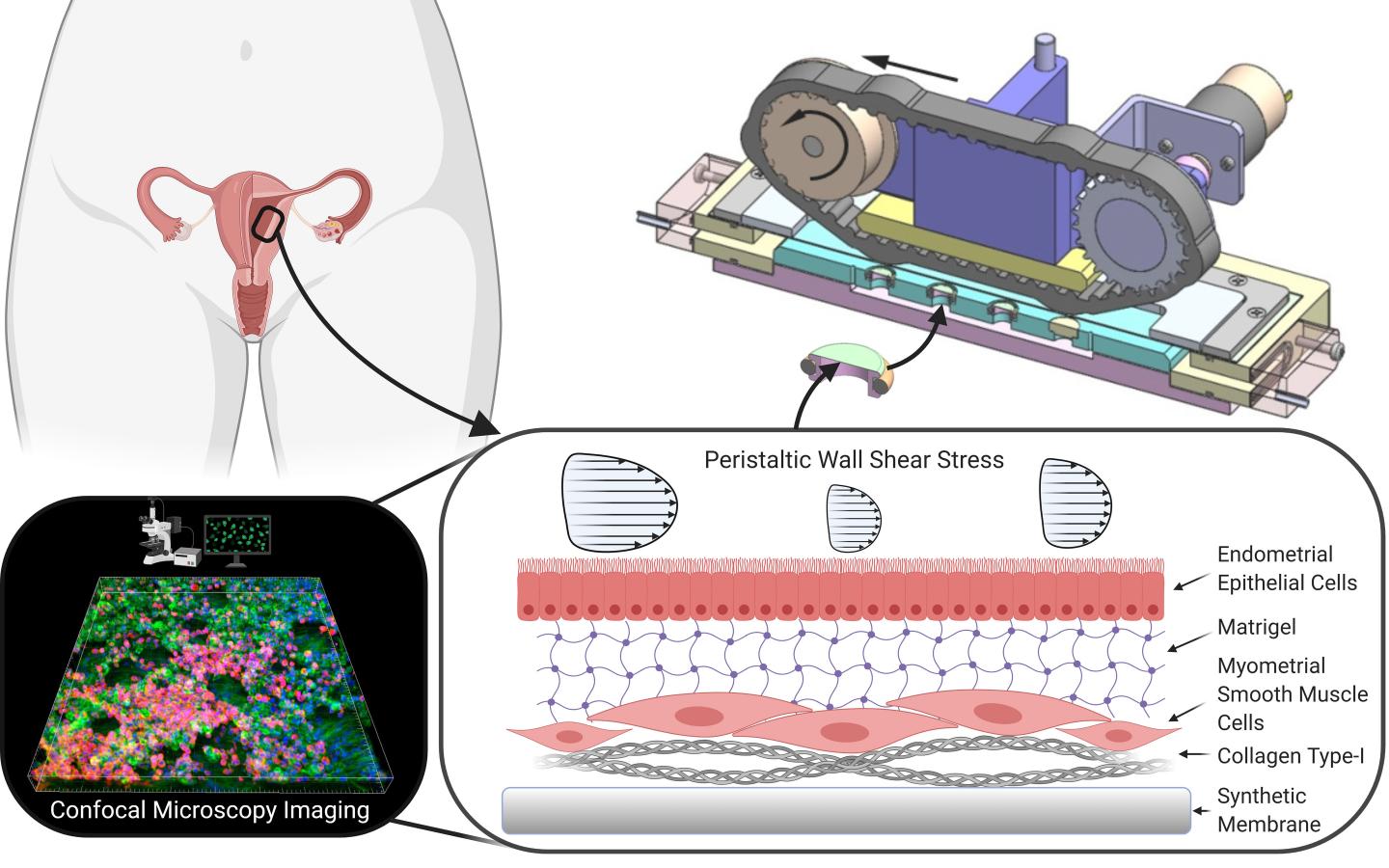
IMAGE

Credit: David Elad

WASHINGTON, June 2, 2020 — Advanced tissue engineering technologies allow scientists to mimic the structure of a uterus, enabling crucial research on fertility and disease.

In an APL Bioengineering article, by AIP Publishing, researchers present two mechanobiology tools for experiments on synthetic or artificial uterine tissue. They wanted to study the negative effects of hyperperistalsis, contractions of the uterine wall that occur too frequently.

Throughout an individual’s lifetime, the uterus undergoes spontaneous contractions of the uterine wall, which can induce uterine peristalsis, a specific wavelike contraction pattern. These contractions are important for many reproductive processes, such as the transportation of sperm prior to impregnation, but hyperperistalsis could impede fertility and lead to diseases, such as adenomyosis or endometriosis.

“The nonpregnant spontaneous myometrial contractions induce the uterine peristalsis, which exerts physical loads on the internal endometrial barrier and, thereby, affect the biological performance,” said David Elad, one of the paper’s authors.

The designed tools include a well, which can be disassembled for installation of a biological in vitro model in an experimental chamber, and a flow chamber and transmission system that create the contraction patterns.

“The cells are cultured on a biological or synthetic membrane stretched over a well bottom, which is installed into a cylindrical medium holder. Once the biological model is ready, the well bottom can be disassembled and then installed in the experimental chamber,” said Elad. “As far as we know, it is the first time an in vitro biological model was exposed to peristaltic wall shear stresses.”

Using their experimental setup, the authors found peristaltic shear stresses caused alterations to the cytoskeleton of endometrial epithelial cells and myometrial smooth muscle cells of the synthetic uterine tissue.

Future research using this approach might include studying the effect of different contraction patterns and the role hormones play in uterine peristalsis. The researchers noted uterine wall models can typically be applied to study models of intestine walls and some organs and tissues.

“The laboratory approach of this work demonstrates future options to explore the complex processes of human reproduction, especially during early stages when accessibility and ethical limitations prohibit in vivo experiments,” said Elad.

###

The article, “Tissue engineered endometrial barrier exposed to peristaltic flow shear stresses,” is authored by David Elad, Uri Zaretsky, Tatyana Kuperman, Mark Gavriel, Mian Long, Ariel Jaffa and Dan Grisaru. The article will appear in APL Bioengineering on June 2, 2020 (DOI: 10.1063/5.0001994). After that date, it can be accessed at https://aip.scitation.org/doi/10.1063/5.0001994.

ABOUT THE JOURNAL

APL Bioengineering is an open access journal publishing significant discoveries specific to the understanding and advancement of physics and engineering of biological systems. See http://aip.scitation.org/journal/apb.

Media Contact
Larry Frum
[email protected]

Related Journal Article

http://dx.doi.org/10.1063/5.0001994

Tags: BiologyBiomechanics/BiophysicsBiomedical/Environmental/Chemical EngineeringBiotechnologyChemistry/Physics/Materials SciencesGynecologyMedicine/Health
Share12Tweet8Share2ShareShareShare2

Related Posts

Optimized Slurry Processing Paves the Way for Better Batteries — Chemistry

Optimized Slurry Processing Paves the Way for Better Batteries

May 13, 2026
Copper(II) Complexes Harnessed by Light Enable Efficient Anti-Markovnikov Alkene Hydration — Chemistry

Copper(II) Complexes Harnessed by Light Enable Efficient Anti-Markovnikov Alkene Hydration

May 13, 2026

Gravitational Wave Detectors Now Feature Automatic Signal Tuning

May 13, 2026

Harnessing Neural Networks for Advances in Nonlinear Optics

May 12, 2026
Please login to join discussion

POPULAR NEWS

  • Research Indicates Potential Connection Between Prenatal Medication Exposure and Elevated Autism Risk

    842 shares
    Share 337 Tweet 211
  • New Study Reveals Plants Can Detect the Sound of Rain

    728 shares
    Share 290 Tweet 182
  • Salmonella Haem Blocks Macrophages, Boosts Infection

    62 shares
    Share 25 Tweet 16
  • Breastmilk Balances E. coli and Beneficial Bacteria in Infant Gut Microbiomes

    57 shares
    Share 23 Tweet 14

About

We bring you the latest biotechnology news from best research centers and universities around the world. Check our website.

Follow us

Recent News

Cognitive Decline Linked to Mortality in Older Women

AI-Driven Peptide Antibiotic Optimization Breakthrough

Gut Microenvironment Reprogrammed to Treat Severe Ulcerative Colitis

Subscribe to Blog via Email

Enter your email address to subscribe to this blog and receive notifications of new posts by email.

Join 82 other subscribers
  • Contact Us

Bioengineer.org © Copyright 2023 All Rights Reserved.

Welcome Back!

Login to your account below

Forgotten Password?

Retrieve your password

Please enter your username or email address to reset your password.

Log In
No Result
View All Result
  • Homepages
    • Home Page 1
    • Home Page 2
  • News
  • National
  • Business
  • Health
  • Lifestyle
  • Science

Bioengineer.org © Copyright 2023 All Rights Reserved.