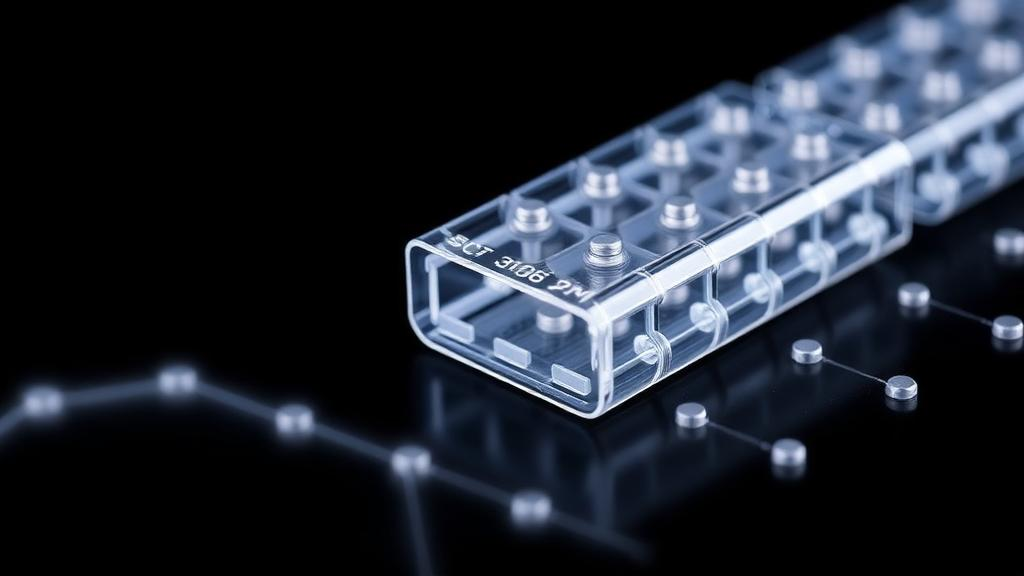
Solid-state batteries have long been heralded as the next great leap in energy storage, promising to replace the flammable liquid electrolytes inside today’s lithium-ion cells with solid materials that could make devices safer and more energy dense. Yet a persistent engineering problem has slowed their progress: the solid materials that shuttle lithium ions between electrodes are often stiff and unforgiving, struggling to maintain the intimate contact with electrode surfaces that a working battery demands. Now, researchers at Rice University have taken an unusually elegant approach to that problem by asking a question that most electrolyte designers have overlooked — what if the material that carries the ions could also bend, flex, and adapt mechanically to the environment inside a cell?
The Rice team, drawn from the departments of Chemical and Biomolecular Engineering, Chemistry, and Materials Science and Nanoengineering, along with the Rice Advanced Materials Institute, has developed a relatively soft and flexible porous material that selectively transports lithium ions. The work, published in the peer-reviewed journal Chemical Science, introduces a new design philosophy for porous solid electrolytes, one that treats mechanical adaptability not as an afterthought but as a core performance criterion, sitting alongside ionic conductivity and chemical stability in the designer’s toolkit.
The material at the heart of the study is called ZnBTCA, and it belongs to a family of compounds known as metal-organic frameworks, or MOFs. These are porous crystalline materials built from metal atoms connected by organic molecules into repeating, lattice-like structures. What makes MOFs so compelling for battery applications is their architecture: they contain tiny, ordered channels whose size and chemistry can be tailored to move or hold specific molecules and ions. In principle, a MOF can act as a molecular sieve for charge, allowing lithium ions to stream through its pores while blocking everything else. Many MOFs previously explored as battery electrolytes, however, have been constructed from relatively rigid aromatic linkers — the organic struts that connect the metal nodes — which produce frameworks that are stiff and mechanically unyielding.
ZnBTCA takes a fundamentally different route. Instead of an aromatic linker, it employs a flexible aliphatic linker, an organic molecule with a pliable carbon-chain backbone. That single design choice ripples through the entire material: the framework itself becomes softer and more mechanically adaptable, capable of deforming and conforming rather than resisting. The researchers also emphasized practicality in their selection of building blocks. The material is assembled from relatively abundant, low-cost components, including zinc — one of the most accessible metals in the battery chemist’s repertoire — and an inexpensive aliphatic linker, an important consideration if such materials are ever to move from the laboratory bench toward real-world manufacturing.
First author Zina Deriche, a graduate student in chemical and biomolecular engineering at Rice, framed the shift in thinking that underpins the work. MOF electrolytes, she noted, are often designed primarily around how effectively they transport ions. The Rice study demonstrates that the mechanical properties of the framework can also be an important part of the design equation. It is a deceptively simple reframing, but one with significant consequences: a material that can flex with the battery as it charges and discharges may hold up better over thousands of cycles than one that cracks or delaminates under mechanical stress.
The dual functionality of ZnBTCA is what excites the team most. The material’s flexible molecular building blocks make it relatively soft, while its negatively charged framework structure favors the movement of positively charged lithium ions through its channels. Stavroula Alina Kampouri, a corresponding author of the study and assistant professor across chemical and biomolecular engineering, chemistry, and materials science and nanoengineering, described the convergence of these properties as the most thrilling aspect of the result. The same material, she explained, brings together flexible building blocks that make the framework softer and more adaptable with a negatively charged structure that promotes selective lithium-ion transport. Bringing those properties together, she said, offers a new way to design MOF electrolytes by considering how ions move and how the material behaves mechanically at the same time.
The experimental results lend strong support to the design concept. The researchers first exchanged the sodium ions residing within the framework for lithium ions, a process known as ion exchange that is common in MOF chemistry. After the exchange, they found that roughly 95 percent of the mobile charge-balancing ions in the material were lithium, while the framework itself remained structurally intact — a critical demonstration that the delicate crystalline lattice could survive the swapping of its guest ions without collapsing. Selectivity matters enormously in an electrolyte: a material that carries only lithium ions, rather than a mixed crowd of mobile species, delivers cleaner, more efficient battery operation and helps prevent parasitic reactions that degrade performance over time.
Further electrochemical testing quantified just how selective the material is. In measurements of the current flowing through the material, lithium ions accounted for approximately 79 percent of the total ionic current — a high lithium-ion transference number that indicates the framework’s channels and charged surfaces are indeed preferentially shepherding lithium rather than the counterions left behind by the exchange process. For electrolyte designers, that figure represents a meaningful benchmark, because a high transference number reduces the concentration gradients that build up inside a cell during fast charging and discharging, which in turn improves power delivery and reduces energy losses.
Perhaps the most demanding test the team ran addressed one of the most feared failure modes in next-generation batteries: short circuiting. In lithium-metal batteries, where a strip of pure lithium metal serves as one electrode, repeated charging and discharging can cause lithium to grow unevenly, forming needle-like structures that eventually pierce the electrolyte and create an unwanted electrical pathway — a short circuit that can disable or even ignite a cell. To probe how ZnBTCA would cope with this challenge, the researchers incorporated the material into a solid electrolyte membrane and sandwiched it between two lithium-metal electrodes. The cells then operated stably for nearly 300 hours as the researchers progressively increased the current, with no evidence of short-circuiting under the conditions tested. While laboratory cycling tests are far from the final word on commercial viability, the result suggests that a softer, more conformable electrolyte membrane may help suppress the mechanical pathways through which dendrites typically propagate.
The broader significance of the work lies in the design principle it establishes. To the team’s knowledge, ZnBTCA is the first MOF electrolyte built from an aliphatic linker with a flexible carbon-chain backbone, a distinction that opens an essentially unexplored region of chemical space for electrolyte development. Sibani Lisa Biswal, chair of chemical and biomolecular engineering and the William M. McCardell Professor in Chemical Engineering at Rice, as well as a professor of materials science and nanoengineering, summarized the lesson: researchers can think beyond just the chemistry and pore structure of these materials, because mechanical flexibility can also become a design tool for developing MOF electrolytes for solid-state batteries. The results suggest that mechanical flexibility could take its place alongside chemical composition, pore structure, and framework charge as a tunable parameter in the rational design of battery electrolytes.
The research was supported by a GEM Fellowship as well as the National Science Foundation under grant No. 2404376, and portions of the work used resources of the Shared Equipment Authority at Rice. As solid-state batteries edge closer to commercial reality in electric vehicles, consumer electronics, and grid storage, the challenge is no longer simply finding materials that conduct lithium ions well — it is finding materials that can survive the mechanical realities of a battery’s life. By proving that a MOF can be simultaneously soft, selective, and structurally robust, the Rice team has added a promising new entry to the electrolyte design playbook, and perhaps a hint that the future of the solid-state battery will be built not on rigid crystals, but on frameworks that know how to flex.
Subject of Research: Flexible metal-organic framework electrolytes for selective lithium-ion conduction in solid-state batteries
Article Title: A softer porous material could help improve solid-state batteries
Article References: A softer porous material could help improve solid-state batteries. (n.d.). Original publication
Image Credits: AI Generated
DOI: Not provided
Keywords: solid-state batteries, metal-organic frameworks, lithium-ion transport, ZnBTCA, electrolytes, mechanical flexibility, Rice University, Chemical Science, aliphatic linker, lithium-metal anodes, ion selectivity, energy storage
News Source: Faith Mcneil. (October 5, 2026). Soft Flexible Framework Material Could Improve Solid-State Battery Design. Scienmag.