• HOME
  • NEWS
  • EXPLORE
    • CAREER
      • Companies
      • Jobs
    • EVENTS
    • iGEM
      • News
      • Team
    • PHOTOS
    • VIDEO
    • WIKI
  • BLOG
  • COMMUNITY
    • FACEBOOK
    • INSTAGRAM
    • TWITTER
Saturday, February 7, 2026
BIOENGINEER.ORG
No Result
View All Result
  • Login
  • HOME
  • NEWS
  • EXPLORE
    • CAREER
      • Companies
      • Jobs
        • Lecturer
        • PhD Studentship
        • Postdoc
        • Research Assistant
    • EVENTS
    • iGEM
      • News
      • Team
    • PHOTOS
    • VIDEO
    • WIKI
  • BLOG
  • COMMUNITY
    • FACEBOOK
    • INSTAGRAM
    • TWITTER
  • HOME
  • NEWS
  • EXPLORE
    • CAREER
      • Companies
      • Jobs
        • Lecturer
        • PhD Studentship
        • Postdoc
        • Research Assistant
    • EVENTS
    • iGEM
      • News
      • Team
    • PHOTOS
    • VIDEO
    • WIKI
  • BLOG
  • COMMUNITY
    • FACEBOOK
    • INSTAGRAM
    • TWITTER
No Result
View All Result
Bioengineer.org
No Result
View All Result
Home NEWS Science News Biology

Are brain-computer interface spellers secure?

Bioengineer by Bioengineer
October 5, 2020
in Biology
Reading Time: 2 mins read
0
IMAGE
Share on FacebookShare on TwitterShare on LinkedinShare on RedditShare on Telegram

IMAGE

Credit: @Science China Press

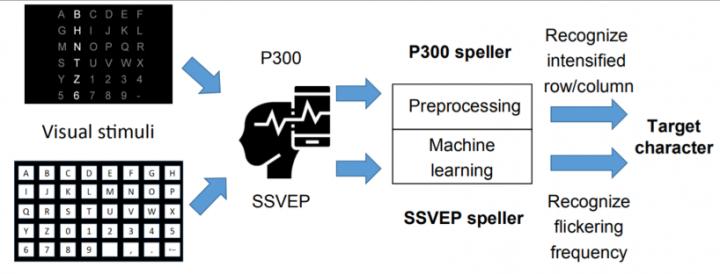
Brain-Computer Interface (BCI) record and decode brain signals to construct a communication pathway, which allows people to interact with computer by thought directly. BCIs have been used in a broad range of applications, including neuroscience, psychology, clinical rehabilitation, and entertainment. As one of the most commonly used BCI systems, electroencephalogram (EEG)-based BCI speller, which allows the user to input text to a computer using EEG signals, is particularly useful to severely disabled individuals, e.g., amyotrophic lateral sclerosis patients, who have no other effective means of communication with another person or a computer. However, one very important question is: are these BCI spellers really secure?

In response to this question, a BCI research team, led by Professor Dongrui Wu from Huazhong University of Science and Technology (HUST), has recently published an article in the Beijing-based National Science Review, which shows that the output of BCI spellers may be easily manipulated by tiny adversarial noise, exposing a critical security concern in EEG-based BCIs.

“It shows for the first time that one can generate tiny adversarial EEG perturbation templates for target attacks for both P300 and SSVEP spellers, i.e., mislead the classification to any character the attacker wants, regardless of what the user intended character is. The consequence could range from merely user frustration to severe misdiagnosis in clinical applications,” they stated in their article entitled “Tiny noise, big mistakes: adversarial perturbations induce errors in Brain-Computer Interface spellers”.

“More seriously, these perturbation templates are so tiny that one can barely distinguish the adversarial EEG trial from the original EEG trial. When drawn together, the signals look almost completely overlapping,” they added. “The adversarial perturbation templates can even stay imperceptible to some widely-used approaches for evaluating the quality of EEG signals.”

“These spellers’ ability to defend adversarial perturbation templates is totally different from their robustness to random noise,” they further emphasized. “Even the BCI spellers which show excellent performance against random noise can be manipulated by these deliberately-designed perturbation templates with a high successful rate.”

They also stated that this security concern is not only specific to the victim models used in these EEG-based spellers, but also other popular BCI systems. “It should be noted that the goal of this study is not to damage EEG-based BCIs. Instead, we aim to demonstrate that serious adversarial attacks to EEG-based BCIs are possible, and hence expose a critical security concern, which has received little attention before,” said Professor Wu. “Our further research will focus on addressing this security issue and making BCI systems safer.”

###

See the article:

Xiao Zhang, Dongrui Wu, Lieyun Ding, Hanbin Luo, Chin-Teng Lin, Tzyy-Ping Jung, Ricardo Chavarriaga

Tiny noise, big mistakes: adversarial perturbations induce errors in Brain-Computer Interface spellers
Natl Sci Rev (September 2020)
https://doi.org/10.1093/nsr/nwaa233

Media Contact
Dongrui Wu
[email protected]

Related Journal Article

http://dx.doi.org/10.1093/nsr/nwaa233

Tags: Biomedical/Environmental/Chemical EngineeringBiotechnologyComputer ScienceElectrical Engineering/ElectronicsSystem Security/HackersTechnology/Engineering/Computer ScienceTelecommunications
Share12Tweet8Share2ShareShareShare2

Related Posts

Florida Cane Toad: Complex Spread and Selective Evolution

Florida Cane Toad: Complex Spread and Selective Evolution

February 7, 2026
New Study Uncovers Mechanism Behind Burn Pit Particulate Matter–Induced Lung Inflammation

New Study Uncovers Mechanism Behind Burn Pit Particulate Matter–Induced Lung Inflammation

February 6, 2026

DeepBlastoid: Advancing Automated and Efficient Evaluation of Human Blastoids with Deep Learning

February 6, 2026

Navigating the Gut: The Role of Formic Acid in the Microbiome

February 6, 2026
Please login to join discussion

POPULAR NEWS

  • Robotic Ureteral Reconstruction: A Novel Approach

    Robotic Ureteral Reconstruction: A Novel Approach

    82 shares
    Share 33 Tweet 21
  • Digital Privacy: Health Data Control in Incarceration

    63 shares
    Share 25 Tweet 16
  • Study Reveals Lipid Accumulation in ME/CFS Cells

    57 shares
    Share 23 Tweet 14
  • Breakthrough in RNA Research Accelerates Medical Innovations Timeline

    53 shares
    Share 21 Tweet 13

About

We bring you the latest biotechnology news from best research centers and universities around the world. Check our website.

Follow us

Recent News

Phage-Antibiotic Combo Beats Resistant Peritoneal Infection

Boosting Remote Healthcare: Stepped-Wedge Trial Insights

Barriers and Boosters of Seniors’ Physical Activity in Karachi

Subscribe to Blog via Email

Enter your email address to subscribe to this blog and receive notifications of new posts by email.

Join 73 other subscribers
  • Contact Us

Bioengineer.org © Copyright 2023 All Rights Reserved.

Welcome Back!

Login to your account below

Forgotten Password?

Retrieve your password

Please enter your username or email address to reset your password.

Log In
No Result
View All Result
  • Homepages
    • Home Page 1
    • Home Page 2
  • News
  • National
  • Business
  • Health
  • Lifestyle
  • Science

Bioengineer.org © Copyright 2023 All Rights Reserved.