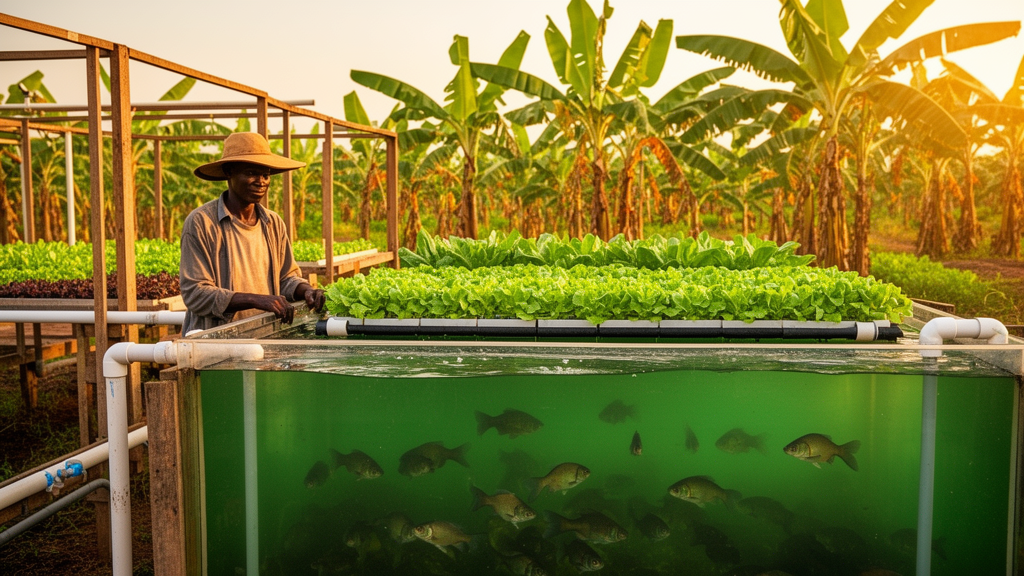
Aquaponics has emerged as the most sustainable small-scale aquaculture system in Uganda’s Lake Victoria Basin, yet it remains the least adopted, according to a cross-sectional study of 169 fish farmers conducted in November 2023 in the districts of Buikwe, Wakiso, and Mpigi. The research, published in Aquaculture Science and Management, found that aquaponics achieved a sustainability index of 0.715, ahead of pond farming at 0.508 and cage farming at 0.448. Despite this advantage, only 7.6 percent of surveyed farmers had taken up aquaponics, while pond farming dominated at 69.6 percent and cage farming accounted for 22.8 percent. The gap between sustainability performance and actual adoption, the authors argue, is driven largely by financial and technical constraints rather than by a lack of awareness of aquaponics’ benefits.
The study set out to answer two linked questions: which socioeconomic and demographic factors influence small-scale fish farmers’ choice among pond, cage, and aquaponics systems, and how sustainable each of those systems is in practice. Uganda’s fisheries sector underpins economic sustenance and food security, but declining wild fish stocks have pushed the country to expand aquaculture. Water bodies cover roughly 18 percent of Uganda’s surface, the fishing industry supports more than 1.8 million people, and aquaculture currently contributes about 3 percent of national GDP. The 2022–2023 government budget allocated $518,919.19, equivalent to UGX 1.92 billion, to bolster the industry. The central region around Lake Victoria is also Uganda’s largest fish-consuming area, with an estimated yearly per capita consumption of nearly 13.6 kilograms.
To capture farmer decisions, the researchers purposively selected three districts known for small-scale aquaculture and surveyed farmers who had participated in 2019 training programs run by the Ministry of Agriculture, Animal Industry, and Fisheries and by development partners including CARITAS and World Vision. District Fisheries Office records listed 200 trained farmers in Buikwe, 130 in Wakiso, and 127 in Mpigi. Using a proportionate random sampling procedure with systematic intervals drawn from certified farmer lists, the team enrolled 169 respondents: 65 from Buikwe, 55 from Wakiso, and 49 from Mpigi. Structured in-person surveys collected data on age, education, household size, income, group membership, training access, and land ownership, alongside farmers’ percentage-based evaluations of environmental, economic, and social sustainability for each system.
Quantitative analysis relied on a Multivariate Probit Model, which allows farmers to adopt more than one system simultaneously and accounts for correlations among the unobserved factors behind each choice. Three binary outcomes were modeled: adoption of pond aquaculture, cage aquaculture, and aquaponics. Assumption tests supported the approach. Mardia’s test for multivariate normality returned a statistic of 4.53 with a p-value of 0.095, off-diagonal correlations in the variance-covariance matrix ranged from 0.35 to 0.60, variance inflation factors between 1.2 and 3.5 ruled out problematic multicollinearity, and a Likelihood Ratio test of 25.6 with p below 0.01 confirmed interdependence among system choices. A Wald test statistic of 19.3, significant at p below 0.05, indicated that the explanatory variables jointly shaped system selection.
The model’s headline result concerned gender. Male farmers were more likely to select cage aquaculture, with a relative risk ratio of 2.52 and a p-value of 0.087, and aquaponics, with a relative risk ratio of 2.12 and a p-value of 0.145, the latter only marginally outside conventional significance thresholds. Men were perceived in qualitative interviews as more likely to adopt aquaponics because the system demands advanced technical knowledge and substantial financial input. Overall, men made up 83.6 percent of the surveyed farmers, a imbalance the authors link to women’s limited access to land, credit, and training. One aquaculture officer in Buikwe told the researchers, “Women often lack ownership of land and capital, making it difficult for them to participate fully in aquaculture.”
Institutional and geographic variables proved more decisive than individual attributes. Membership in farmers’ groups significantly influenced the choice of all three systems, with relative risk ratios of 0.56 for ponds, 0.46 for cages, and 0.82 for aquaponics, each statistically significant. The authors interpret this as evidence that collective knowledge, shared resources, and financial support within groups shape aquaculture decisions. Geographic location significantly affected pond adoption, with a relative risk ratio of 0.15 and a p-value of 0.031, and aquaponics adoption, with a relative risk ratio of 0.42 and a p-value of 0.047, while its effect on cage farming was marginally significant at a relative risk ratio of 0.8 and a p-value of 0.055. Land tenure security, meanwhile, reduced the likelihood of choosing cage aquaculture, with a relative risk ratio of 0.13 and a p-value of 0.010, suggesting that farmers with secure landholdings favor land-based pond systems. Notably, access to formal training was not statistically significant, and neither were age, education, marital status, household size, farming experience, or income, leading the authors to conclude that institutional mechanisms such as land tenure policies and cooperatives matter more than individual characteristics.
Qualitative data, gathered through four Key Informant Interviews with district fisheries officers, extension officers, community leaders, and training organization representatives, plus eight Focus Group Discussions, reinforced these patterns. Farmers consistently cited the lack of credit and the high initial cost of systems like aquaponics as their main barriers. A farmer in Wakiso remarked, “The system has potential, but the initial setup cost is beyond what most small-scale farmers can afford.” Extension officers, by contrast, emphasized technical training and infrastructure, with one explaining that “hands-on demonstrations are crucial for farmers to fully grasp the potential of new systems like aquaponics.” In Buikwe, access to water bodies made pond farming feasible, with one respondent calling water access the primary factor in the decision to use ponds. A cooperative leader in Mpigi described how group membership allowed members to share costs, exchange knowledge, and collectively negotiate better market prices.
The sustainability assessment, computed with a weighted scoring method that normalized parameters to a 0–1 scale, ranked aquaponics highest at 0.715, credited to resource efficiency, climate resilience, and social inclusivity, though the system faces high initial costs and requires skilled labor. Pond farming scored a moderate 0.508, benefiting from strong community participation and cultural acceptance but hampered by lower water efficiency and higher climate vulnerability. Cage farming scored lowest at 0.448, offering job creation and profitability while facing significant environmental challenges including water pollution concerns and climate vulnerability, and lacking community involvement and gender inclusivity. Demographically, respondents averaged 47.5 years of age, about 11 years of education, 3.9-person households, and 3.3 years of fish farming experience, and 77.8 percent were married. Buikwe farmers reported the highest average monthly income at USD 306.
Framed through Rogers’ Diffusion of Innovations theory, the authors interpret pond farming’s dominance as a product of relative advantage, compatibility with existing practices, and high observability, since farmers can easily see peers’ results, particularly in Mpigi where pond farming reaches 87 percent. Cage farming, more prevalent in Buikwe at 35.4 percent, is constrained by cost and technical complexity, while aquaponics suffers from low observability because its enclosed systems limit peer learning and breed misconceptions about practicality. The study recommends strengthening access to credit, farmer training, and government support, alongside policies that empower women and improve financial services for farmers. It further calls for location-specific policies addressing water accessibility, stronger fish farmer cooperatives, land reforms to secure resource access for capital-intensive systems, gender-sensitive programs, and demonstration farms and community-led pilots to raise aquaponics visibility. The authors caution that the findings rest on a cross-sectional survey of trained farmers in three districts, so the estimates describe associations within that population rather than causal effects, and the sustainability scores reflect farmers’ own percentage-based evaluations processed through the weighted scoring approach.
Subject of Research: Socioeconomic drivers of small-scale aquaculture system choice and sustainability in the Lake Victoria Basin, Uganda
Article Title: Drivers of small-scale aquaculture systems adoption and sustainability in the Lake Victoria Basin, Uganda
Article References: Syliver, B., Limuwa, M., & Semyalo, R. (2026). Drivers of small-scale aquaculture systems adoption and sustainability in the Lake Victoria Basin, Uganda. Aquaculture Science and Management, 3(1), Article 14. https://doi.org/10.1186/s44365-026-00042-w
Image Credits: AI Generated
DOI: 10.1186/s44365-026-00042-w
Keywords: aquaculture, Uganda, Lake Victoria Basin, aquaponics, pond farming, cage farming, sustainability index, Multivariate Probit Model, small-scale farmers, gender disparities, food security, Diffusion of Innovations
News Source: Sloane Callahan. (October 28, 2026). Aquaponics tops sustainability but money and gender shape fish farming choices in Uganda. Scienmag.