• HOME
  • NEWS
  • EXPLORE
    • CAREER
      • Companies
      • Jobs
    • EVENTS
    • iGEM
      • News
      • Team
    • PHOTOS
    • VIDEO
    • WIKI
  • BLOG
  • COMMUNITY
    • FACEBOOK
    • INSTAGRAM
    • TWITTER
Friday, June 26, 2026
BIOENGINEER.ORG
No Result
View All Result
  • Login
  • HOME
  • NEWS
  • EXPLORE
    • CAREER
      • Companies
      • Jobs
        • Lecturer
        • PhD Studentship
        • Postdoc
        • Research Assistant
    • EVENTS
    • iGEM
      • News
      • Team
    • PHOTOS
    • VIDEO
    • WIKI
  • BLOG
  • COMMUNITY
    • FACEBOOK
    • INSTAGRAM
    • TWITTER
  • HOME
  • NEWS
  • EXPLORE
    • CAREER
      • Companies
      • Jobs
        • Lecturer
        • PhD Studentship
        • Postdoc
        • Research Assistant
    • EVENTS
    • iGEM
      • News
      • Team
    • PHOTOS
    • VIDEO
    • WIKI
  • BLOG
  • COMMUNITY
    • FACEBOOK
    • INSTAGRAM
    • TWITTER
No Result
View All Result
Bioengineer.org
No Result
View All Result
Home NEWS Science News Chemistry

An innovative electron microscope overturning common knowledge of 88 years history

Bioengineer by Bioengineer
June 11, 2019
in Chemistry
Reading Time: 2 mins read
0
IMAGE
Share on FacebookShare on TwitterShare on LinkedinShare on RedditShare on Telegram

Direct atom-resolved imaging of magnetic materials
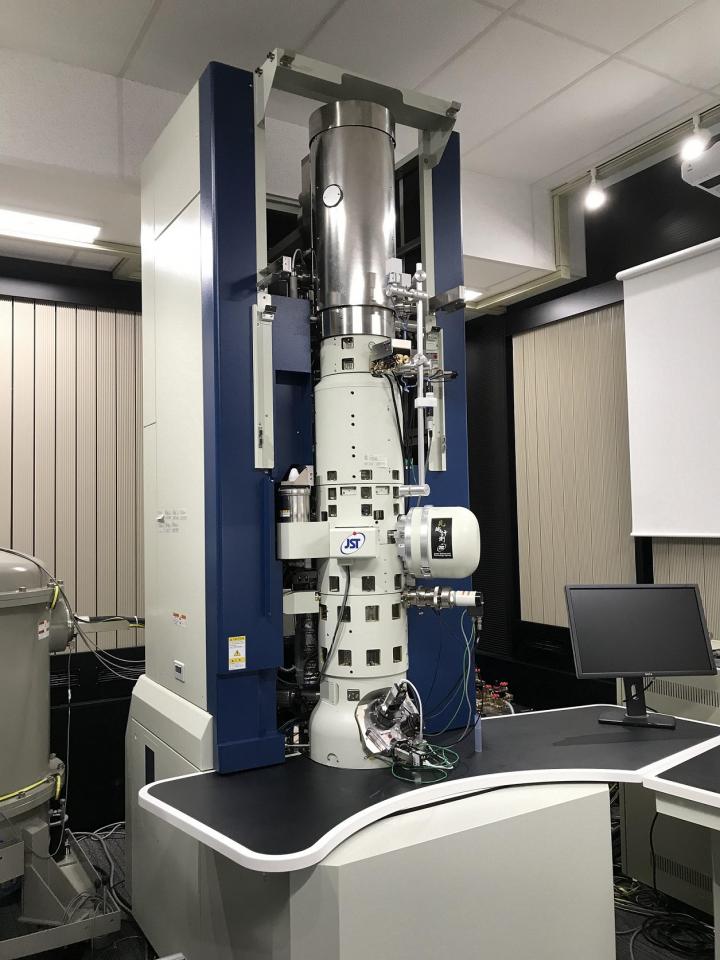
IMAGE

Credit: JST

Under the JST-SENTAN program (Development of System and Technology for Advanced Measurement and Analysis, Japan Science and Technology Agency), the joint development team of Prof. Naoya Shibata at the University of Tokyo and JEOL Ltd., has developed a revolutionary electron microscope that incorporates newly designed magnetic objective lenses, and achieved direct, atom-resolved imaging of materials with sub-Å spatial resolution, with a residual magnetic field less than 0.2 mT at the sample position. To the best of our knowledge, this is the first time that such a goal has been achieved.

In the 88 years since the seminal invention of the transmission electron microscope (TEM) in 1931, researchers have continually pursued better spatial resolution. The design of magnetic objective lenses with smaller lens-aberration coefficients has been necessary, and aberration-correcting lens systems for scanning TEM (STEM) have achieved sub-Å spatial resolution.

One critical disadvantage of current magnetic condenser-objective-lens systems for atomic-resolution TEMs/STEMs is that the samples must be inserted into very high magnetic fields of up to 2-3 T. Such high fields can severely hamper atomic-resolution imaging of many important soft/hard magnetic materials, such as silicon steel, because the strong field can greatly alter–or even destroy–the material’s magnetic and sometimes physical structure. Recently, the development of new magnetic materials has advanced rapidly. As atomic-scale structural analysis is key to the abovementioned technology, a solution to this problem has long been required.

The joint team has developed a new magnetic-field-free objective-lens system, containing two round lenses positioned in an exact mirror-symmetric configuration with respect to the sample plane. This new lens system provides extremely small residual magnetic fields at the sample position while placing the strongly excited front/back objective lenses close enough to the sample to obtain the short focus length condition indispensable for atomic-resolution imaging. Consequently, the residual magnetic fields generated near the sample center are much

The joint team has used this new system to observe the atomic structure of a grain-oriented silicon-steel sheet, which is one of the most important soft magnetic engineering materials. This sheet is used as a core material for electric transformers and motors, and its atomic-resolution characterization of individual defects has long been sought. Using the newly developed lens system, the resolved atomic structure of the silicon steel was clearly observed, and direct, atom-resolved imaging in a magnetic-field-free environment was realized for electron microscopy, enabling unprecedented atomic-level structural characterization of magnetic materials.

The newly developed electron microscope can be operated in the same manner as that of conventional TEMs/STEMs. It is expected to promote substantial further research and development in various nanotechnology fields.

###

Media Contact
Naoya Shibata
[email protected]

Original Source

https://www.jst.go.jp/pr/announce/20190524/index_e.html

Related Journal Article

http://dx.doi.org/10.1038/s41467-019-10281-2

Tags: Atomic PhysicsAtomic/Molecular/Particle PhysicsChemistry/Physics/Materials SciencesElectromagneticsIndustrial Engineering/ChemistryMaterialsMolecular PhysicsNanotechnology/Micromachines
Share13Tweet8Share2ShareShareShare2

Related Posts

AI and Physics Collaborate to Design Advanced Hydrogen Storage Materials

June 25, 2026

International Team Including Dresden Scientists Develops Novel Designer Proteins for Advanced Study of Living Tissue

June 25, 2026

New Study Uncovers Key Factors Driving Water Chemistry in Nanoscale Environments

June 25, 2026

Plasma Technology Extends Catalyst Lifespan in Hydrogen Production

June 24, 2026
Please login to join discussion

POPULAR NEWS

  • Saying Goodbye to PGY-6: Pediatric Fellowship Realities

    103 shares
    Share 41 Tweet 26
  • Multi-Hospital Study Reveals Long Covid Burden Is Twice as High as Current Estimates

    92 shares
    Share 36 Tweet 23
  • Detection of EDCs in Breast Milk and Infant Urine Up to Six Months Highlights Early Exposure Risks

    77 shares
    Share 31 Tweet 19
  • New Drug Candidate Developed at McMaster Shows Potential for Treating Brain Cancer

    58 shares
    Share 23 Tweet 15

About

We bring you the latest biotechnology news from best research centers and universities around the world. Check our website.

Follow us

Recent News

Tracking Lanthanide-Labeled Microplastics in Plants

POSTECH Researchers Slash Cost of Reconstituted Cell-Free Systems by 95%

AI and Physics Collaborate to Design Advanced Hydrogen Storage Materials

Subscribe to Blog via Email

Success! An email was just sent to confirm your subscription. Please find the email now and click 'Confirm' to start subscribing.

Join 82 other subscribers
  • Contact Us

Bioengineer.org © Copyright 2023 All Rights Reserved.

Welcome Back!

Login to your account below

Forgotten Password?

Retrieve your password

Please enter your username or email address to reset your password.

Log In
No Result
View All Result
  • Homepages
    • Home Page 1
    • Home Page 2
  • News
  • National
  • Business
  • Health
  • Lifestyle
  • Science

Bioengineer.org © Copyright 2023 All Rights Reserved.