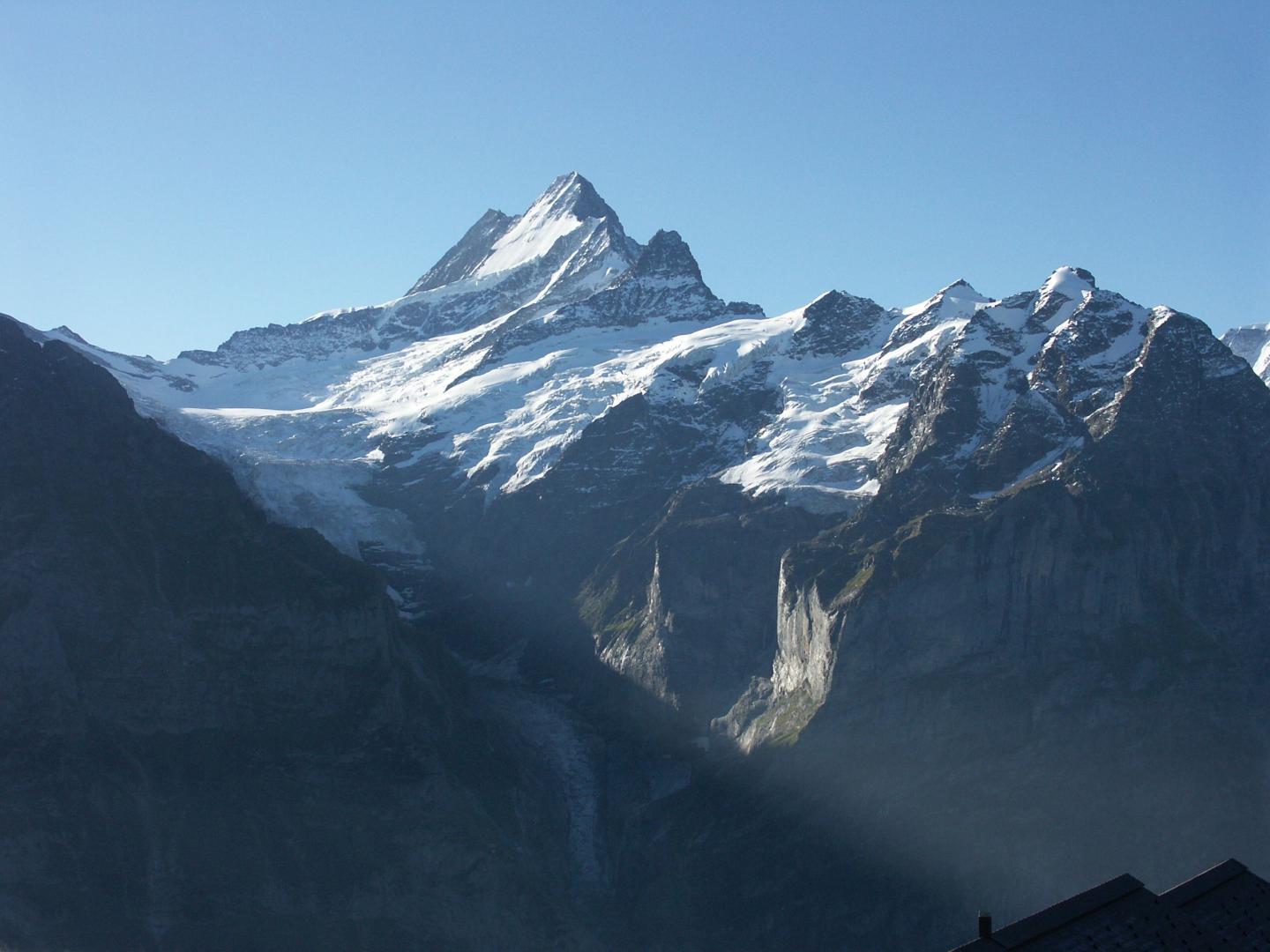
Credit: IUCN/Martin Price
WASHINGTON– Glaciers are set to disappear completely from almost half of World Heritage sites if business-as-usual emissions continue, according to the first-ever global study of World Heritage glaciers.
The sites are home to some of the world’s most iconic glaciers, such as the Grosser Aletschgletscher in the Swiss Alps, Khumbu Glacier in the Himalayas and Greenland’s Jakobshavn Isbrae.
The study in the AGU journal Earth’s Future and co-authored by scientists from the International Union for Conservation of Nature (IUCN) combines data from a global glacier inventory, a review of existing literature and sophisticated computer modeling to analyze the current state of World Heritage glaciers, their recent evolution, and their projected mass change over the 21st century.
The authors predict glacier extinction by 2100 under a high emission scenario in 21 of the 46 natural World Heritage sites where glaciers are currently found. Even under a low emission scenario, eight of the 46 World Heritage sites will be ice-free by 2100. The study also expects that 33 percent to 60 percent of the total ice volume present in 2017 will be lost by 2100, depending on the emission scenario.
“Losing these iconic glaciers would be a tragedy and have major consequences for the availability of water resources, sea level rise and weather patterns,” said Peter Shadie, Director of the International Union for Conservation of Nature’s World Heritage Programme. “This unprecedented decline could also jeopardize the listing of the sites in question on the World Heritage list. States must reinforce their commitments to combat climate change and step up efforts to preserve these glaciers for future generations.”
Several iconic landscapes found in World Heritage sites will be impacted by rising temperatures.
- Los Glaciares National Park in Argentina contains some of the largest glaciers on Earth and a very large ice loss – about 60 percent of the current volume – is predicted by 2100 within this site.
- In North America, Waterton Glacier International Peace Park, Canadian Rocky Mountain Parks and Olympic National Park could also lose more than 70 percent of their current glacier ice by 2100, even under drastically lowered carbon dioxide emissions.
- In Europe, the disappearance of small glaciers is projected in the Pyrénées – Mont Perdu World Heritage site before 2040.
- Te Wahipounamu – South West New Zealand, which contains three quarters of New Zealand’s glaciers, is projected to lose 25 percent to 80 percent of the current ice volume over the course of this century.
Beyond these alarming results, the authors emphasize the key role that glaciers play for ecosystems and societies at a global scale. Glacier conservation could thus serve as a trigger to tackle the unprecedented issue of climate change.
“To preserve these iconic glaciers found in World Heritage sites, we urgently need to see significant cuts in greenhouse gas emissions. This is the only way of avoiding long-lasting and irreversible glacier decline and the related major natural, social, economic and migratory cascading consequences,” says Jean-Baptiste Bosson, scientific advisor for the IUCN’s World Heritage programme and lead author of the new study. “The study on glacier decline further emphasizes the need for individual and collective actions to achieve the mitigation and adaptation aspirations of the Paris Agreement on climate change.”
Climate change is the fastest growing threat to natural World Heritage sites, according to the IUCN World Heritage Outlook 2 report, with the number of sites threatened by climate change doubling between 2014 and 2017.
The authors of the study also developed the first ever inventory of glaciers on the UNESCO World Heritage list, documenting about 19,000 glaciers present in 46 out of the 247 natural World Heritage sites.
###
Founded in 1919, AGU is a not-for-profit scientific society dedicated to advancing Earth and space science for the benefit of humanity. We support 60,000 members, who reside in 135 countries, as well as our broader community, through high-quality scholarly publications, dynamic meetings, our dedication to science policy and science communications, and our commitment to building a diverse and inclusive workforce, as well as many other innovative programs. AGU is home to the award-winning news publication Eos, the Thriving Earth Exchange, where scientists and community leaders work together to tackle local issues, and a headquarters building that represents Washington, D.C.’s first net zero energy commercial renovation. We are celebrating our Centennial in 2019. #AGU100
IUCN is a membership Union uniquely composed of both government and civil society organisations. It provides public, private and non-governmental organisations with the knowledge and tools that enable human progress, economic development and nature conservation to take place together. http://www.
AGU press contact:
Nanci Bompey
+1 (202) 777-7524
[email protected]
IUCN press contact:
Goska Bonnaveira
+41792760185
[email protected]
Contact information for the researchers:
Jean-Baptiste Bosson
+33 678 54 33 23, +41 77 447 06 43
[email protected]
Matthias Huss
+41 44 632 40 93, +41 79 752 72 62
[email protected]
Elena Osipova
[email protected]
Media Contact
Nanci Bompey
[email protected]
Original Source
https:/