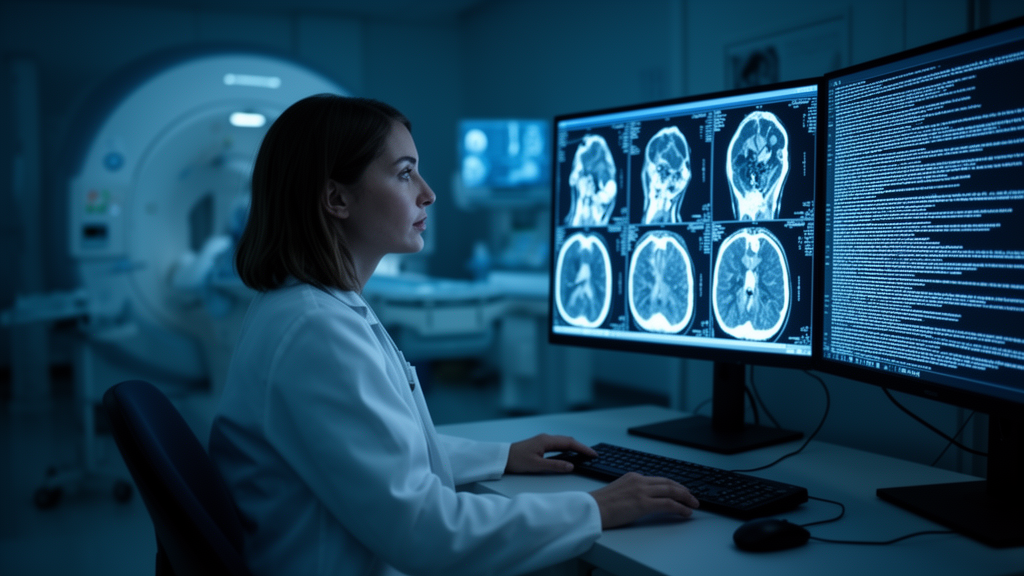
Radiological impressions—the short summary statements that guide clinical decisions after an imaging study—depend on expertise that is unevenly distributed across hospitals, and general-purpose large language models have so far lacked the domain-specific reliability needed for this task. A team led by Ruixin Wang and Jun Liu reports in Nature Communications the development and evaluation of Impression-R1, a domain-specialized large reasoning model trained to generate radiological impressions. The work, published open access on 28 October 2026, describes an Imitation–Reasoning–Reinforcement training pipeline that combines large-scale supervised learning, clinically conditioned reasoning, and radiology-aware reward optimization.
The benchmarking effort was substantial. The researchers evaluated the model across 11,884 cases drawn from six institutions and three public datasets, covering a range of imaging modalities, anatomical regions, and diseases. Testing also included cross-lingual evaluation on English-language benchmarks. Across these settings, Impression-R1 outperformed or matched state-of-the-art general-purpose models, according to the study.
A 200-case head-to-head comparison put the model directly against practicing radiologists. In that evaluation, Impression-R1 showed stronger objective agreement with institution-derived reference impressions than all participating radiologists, while its subjective performance fell within the range of less-experienced radiologists under the study’s evaluation framework. The authors are careful to frame this as performance within a specific study evaluation design rather than a general claim of clinical superiority. In prospective testing, radiologists rated the model’s reasoning and clinical relevance highly.
The most clinically consequential results came from a randomized within-reader study of 360 interpretations. With AI assistance, report quality improved with an adjusted difference of 0.28 (95% confidence interval, 0.10–0.46), and completion time fell by 27% (95% CI, 19.0%–33.9%). Harmlessness scores, by contrast, showed no significant difference between conditions, with an adjusted difference of 0.08 (95% CI, −0.11–0.28). These numbers indicate a measurable gain in quality and speed without a detectable penalty on the safety-related measure in this study.
The authors position Impression-R1 as an example of a clinically informed framework for building and evaluating domain-specialized reasoning models, and they state that it can improve radiological reporting quality and efficiency. They also emphasize that continued validation is required before broader clinical deployment, a caveat that accompanies the reported gains. The article is published as an early-share version that is citable and carries a permanent DOI, subject to further edits before the final Version of Record.
Subject of Research: Development and multicenter evaluation of a domain-specialized large reasoning model for generating radiological impressions
Article Title: Impression-R1 for radiological impression generation with multicenter benchmarking and prospective evaluations
Article References: Wang, R., Wang, J., Yin, Y., Li, C., Zheng, C., Zeng, Y., Zhang, Z., Wu, L., Lv, H., Li, M., Hu, S., Du, Y., Luo, S., Fan, L., Liu, X., Tan, G., Wang, Z., Zhao, W., Peng, S., & Liu, J. (2026). Impression-R1 for radiological impression generation with multicenter benchmarking and prospective evaluations. Nature Communications. https://doi.org/10.1038/s41467-026-79102-7
Image Credits: AI Generated
DOI: 10.1038/s41467-026-79102-7
Keywords: radiology, large language models, Impression-R1, medical imaging, clinical decision-making, randomized within-reader study, report quality, artificial intelligence, Nature Communications, reasoning model, radiological, impression
News Source: Ophelia Keating. (October 28, 2026). AI Model Impression-R1 Matches Radiologists in Multicenter Impression Writing Test. Scienmag.