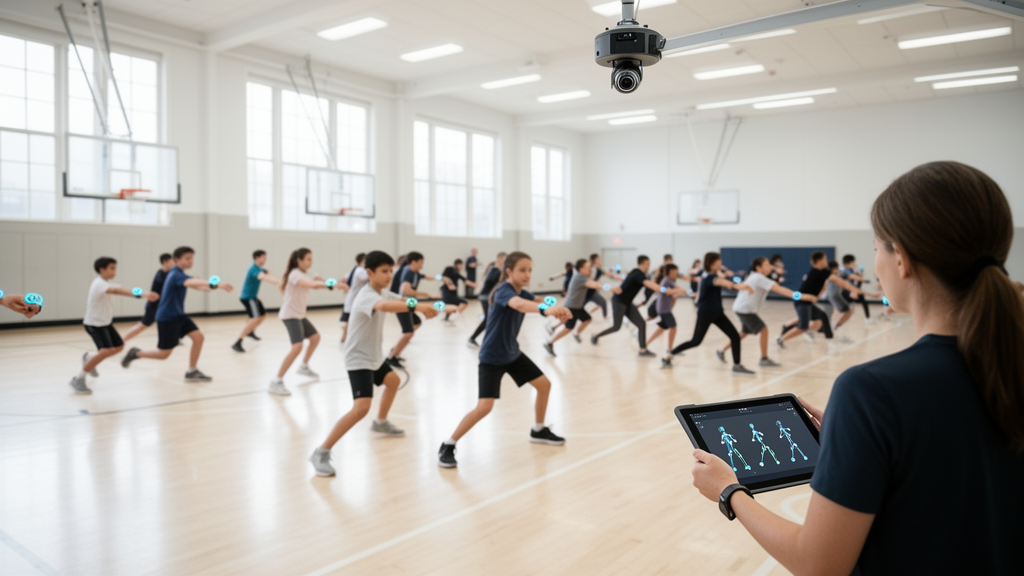
A randomized controlled trial at a Chinese university will test whether an artificial intelligence-guided smartphone application, embedded in mandatory physical education classes and supported by instructors, can improve students’ physical activity, fitness and psychological well-being. The researchers will enroll 128 undergraduates and compare the combined digital and teacher-supported program with conventional physical education over two consecutive semesters. This is a protocol describing a planned experiment, not a report of results, so the intervention’s effectiveness remains unknown until recruitment, delivery and follow-up are complete.
The trial centers on Dreamer®, a fitness application that combines adaptive exercise recommendations, activity tracking, automated prompts and social features with weekly support from physical education instructors. University students are an especially relevant population for testing this approach because the transition to higher education can coincide with reduced physical activity and more sedentary routines. Traditional classes provide scheduled exercise, but instructors often have limited mechanisms for monitoring students outside class or delivering personalized feedback. The proposed system is intended to preserve the structure of physical education while extending support between sessions.
Students will use Dreamer® throughout an intervention period of approximately 32 weeks, matching the duration of two academic semesters. The application will collect information such as body composition, step count and activity frequency, then use those observable inputs to offer individualized exercise content and guidance. Teachers will be able to review students’ progress and provide weekly feedback, encouragement and adjustments when participants fall behind their running goals. The researchers emphasize that the proprietary computational architecture is inaccessible to them, so the protocol describes the app’s functions without attributing its recommendations to a particular machine-learning model.
The campus running program is a central part of the intervention. Participants can complete timed runs and distance challenges, with the app recording the date, distance, duration and frequency of each session. Planned runs range from 1 to 3 kilometers, and students are expected to progress toward a semester goal of 90 kilometers. Real-time prompts provide feedback when running pace falls outside a predefined target range, while post-session summaries and weekly progress reports offer more detailed analysis. Achievement badges, reminders and peer sharing are also intended to sustain motivation. Control-group students will follow a similar semester-long running regimen and manually log their sessions, but they will not receive personalized app-based prescriptions, automated feedback, achievement badges or app-generated reminders.
Eligible participants will be full-time students aged 18 to 25 who are enrolled in mandatory physical education courses, own a compatible Android or iOS smartphone, can perform moderate-intensity exercise and provide written informed consent. Students with chronic illnesses, musculoskeletal limitations or other conditions that preclude regular exercise will be excluded. After informed consent and baseline assessments, an independent statistician will generate a computer-based allocation sequence using block randomization stratified by gender and baseline physical activity. Opaque, sequentially numbered sealed envelopes will conceal assignments. Because students and instructors cannot realistically be blinded to a behavioral and technology-supported program, outcome collectors and data analysts will remain unaware of allocation, while students and instructors cannot be blinded.
Physical activity is the primary confirmatory outcome and will be measured at 32 weeks by the International Physical Activity Questionnaire, with baseline, 16-week and three-month post-intervention assessments also planned. The sample-size calculation uses an expected standardized between-group effect of Cohen’s d = 0.55, a two-sided significance level of 0.05 and 80% statistical power. Under those assumptions, approximately 53 evaluable participants per group would be required. Increasing the target to 64 participants per group allows for an anticipated 15% attrition, giving the trial a recruitment goal of 128 students. The primary analysis will compare physical activity at week 32 while accounting for baseline, and sensitivity analyses will compare results from complete-case and multiply imputed datasets.
Health-related fitness will be evaluated with a combination of application data and standardized physical tests. Bioelectrical impedance scales will measure body mass index, waist-to-hip ratio and body fat percentage. Cardiovascular endurance will be assessed through a three-minute step test, muscular strength through handgrip testing, and muscular endurance through push-ups and sit-ups. Goniometer-based joint range-of-motion tests and the sit-and-reach test will evaluate flexibility. These measures, along with app-recorded running speed, distance and frequency, will be collected at baseline, week 16, week 32 and the three-month follow-up. The protocol follows relevant ACSM assessment guidance and is aligned with SPIRIT 2013 and the CONSORT-EHEALTH checklist for digital health interventions.
Psychological and behavioral outcomes include exercise motivation, health-related quality of life, sleep quality, depression, anxiety, perceived stress, self-esteem and perceived social support. The assessment battery comprises the Behavioral Regulation in Exercise Questionnaire, RAND-36 Health Survey, Sleep Condition Indicator, Patient Health Questionnaire-9, Generalized Anxiety Disorder-7, Perceived Stress Scale, Rosenberg Self-Esteem Scale and Oslo Social Support Scale. Participants in both groups will also complete the International Physical Activity Questionnaire at all four time points. Application quality will be assessed with the Mobile Application Rating Scale, which covers engagement, functionality, aesthetics and information, while qualitative interviews with a subset of participants will explore their experiences and satisfaction.
The statistical plan will use repeated-measures analysis of variance for primary physical activity and fitness outcomes, examining changes across baseline, midpoint, intervention completion and follow-up. Group-by-time interactions will test whether trajectories differ between intervention and control conditions, with Bonferroni-adjusted pairwise comparisons where appropriate. Linear mixed models will analyze secondary outcomes, including app usability, with individual-level random intercepts. Subgroup analyses will explore whether age, gender or socioeconomic status modifies intervention effects. Generalized estimating equations will assess whether any mental health, behavioral or fitness differences persist at the three-month follow-up. Effect sizes will accompany p-values, which will be interpreted using a threshold of p < 0.05. Trained assessors will collect data, and digital records will be coded and stored under access controls in line with Chinese data-protection requirements.
Several limitations could shape interpretation. The trial is confined to one university in China, so its institutional culture, curriculum and local patterns of technology use may limit generalizability. The lack of participant and instructor blinding leaves room for expectation or performance bias despite blinded assessors and analysts. Repeated questionnaires and physical tests may also burden students, potentially producing fatigue and missing follow-up data. The protocol attempts to reduce these problems through flexible scheduling, electronic questionnaires, reminders, rest periods and make-up assessments. Participants who stop using the intervention will still be encouraged to complete follow-up evaluations, and nonparticipation will not affect physical education grades. Safety will be monitored for events including musculoskeletal pain, sprains, falls, dizziness and fainting, with activity suspension and medical referral where appropriate. Ethical approval has been granted, and the trial is registered as ChiCTR2600133726.
Subject of Research: Randomized trial protocol testing an AI-guided, teacher-supported mobile health intervention in university physical education.
Article Title: AI-guided mobile health integrated with physical education improves physical activity and psychophysiological outcomes in university students: a randomized controlled trial protocol
Article References: Yu, H., Xu, G., Li, X., Song, G., Li, M., Qian, G., Ossowski, Z., & Szumilewicz, A. (2026). AI-guided mobile health integrated with physical education improves physical activity and psychophysiological outcomes in university students: a randomized controlled trial protocol. Frontiers in Digital Health, 8, Article 1862894. https://doi.org/10.3389/fdgth.2026.1862894
Image Credits: AI Generated
DOI: 10.3389/fdgth.2026.1862894
Keywords: randomized controlled trial, mobile health, artificial intelligence, physical education, university students, physical activity, health-related fitness, psychological well-being, exercise adherence, digital health, AI-guided, mobile
News Source: Courtney Benton. (October 21, 2026). AI-guided physical education trial to test student activity and well-being. Scienmag.