An image-processing workflow based on OpenCV measured smaller grains than several conventional approaches in the fusion zones of gas tungsten arc welded Ti-6Al-4V, with results showing progressive refinement across four welding conditions. The automated method produced mean linear-intercept values of 421.0 ± 21.0 micrometers for direct-current welding, 300.0 ± 20.6 micrometers for pulsed direct current, 261.0 ± 31.9 micrometers for ultrasonic vibration-assisted direct current, and 243.9 ± 10.4 micrometers for ultrasonic vibration-assisted pulsed direct current.
The study examined Ti-6Al-4V weldments produced under conventional direct-current, pulsed direct-current, ultrasonic vibration-assisted direct-current, and ultrasonic vibration-assisted pulsed direct-current conditions. Researchers focused on the fusion zone, where large and uneven grain morphologies can make quantitative metallography vulnerable to differences in how operators identify and measure grain boundaries.
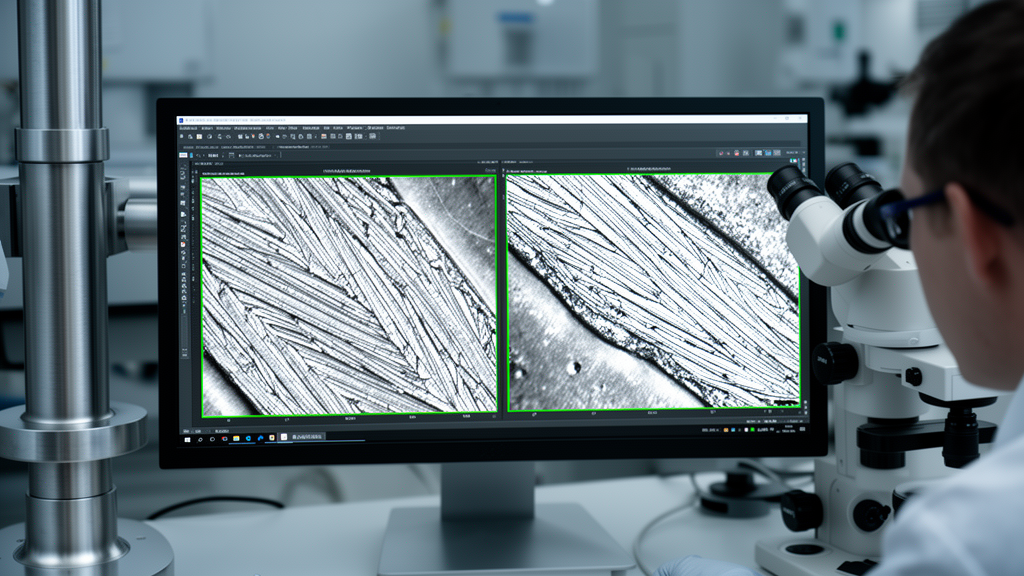
For the automated analysis, the researchers converted fusion-zone micrographs to grayscale and applied filtering, boundary detection, segmentation and morphological operations. The workflow then identified individual grains and calibrated their dimensions spatially at approximately 3.03 micrometers per pixel. Together, these steps allowed grain size to be derived consistently from the images rather than relying entirely on manual boundary selection and measurement.
The OpenCV results were compared with three methods described in ASTM E112: the Jeffries planimetric method, the Heyn linear-intercept method and the Abrams three-circle method. Relative to these reference approaches, the OpenCV workflow had mean biases of −20.18 micrometers against the planimetric method, −65.13 micrometers against the linear-intercept method and −128.12 micrometers against the three-circle method.
Agreement also varied substantially among the comparators. The mean absolute percentage error was 6.47% for the comparison with the Jeffries planimetric method, 17.04% for the Heyn linear-intercept method and 29.60% for the Abrams three-circle method. These values show that the closest numerical agreement was with planimetric analysis, while the three-circle method produced the largest divergence from the automated measurements.
Across the four welding conditions, the automated measurements were associated with progressively smaller mean linear intercepts from conventional direct current to pulsed direct current and then to the two ultrasonic vibration-assisted conditions. The ultrasonic vibration-assisted pulsed condition yielded the smallest reported mean value, 243.9 micrometers, compared with 421.0 micrometers for conventional direct current. Within this experimental set, the measurements therefore showed grain refinement with pulsing and ultrasonic vibration, although the study does not establish that either treatment alone caused the effect.
The findings suggest that computer vision can provide a repeatable route to grain-size characterization in fusion-zone micrographs, particularly where irregular grain shapes complicate manual metallography. The approach also quantifies an important limitation: automated segmentation did not reproduce every ASTM E112 result closely. Its strongest agreement was with the Jeffries method, whereas substantially larger differences appeared in comparisons with the Heyn and Abrams approaches.
Researchers cautioned that the OpenCV workflow should not be treated as an exact replacement for ASTM E112 analysis. The reported evidence supports its use as a consistent supplementary measurement approach for the studied Ti-6Al-4V gas tungsten arc weldments, not as a universally equivalent standard. The comparison was limited to four welding conditions and the fusion-zone images processed under the developed calibration workflow, so the results do not show that the same agreement would apply to every alloy, welding process, imaging system or grain morphology.
Subject of Research: Automated grain-size characterization of Ti-6Al-4V gas tungsten arc weldments using OpenCV and ASTM E112 comparison methods
Article Title: Automated grain-size characterization of GTAW Ti-6Al-4 V weldments using OpenCV and comparison with ASTM-based intercept methods
Article References: Gudisi, M. R., Talari, M. K., Gopal, A. V., & Nagallapati, V. (2026). Automated grain-size characterization of GTAW Ti-6Al-4 V weldments using OpenCV and comparison with ASTM-based intercept methods. Scientific Reports. https://doi.org/10.1038/s41598-026-76591-w
Image Credits: AI Generated
DOI: 10.1038/s41598-026-76591-w
Keywords: OpenCV, grain size, Ti-6Al-4V, GTAW, computer vision, metallography, ultrasonic vibration, pulsed welding, ASTM E112, fusion zone, Automated, grain-size
News Source: Denise Maddox. (October 21, 2026). OpenCV grain sizing compares with ASTM methods in Ti-6Al-4V welds. Scienmag.