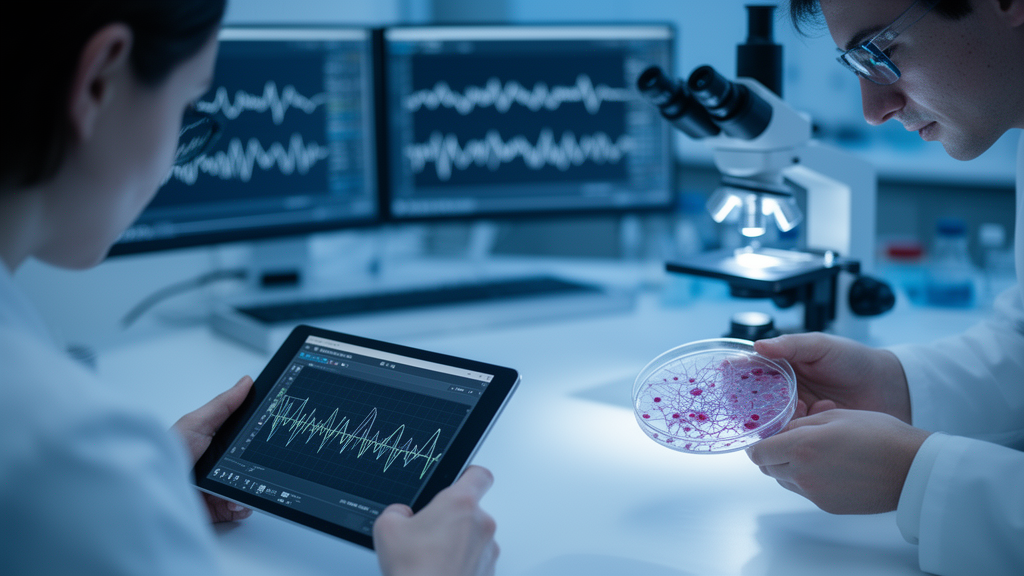
Huntington’s disease has long presented medicine with a cruel paradox. Because it is caused by a single, well-characterized genetic mutation, researchers can identify who will develop the disease decades before symptoms appear, yet the tools used to measure its progression remain stubbornly blunt. A new review published in Frontiers in Molecular Medicine argues that the solution may already be sitting in patients’ pockets, homes, and daily routines. Amit Khanna of Novartis and Graham Jones of Novartis and Tufts University Medical Center propose that artificial intelligence inspired approaches to passive patient monitoring, capturing what they call the “digital exhaust” of activities of daily living, could fundamentally reshape how Huntington’s disease is tracked in drug development and managed in clinical care.
The core problem the authors identify is temporal. Huntington’s disease is caused by expanded CAG repeats in the HTT gene on chromosome 4p16.3, and its prodromal phase, the long silent stretch before formal diagnosis, often spans more than a decade. During this period and after clinical onset, symptoms emerge in a non-linear fashion, with motor, cognitive, and psychiatric manifestations fluctuating over short time scales. The standard instruments used to assess the disease, including the Unified Huntington’s Disease Rating Scale and its composite version, the cUHDRS, are deployed episodically during clinic visits. They capture a snapshot, not the film. In early stages of the disease, where changes are subtle and variable, these episodic assessments can obscure the very treatment effects that clinical trials are designed to detect, potentially masking the benefit of investigational drugs and inflating the size, cost, and duration of studies.
The review situates digital health technologies as a complement to existing clinical research outcomes and patient reported outcomes rather than a replacement. Fluid biomarkers such as mutant huntingtin protein and neurofilament light chain measured in cerebrospinal fluid, and more recently in serum, correlate with symptoms and show promise, as do emerging assays based on deregulated phosphatidylcholine metabolism and advanced imaging modalities including MRI, PET, and functional MRI. But these measures are invasive, expensive, or episodic in their own right. What digital technologies offer is the possibility of high-frequency, longitudinal tracking of motor and cognitive function at scale, in the patient’s natural environment, without the friction of repeated clinic visits.
A concrete proof of concept already exists. The Huntington’s Disease Digital Motor Score, developed by Roche Diagnostics on a smartphone platform, represents a natural extension of physician-based episodic monitoring, translating structured motor tasks into quantitative data that can detect progression with greater sensitivity than traditional scales alone. The review also points to a broader ecosystem of digital tools matured in adjacent neurodegenerative diseases, including multiple sclerosis, Parkinson’s disease, and Alzheimer’s disease, where wearable sensors, gait measurement devices, and tablet-based assessments have been deployed with increasing sophistication. The COVID-19 pandemic accelerated the incorporation of telemedicine and remote patient reported outcomes, demonstrating that decentralized assessment is feasible even in populations with complex neurological burdens.
Yet the authors are candid about the limitations of active digital tools. Wearable devices and smartphone applications impose a burden on users, and adherence tends to decline significantly over time, undermining their utility in the long-term studies that neurodegenerative disease research demands. This is where the concept of the digital exhaust becomes central. Rather than asking patients to perform tasks, the vision is to extract clinically meaningful signals from the data people generate simply by living: the accelerometer readings from a wrist-worn device, the rhythm of keystrokes on a keyboard, the acoustic signatures of speech captured by smartphone microphones, sleep patterns derived from device sensors, and even patterns of web and social media activity that may correlate with apathy, depression, and anxiety.
The technical palette the review assembles is strikingly broad. Inertial measurement units in consumer wearables can detect movement anomalies. Smartphone and computer interactions can yield vocal features such as pitch frequency, jitter, and shimmer, which have been shown in prior research to help classify Huntington’s disease using acoustic and lexical features. Ocular analysis through digital cameras can monitor saccades, rapid eye movements whose latency and inhibition are altered in both manifest and premanifest disease. Optical coherence tomography, a benchtop instrument already ubiquitous in optometry offices, can detect retinal biomarkers associated with neurodegeneration. The authors even suggest that non-traditional service providers such as optometrists and dentists could eventually participate in screening and early diagnosis, expanding the diagnostic funnel far beyond the neurology clinic.
Perhaps the most futuristic element of the proposal involves the home itself. The authors envision fully passive residential monitoring built on the Internet of Medical Things, where ambient sensors gather rich data with very high frequency and zero patient burden. They point to passive radio-frequency sensing, already piloted with some success in Parkinson’s disease, which can capture features derived from motion, breathing, and sleep staging and correlate them with activities of daily living. Technologies borrowed from home security and automotive safety, including millimeter-wave radar, infrared motion detection, ultrasonic reflection, and echolocation-inspired systems, could detect room occupancy, falls, and movement patterns. These platforms are well suited to home health monitoring because their waveforms penetrate structural features, function nocturnally, and tolerate challenging environments such as steam and humidity. A collaboration between the home security industry and health technology developers, the authors argue, could be fertile ground for innovation, potentially accelerated through demonstration projects in assisted living facilities.
On the biochemical front, the review highlights emerging non-invasive biomarkers that could eventually be packaged into consumer-grade assay kits, much as flow-based COVID-19 tests popularized at-home diagnostics. Salivary levels of total huntingtin protein have been found to be elevated in Huntington’s disease patients, and salivary interleukin-6, but not plasma levels, correlates with clinical metrics. Mutant huntingtin protein has also been detected at high levels in tear fluid. These analytes, combined with the digital exhaust of daily living, could form a multi-modal picture of disease state that is both biologically grounded and behaviorally rich.
The authors organize the potential data streams around four major symptom domains. Gross and fine motor performance would draw on activity-tracking wearables, ambient monitoring, active keyboard and ocular tests, and passive motion and keystroke capture. Cognitive function, including executive function, memory recall, and processing speed, could be probed through gamified challenges on digital devices. Quality of life and psychiatric measures, including apathy and anxiety, could be inferred from combinations of web activity, sleep metrics, activity profiles, and social media interaction. Speech and acoustic function would be assessed through altered prosody, intonation, and phonation captured during ordinary computer and smartphone use. Recent research on passive smartphone sensors suggests that psychopathological markers such as internalization, detachment, disinhibition, antagonism, and thought disorder can be derived from GPS and IMU data combined with device activity logs, hinting at the depth of insight available from devices people already carry.
The authors liken the resulting composite record to on-board diagnostics in automobiles or flight data recorders in aircraft: continuous, passive documentation of the patient’s state between scheduled service intervals. Smart residential video devices, including televisions and computers with large graphical interfaces, could overcome the ergonomic limitations of smartphones, offering gamified symptom assessments, informational content, and two-way communication with health providers. The result, if realized, would be a real-world portrait of daily living that complements interval-based clinical assessment and gives drug developers the statistical power to detect treatment effects earlier, with smaller cohorts and shorter trials.
None of this happens without coordination, and the review closes with a concrete call to action. The authors urge convening dialogue among pharmaceutical industry delegates, Huntington’s disease experts, research foundations such as CHDI, professional medical societies, and digital health technology developers. They call on integrators such as the Critical Path Institute, which has made notable inroads deploying digital approaches in Parkinson’s disease, to engage health authorities on the design of composite measures and endpoints. They propose incentivizing data sharing and federated learning consortia through funding mechanisms such as the Innovative Health Initiative and the US National Institutes of Health, reimagining established endpoints like the cUHDRS to benefit from digital monitoring, and convening working groups to design interoperability standards. Existing frameworks such as Fast Healthcare Interoperability Resources and Health Level Seven address many technical issues, but integration with electronic health records will require careful alignment with region-specific data protection regimes including the General Data Protection Regulation and the Health Insurance Portability and Accountability Act.
The stakes are considerable. Huntington’s disease affects roughly one in ten thousand people, with higher prevalence in persons of Caucasian descent, and it is fatal, with a median post-diagnosis survival of just fifteen years. As a Mendelian disorder, its pathogenesis is molecular rather than environmental, and children of affected parents face a fifty percent probability of inheritance, making early detection and accurate progression tracking uniquely consequential for this population. The authors argue that once disease-modifying treatments become available, digital monitoring would enable a shift to the left, identifying and treating patients at the earliest stages of disease with precision that episodic clinic visits cannot match. Given the ethical, economic, and societal burden of neurodegenerative disease, they conclude, capturing the digital exhaust of daily life may prove to be one of the most consequential untapped resources in modern medicine.
Subject of Research: AI-inspired passive digital monitoring for tracking Huntington's disease progression in drug development
Article Title: The potential of AI inspired approaches for patient monitoring in drug development for Huntington’s disease: capturing the digital exhaust for activities of daily living
Article References: The potential of AI inspired approaches for patient monitoring in drug development for Huntington’s disease: capturing the digital exhaust for activities of daily living. (n.d.). https://doi.org/10.3389/fmmed.2026.1966010
Image Credits: AI Generated
DOI: 10.3389/fmmed.2026.1966010
Keywords: Huntington's disease, artificial intelligence, digital biomarkers, passive monitoring, digital health technology, drug development, neurodegeneration, wearable sensors, Internet of Medical Things, activities of daily living, clinical trials, UHDRS
News Source: Ophelia Keating. (October 16, 2026). AI and the Digital Exhaust: How Everyday Data Could Transform Huntington’s Disease Drug Development. Scienmag.