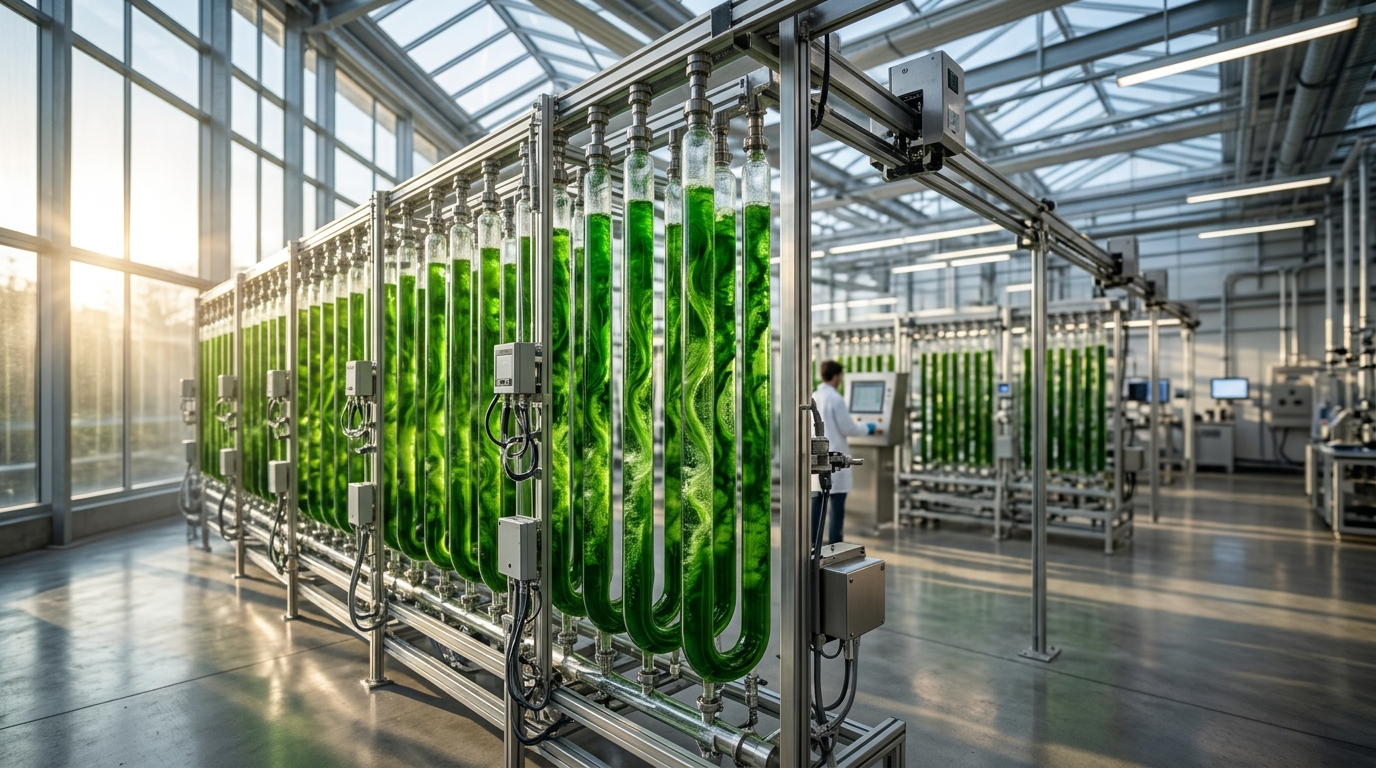
Microalgae have quietly become one of biotechnology’s most versatile workhorses, churning out lipids for biofuels, proteins for nutraceuticals, and bioactive molecules for pharmaceuticals while simultaneously mopping up pollutants in bioremediation schemes. The global market for these microscopic photosynthetic factories was valued at USD 977 million in 2021 and is projected to exceed USD 2 billion by 2030, with demand expected to grow at a compound annual growth rate of 7.8 percent in South Asia and 6.8 percent in East Asia. But behind that commercial promise lies a stubborn operational problem: keeping the organisms alive and productive requires continuous monitoring and precise, adaptive control of cultivation conditions, something industrial-scale facilities still struggle to deliver in real time.
A mini-review published in Frontiers in Systems Biology argues that the missing ingredient is not better sensors or smarter models, but an orchestration layer that can tie them together autonomously. Researchers from the Manipal Institute of Technology in India propose what they call an agentic AI framework for microalgal cultivation, one in which software agents coordinate sensing, interpretation, and action without waiting for a human operator to translate a prediction into a valve adjustment. The catch, the authors are careful to stress, is that the architecture remains entirely conceptual. It has not been implemented in any algal system and requires experimental validation before anyone can claim it works.
The case for automation rests on how quickly things can go wrong. Microalgal growth is influenced by light, pH, temperature, CO2 availability, nutrient balance, and contamination, and changes in these factors can affect culture growth over timescales ranging from minutes to hours. Traditional monitoring methods such as microscopy, periodic chemical sampling, and offline molecular assays simply cannot keep pace with that tempo, creating a gap between conventional practices and the operational demands of industrial cultivation. Even where AI and machine learning have been deployed, many applications produce predictions that still require human interpretation before any adjustment is made, adding delays and limiting adaptability across strains, reactor configurations, and environmental conditions.
The review maps out what it calls the agent’s perceptual field: four complementary sensing layers, each at a different level of maturity. The first is physicochemical and IoT-enabled sensing. Ion-selective field-effect transistor pH probes and wireless sensor networks have already demonstrated stable, continuous monitoring in microalgal growth systems, while automated low-cost online modules with self-cleaning sampling cycles improve sensor reliability during long-term runs. One IoT-integrated network built around a NodeMCU ESP8266 for Spirulina cultivation streams absorbance-based biomass measurements from a TCS3200 colour sensor to the ThingSpeak platform for real-time remote visualization at low cost. These systems can also provide remote actuation interfaces, meaning they can not only watch a culture but adjust it.
The second layer is optical and spectroscopic monitoring, which has matured considerably in recent years. Raman spectroscopy paired with partial least squares regression enables real-time quantification of nutrients including nitrate, sulfate, glucose, and phosphate in the culture medium of Chlorella vulgaris, with reported R2 values ranging from 0.9661 to 0.9892. Electrochemical impedance spectroscopy offers a complementary approach, measuring changes in electrical impedance to monitor cell adhesion and growth, and has been used to estimate chlorophyll concentrations in Spirulina, Chlorella, and mixed cultures with regression R2 values of at least 0.885 and prediction accuracies between 84 and 94 percent. Fluorescence spectroscopy adds another dimension, distinguishing algal groups through pigment-specific emission patterns, and a recent study reported the potential of quasi-3D-fluorescence spectroscopy for rapid, in situ species-level analysis.
The third and fourth layers operate on slower timescales but probe deeper into the biology. Episodic molecular inputs such as fluorescence in situ hybridization, quantitative PCR, and sandwich hybridization provide rapid, sensitive detection of target algae and contaminants, with sensitivity greater than microscopy-based monitoring, and can function as agent-triggerable deep-state assessments initiated when optical or chemical anomalies appear. Omics-derived data go further still. A recent transcriptomic analysis of Vischeria sp. WL1 under nitrogen deprivation revealed significant differential expression of fatty-acid biosynthesis genes within 24 hours of nitrogen depletion, showing that molecular-level metabolic reprogramming occurs before any visible change in optical density or culture output. That temporal sensitivity, the authors argue, makes transcriptomics an episodic early-warning layer: when dissolved-nitrate sensors flag depletion, transcriptomic analysis can offer molecular confirmation before the culture visibly suffers.
On top of these sensing layers sit the analytical tools the agent would call upon. Image-based deep learning already enables automated assessment of morphological state, growth-stage classification, and contamination detection: integrated microfluidic platforms achieved an overall mean average precision of 92.8 percent at an intersection-over-union threshold of 0.5, with 97.5 percent detection accuracy for Haematococcus pluvialis and 96.3 percent classification accuracy for the astaxanthin accumulation state over 30 days of continuous monitoring, while EfficientNet-B0 classifiers applied to microscopic images reached 92.2 percent accuracy and an F1 score of 0.91 for growth-stage classification. Predictive growth models add forward-looking estimates. Long short-term memory and support vector regression models incorporating light-history sequences captured acclimation effects that static models missed, improving outdoor growth prediction under variable irradiance, and graph learning with Binarized Attributed Network Embedding improved XGBoost predictions of Porphyridium biomass production. Multimodal fusion has been demonstrated too: a set of seven in-line sensors measuring temperature, pH, light intensity, electrical conductivity, flow rate, oxygen content, and light exposure was combined with camera-based image acquisition and machine-learning estimators in tubular photobioreactors for Chlorella sp., while two-dimensional fluorescence spectroscopy with PLSR-based machine learning enabled simultaneous estimation of cell count, chlorophyll content, and carotenoid fractions in Dunaliella salina.
Genome-scale metabolic models, or GEMs, supply the mechanistic backbone. AlgaGEM, built on the Chlamydomonas reinhardtii genome and a Kyoto Encyclopedia of Genes and Genomes reaction database, describes 1,725 distinct reactions and 1,862 metabolites across four cellular compartments. It predicted an eightfold increase in hydrogen yield under disrupted cyclic electron flow, comparable to the five to thirteen-fold increase observed in the mutant stm6 strain, a result the review cites as evidence that stoichiometric constraints can support accurate species-specific predictions even when compartmentalization data come from a related organism. Beyond Chlamydomonas, the model iCzof1915 for Chromochloris zofingiensis was created using the Rapid Annotation of Photosynthetic Systems tool, with astaxanthin biosynthesis reactions incorporated and thermodynamically infeasible loops removed by manual curation, underscoring that species’ industrial potential as a lipid and carotenoid producer. Yet the dynamic, real-time GEM that the proposed agent would need to query as conditions change has not been demonstrated in any algal species.
The agentic layer itself is defined not by any particular foundation model or large language model but by the cultivation tasks it performs and its capacity for autonomous, goal-directed action. The review distinguishes three levels of increasing autonomy: adaptive monitoring, in which the agent integrates continuous measurements, detects anomalies, and selects relevant analytical tools; supervisory process control, in which it compares inferred conditions with cultivation objectives and recommends or implements constrained changes to light, CO2 delivery, nutrient supply, aeration, or sampling frequency; and closed-loop experimentation, in which it chooses additional measurements or experiments when available evidence is insufficient. A practical architecture would comprise bounded functions of perception, state assessment, tool selection, evidence integration, decision-making, action, and feedback, with persistent memory storing current states, model outputs, operational constraints, and intervention histories, and an uncertainty module assessing confidence and disagreement before the decision layer chooses to act within a safety envelope, gather further information, or request human review.
Whether any of this can actually be built for algae remains an open question. Fully agentic microalgal cultivation has not yet been demonstrated, though evidence is converging at the component level: an autonomous agentic AI called Eubiota demonstrates modular agentic reasoning in microbiome research, agentic multi-omics workflows have been studied in precision oncology, and autonomous laboratory systems for microbial bioproduction have demonstrated robotic execution, measurement, and optimization in closed loops. These examples show the relevant component classes exist, but they do not prove the feasibility of autonomous algal control. The main challenge, the authors conclude, is not the lack of a technical foundation but the experimental integration and validation of these components as a dependable, uncertainty-aware, closed-loop system for microalgal production. Limited cross-system generalizability remains a major limitation of AI/ML-based productivity prediction, as models trained on specific strains and operating conditions frequently do not transfer reliably across different reactors, habitats, and nutrient regimes, and agentic AI is itself vulnerable to biased input data, hallucinations, and reward hacking, weaknesses that biological variability, sensor drift, and contamination events could readily expose. Future priorities include creating open datasets for algal cultivation, demonstrating agent-controlled cultivation at pilot scale, developing uncertainty-aware agents that understand their constraints, and building dynamic real-time GEMs that can capture metabolic changes as they occur.
Subject of Research: A proposed agentic AI architecture for autonomous real-time monitoring and control of microalgal cultivation.
Article Title: From conventional monitoring to agentic AI: integration of data streams and computational tools for real-time microalgal surveillance
Article References: Lekhana, H. L., Mukunthan, K. S., & Balaji, S. (2026). From conventional monitoring to agentic AI: integration of data streams and computational tools for real-time microalgal surveillance. Frontiers in Systems Biology, 6, Article 1931534. https://doi.org/10.3389/fsysb.2026.1931534
Image Credits: AI Generated
DOI: 10.3389/fsysb.2026.1931534
Keywords: agentic AI, microalgae, photobioreactors, genome-scale metabolic models, machine learning, sensor fusion, IoT, Raman spectroscopy, transcriptomics, self-driving laboratories, bioprocess control, systems biology
News Source: Drew Townsend. (November 5, 2026). Agentic AI could soon run microalgae farms, but no one has built it yet. Scienmag.