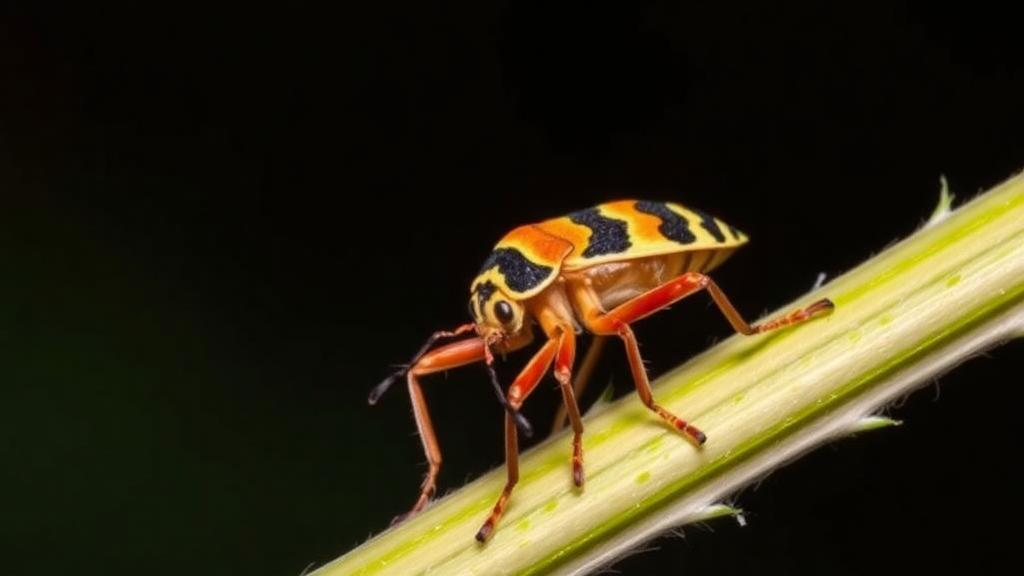
In the dense tropical forests of Africa, a small group of plant bugs has quietly gone unnoticed for nearly half a century. Now, a comprehensive taxonomic revision published in the Deutsche Entomologische Zeitschrift has brought the genus Kunungua back into the spotlight, describing three brand-new species and reshaping our understanding of this enigmatic lineage. The study, led by researchers examining roughly 350 specimens from museum collections across the globe, offers the first detailed look at these insects since their initial description in 1951.
Kunungua belongs to the plant bug family Miridae, one of the largest families of true bugs, and more specifically to the subfamily Bryocorinae, a principally tropical group comprising more than 1,000 species assigned to approximately 200 genera. Within this subfamily, the tribe Eccritotarsini accounts for more than 60 percent of all described bryocorine species. While the majority of eccritotarsine taxa are confined to the New World, existing data suggest an Oriental origin for the clade, with representatives spreading from the southern part of North America and the Neotropics to the Philippines, New Guinea, and northern Australia.
The researchers identified a distinctive lineage within Eccritotarsini, which they refer to as the Prodromus group of genera. This group is characterised by a unique modification of the male genitalia, specifically the aedeagus, which takes the form of a simple sclerotised tubule. In these bugs, the outer section of the aedeagus, known as the phallotheca, and the inner section, the endosoma, lack a clear demarcation. While in other bugs the endosoma is membranous and eversible, in the Prodromus complex it remains consistently everted and sclerotised. The ductus seminis in this group remains entirely membranous and terminates with a secondary gonopore that lacks ornamentation. Some members of this group also exhibit small, non-retractable membranous lobes at the apex of the aedeagus.
Beyond these genitalic features, taxa belonging to the Prodromus group typically display substylate eyes, a deeply punctate pronotum, a generally elongated body with long and comparatively thin legs, and a broad head in dorsal view. The group comprises seventeen genera, including Ambunticoris, Duducoris, Ernestinus, Frontimiris, Grossicoris, Kunungua, Myiocapsus, Namyatovia, Prodromus, Sinervus, Sinervaspartus, Spartacus, Stenopterocorisca, Stonedahlia, Stylopomiris, Taricoris, Thaumastomiris, and Zikaniola. Three genera from this group, Duducoris, Kunungua, and Prodromus, are known to inhabit the Ethiopian Region, with Duducoris and Kunungua restricted to this region while Prodromus has a more widespread distribution that includes the Oriental Region.
Kunungua was established by Carvalho in 1951 to comprise two African species with a wide head and stylate eyes, namely K. boxi from Ghana, the type species of the genus, and K. cinnamomea from Congo. Since then, two more species had been described, K. ukerewensis from Tanganyika and K. pallida from Sudan, but no new information regarding the genus had been published in nearly fifty years. The current revision redescribes all known Kunungua species and adds three new ones: K. atramentomaculata, K. gemina, and K. ornata. A notable feature for distinguishing Kunungua species is their specific colour patterns with distinct bands, while the shape of the parameres plays a crucial role in separating species that may appear superficially similar.
The revised diagnosis of Kunungua reveals a suite of characters that set it apart from related genera. The head is hammer-shaped, only 0.2 to 0.4 times as long as wide, with a longitudinally sulcate vertex and distinctly pedunculate eyes. The collar and pronotal disk are deeply punctate, with dense punctures whose spacing is smaller than the puncture diameter. The calli are prominently raised and divided by a deep longitudinal depression, while the scutellum is very small, only about 0.3 times as wide and 0.3 to 0.4 times as long as the pronotum, and strongly pointed at the apex. The membrane has a thick vein with an acute apical angle, and the membranal cell nearly reaches the apex of the cuneus. Total body length ranges from 3.5 to 4.3 millimetres, with the body elongate at 3.4 to 4.1 times as long as the width of the pronotum.
While working on the updated diagnosis, the researchers conducted a thorough morphological analysis to distinguish Kunungua from its two closest relatives, Prodromus and Duducoris. Their results confirmed that Kunungua warranted recognition as a separate genus, but revealed no distinct differences between Duducoris and Prodromus. Odhiambo had originally described Duducoris in 1962 to accommodate three newly described species from Uganda, differentiating it by a more flattened body, a non-sulcate vertex, eyes only weakly projecting above the vertex, a relatively short narrowed basal part of the antennal segment, weakly raised calli, a pronotum deeply emarginated posteriorly, and shorter legs. However, after examining specimens of various species within both genera, the researchers found that characters such as pronotal convexity, clypeal swelling, the length of the thin basal part of antennal segment I, eye shape, and the degree of posterior pronotal emargination all varied continuously across species of both genera. The species P. ibbaicus and P. kawandanus, for instance, exhibit characters traditionally considered typical for Duducoris, including weakly elevated eyes, a moderately convex frons, a distinctly swollen anteclypeus, and a flattened pronotal disk. The researchers concluded that Duducoris represents a specific form of the highly polymorphic genus Prodromus and synonymised the two, resulting in new combinations for the five species previously contained in the subsumed genus.
With the synonymy established, Prodromus is redefined to contain 31 species distributed across the Paleotropical region. Host plant associations remain poorly known for most members, though P. clypeatus and P. oculatus have been reported to feed on banana, while P. melanonotus and P. thaliae have been documented as inhabitants of Marantochloa and Thalia, members of the Marantaceae family. The only known host for a Kunungua species is Aframomum, a member of the Zingiberaceae, on which the type species K. boxi was collected in Ghana.
Within Kunungua itself, the researchers recognised two species groups based on external characters, particularly colouration. The first comprises K. boxi and K. cinnamomea, which share brown hemelytra, a fuscous membrane, a distinctly swollen clypeus and frons, an extremely short labium reaching only the procoxa, a reddish and comparatively short antennal segment I, a short eye peduncle, and a cinnamon-coloured pronotum. The second group includes the remaining species, characterised by yellowish white hemelytra with specific brownish bands, an antennal segment I that gradually darkens from pale yellow to brown, a transparent membrane, strongly pedunculate eyes, a slightly swollen frons, a labium reaching approximately the middle of the mesothorax, and a distinctly curved distal membranal vein forming a right angle. Interestingly, K. cinnamomea appears to be the only species possessing denticles on the apex of the right paramere, though the poor quality of existing illustrations for K. boxi prevents any conclusions about that species.
The three new species are distinguished primarily by their colour patterns and genitalic structures. Kunungua atramentomaculata, known from two females collected in Haut Uelé in the Democratic Republic of the Congo, bears a brown transverse band on the corium that blurs distally like an ink spot, giving the species its name. Kunungua gemina, described from multiple specimens in Upemba National Park, resembles the dark form of K. ukerewensis in general appearance but differs in having a needle-shaped apex of the right paramere, a pale yellow apically darkened antennal segment I, and a dark brown collar. Kunungua ornata, known from two males in the Congo, displays a wide oblique brown band along the cuneal fracture that gradually narrows towards the costal margin, a feature absent in all congeners. The researchers also excluded K. pallida from Kunungua, finding that this pale greenish yellow species from Sudan possesses sessile eyes, weakly raised calli, a long labium reaching the mesocoxa, and a strongly angulate membranal vein, characters atypical for the genus. With no suitable eccritotarsine genus available to receive it, K. pallida is now treated as a species of uncertain generic placement, pending the discovery of male specimens that would allow proper genitalic comparison.
Subject of Research: Taxonomy and Biodiversity
Article Title: Revision of the genus Kunungua ( Hemiptera , Heteroptera , Miridae ) with descriptions of three new species and new generic synonymy
Article References: Bolshakova, D. S., & Konstantinov, F. V. (2024). Revision of the genus Kunungua (Hemiptera, Heteroptera, Miridae) with descriptions of three new species and new generic synonymy. Deutsche Entomologische Zeitschrift, 71(1), 219-239. https://doi.org/10.3897/dez.71.122735
Image Credits: AI Generated
Keywords: Kunungua, Miridae, plant bugs, taxonomy, new species, Hemiptera, Heteroptera, Eccritotarsini, Prodromus, African entomology, Revision, genus
News Source: Gavin Prescott. (October 19, 2026). African plant bug genus Kunungua gains three new species in half-century taxonomic overhaul. Scienmag.