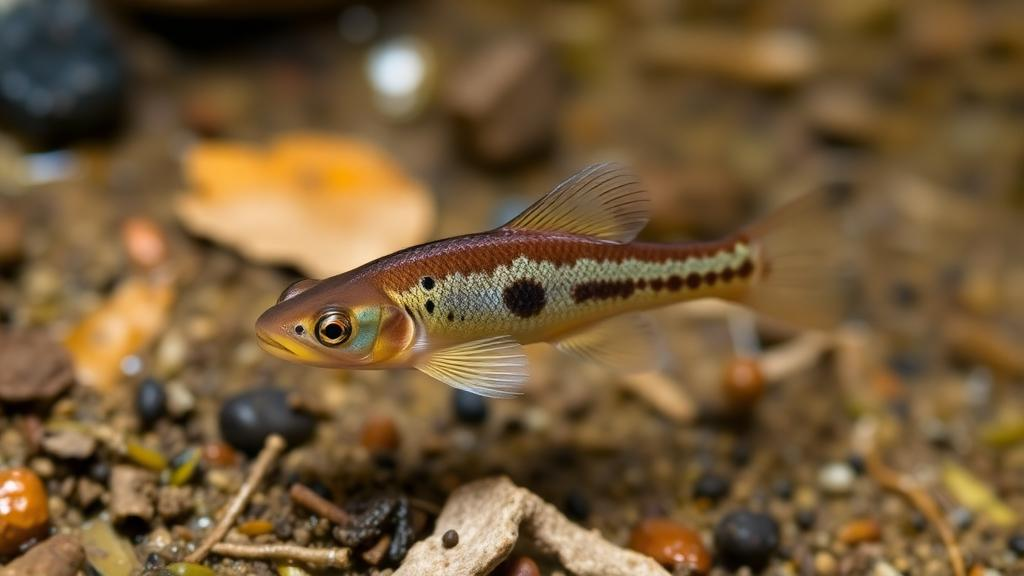
Deep in the Dayao Mountains of Guangxi, southern China, a small brown fish has been hiding in plain sight for two decades. Specimens first collected in 2005 from a rocky streamlet near Fenzhan Village in Jinxiu County were labeled as the flat-headed loach Oreonectes platycephalus, a species described as far back as 1868. A new study, published in the journal Zoosystematics and Evolution, shows that those fish, together with fresh samples gathered in 2024 and 2025, actually belong to an entirely undescribed species. The team has formally named it Oreonectes jinxiuensis, after Jinxiu Town, the type locality where every known specimen was collected.
The discovery matters because the genus Oreonectes is undergoing a quiet taxonomic revolution. Only a few years ago the genus contained a handful of species confined to cold, fast-flowing headwaters in Guangxi, Guangdong, Hong Kong, and northern Vietnam. With the addition of O. jinxiuensis, thirteen valid species are now recognized, ten of them from Guangxi alone, and most described within just the past two years. Scientists suspect that many more cryptic species remain concealed within what has long been treated as a single, widespread species, making karst streams in southern China one of the least appreciated hotspots of freshwater fish diversity in Asia.
The difficulty is that loaches of this genus are morphologically conservative. They share a depressed head, a compressed cylindrical body, adjacent anterior and posterior nostrils with a tube-like base and a whisker-like tip, and a rounded or truncated caudal fin. In the field, even experienced ichthyologists struggle to separate species that differ only in fin-ray counts, gill-raker numbers, or subtle proportional measurements. That conservatism explains why the Jinxiu fish sat unexamined in museum cabinets and the literature for so long: its cataloged identity, O. platycephalus, seemed unremarkable because that name had been applied loosely to specimens across Guangxi for decades, even though the true type locality of O. platycephalus lies in Hong Kong.
To resolve the question, the researchers combined traditional anatomy with molecular phylogenetics. Specimens were fixed in formalin, transferred to ethanol, and deposited in the Kunming Natural History Museum of Zoology at the Kunming Institute of Zoology, Chinese Academy of Sciences. The holotype, a 48.9 millimeter female, was collected on 15 October 2005 from the Liujiang River system of the Pearl River basin, along with paratypes ranging from 40.1 to 55.2 millimeters in standard length. Measurements were taken point-to-point with vernier calipers accurate to 0.1 millimeter, and fin rays were counted under a microscope following established protocols, with the last two rays sharing a single pterygiophore counted as one.
The anatomical diagnosis is distinctive. Oreonectes jinxiuensis possesses a degenerated swim bladder whose posterior chamber is reduced to roughly 1.6 times eye diameter, connected to the anterior chamber by a short tube less than half the length of that chamber. Its anterior and posterior nostrils sit adjacent to each other, and the first gill arch carries 13 inner gill rakers, a count unmatched among its relatives. The dorsal-fin origin lies clearly behind the pelvic-fin origin, the pectoral fin bears 10 branched rays, the caudal fin 14 to 15 branched rays, and the preanal length measures 73.7 to 77.3 percent of standard length. Live fish are yellowish-brown with a striking black longitudinal stripe along the lateral line, a pigment pattern absent in true O. platycephalus.
Genetic evidence clinched the case. The team sequenced two mitochondrial markers, cytochrome c oxidase subunit I (COI) and cytochrome b (Cyt b), from the new specimens and combined them with additional sequences downloaded from GenBank. Using Bayesian inference in MrBayes, with the optimal substitution model GTR+I+G selected by PartitionFinder, they reconstructed a phylogeny in which the genus Oreonectes forms a monophyletic group sister to a clade containing the genera Guinemachilus and Micronemacheilus. Within that tree, O. jinxiuensis emerged as a highly supported clade, with Bayesian posterior probabilities of at least 0.95, grouping with its closest relatives O. guilinensis and O. platycephalus while remaining clearly distinct from both.
The genetic distances are striking for animals that look so similar. Uncorrected p-distances based on the concatenated COI and Cyt b dataset range from 4.1 percent between the new species and O. guilinensis to 10.6 percent versus O. guananensis. Even against its phylogenetically closest relative O. platycephalus, the divergence reaches 7.8 percent, far exceeding the differences between many already recognized species pairs in the genus, such as the 4.4 percent separating O. damingshanensis from O. zhangi. These values mirror the species-level divergences documented across other Oreonectes lineages, providing independent molecular confirmation that the Jinxiu fish is not a geographic variant but a separate evolutionary lineage.
Morphometric statistics told the same story. A principal component analysis comparing the new species with O. guilinensis and O. platycephalus extracted two components accounting together for about 64 percent of the variance, the first driven largely by predorsal length, pelvic and pectoral-fin length, caudal-peduncle length, and interorbital width, the second by standard length and preanal and preanus lengths. In the resulting scatter plots the three species occupy distinct regions of morphospace. The new species differs from O. guilinensis in its degenerated versus developed swim bladder, its 8 to 16 lateral-line pores versus only 4 to 6, and a suite of proportional measurements, and from O. platycephalus in dorsal-fin ray counts, pelvic-fin rays, head length, and body width.
Oreonectes jinxiuensis is currently known only from Jinxiu Town in Laibin City, and possibly from Xiuren Town in Lipu City, both within the Liujiang River system of the Pearl River basin in the Dayao Mountains. There it inhabits shallow streamlets roughly half a meter deep, rich in rocks and aquatic macrophytes, alongside other fish such as Acrossocheilus parallens, Rhinogobius giurinus, and Opsariichthys bidens. Mature males can be recognized by a genital papilla immediately behind the anus, a fleshy prominence lacking in females, a modest but useful sexual dimorphism for identifying living specimens.
The authors argue that the complex karst landscape of Guangxi, with its labyrinthine underground rivers interlinked with surface waters, has repeatedly fragmented and reconnected fish populations, driving the dispersal and diversification that produced so many localized species. Because earlier surveys routinely misidentified such fish as O. platycephalus, the researchers warn that additional records across southern China may conceal further new species awaiting recognition. Notably, a mitochondrial sequence from Lipu City previously deposited in GenBank as O. platycephalus clustered separately from all verified samples of that species, suggesting its identification is unreliable and its true status requires re-examination. The team concludes that only the combination of careful morphology and molecular data can untangle the true diversity of this highly conserved genus, and that China’s karst headwaters almost certainly hold more surprises of this kind.
Subject of Research: Taxonomic description of a new cave and stream loach species, Oreonectes jinxiuensis, from Guangxi, China, using morphology and mitochondrial DNA
Article Title: Description of a new species of Oreonectes ( Cypriniformes , Nemacheilidae ) from Guangxi, China
Article References: Chen, Z.-N., Huang, S.-R., Zou, T.-X., Du, L.-N., & Lin, F. (2026). Description of a new species of Oreonectes (Cypriniformes, Nemacheilidae) from Guangxi, China. Zoosystematics and Evolution, 102(1), 119-130. https://doi.org/10.3897/zse.102.172439
Image Credits: AI Generated
Keywords: Oreonectes jinxiuensis, new species, loach, Nemacheilidae, Guangxi, karst, mitochondrial DNA, phylogenetics, taxonomy, freshwater fish, China, biodiversity
News Source: Margaret Porter. (October 19, 2026). Hidden New Loach Species Discovered in China’s Karst Mountain Streams. Scienmag.