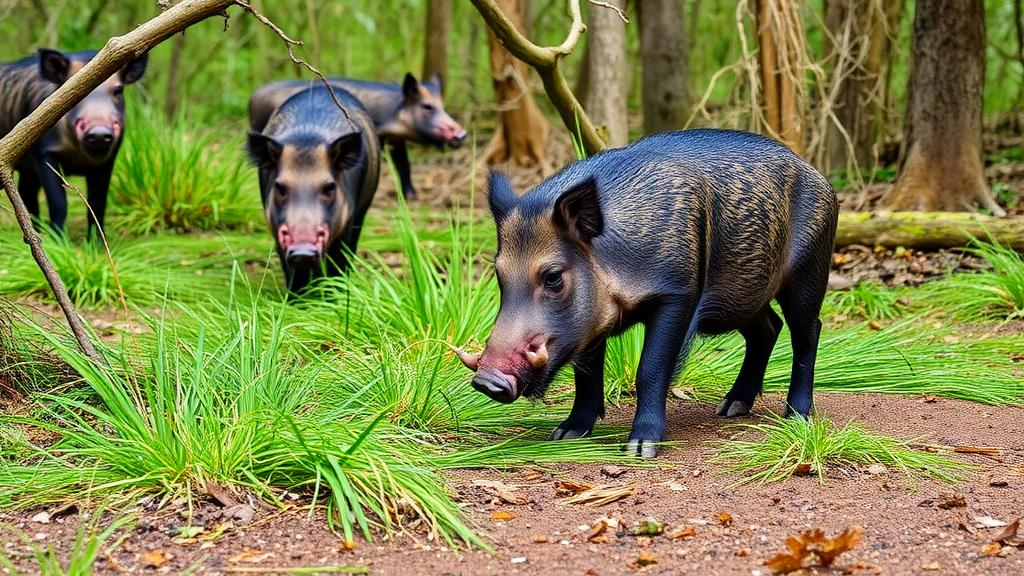
In the rolling forests and grasslands of southern Brazil, an ecological invader is quietly tightening its grip. The wild boar, Sus scrofa, one of the world’s most widely distributed invasive mammals, has now been confirmed in more than a quarter of the region’s protected areas, yet fewer than half of the sites where it occurs are doing anything to control it. A new survey of park managers across the states of Rio Grande do Sul, Santa Catarina and Paraná reveals a conservation system that knows the threat is real but lacks the people, protocols and coordination to confront it effectively. The findings, published in the journal Neotropical Biology and Conservation, offer one of the most detailed diagnoses to date of how a notoriously destructive invader is being handled inside the very places designed to shield biodiversity from such pressures.
The research team compiled a list of 701 protected areas across Brazil’s southern region, an expanse of roughly 576,774 square kilometers spanning two biomes: Tropical and Subtropical Moist Broadleaf Forests, and Tropical and Subtropical Grasslands, Savannas and Shrublands. After excluding marine sites, the researchers sent an online questionnaire to 297 areas and received completed responses from 129, covering federal, state and municipal spheres. The survey, structured on the REDCap platform, asked managers about wild boar occurrence, perceived impacts, control techniques, and the reasons behind decisions to manage or not to manage. Responses were analyzed with descriptive statistics, and open-ended answers were grouped through discourse analysis into meaningful categories.
The results paint a sobering picture. Wild boars were reported present in 36 of the 129 responding protected areas, or 27.9 percent, including 26 strictly protected areas and ten sustainable use areas. The first sightings within the region’s parks date to 2005, with detections continuing steadily through 2020. The earliest records clustered in the forest biome, and the grasslands saw their first confirmed presence only in 2007. In Rio Grande do Sul, the invasion advanced rapidly between 2005 and 2008, then settled into a pattern of one or two new detections per year, peaking at four records in 2015. Notably, the first detections tended to occur in federal areas before spreading to state and municipal sites, possibly because larger federal parks are more prone to colonization while smaller municipal reserves, often near urban zones, are avoided by boars wary of human presence.
Yet presence does not equal action. Of the 36 areas reporting wild boars, only 14 were carrying out any management at all, meaning roughly two-thirds of invaded sites were doing nothing. When managers were asked to rate, on a scale from 0 to 100 percent, how much the wild boar contributed to negative effects within their area compared with all other drivers, a striking divide emerged. Managers who ran control campaigns assigned the boar an average responsibility of 59.4 percent, while those who did not manage the species gave it just 28.9 percent. The same pattern held when the boar was compared only with other invasive species: 62.6 percent versus 40.7 percent. Perception, in other words, tracks action rather than the reverse, suggesting that the decision to manage reflects how seriously the threat is weighed against other demands on limited resources.
The reasons for inaction fell into two broad groups. The first, labeled low invasion intensity, covered justifications such as the low number of recorded individuals, few observed effects, recent arrival, or the simple judgment that control was not a priority. Sixteen of the 22 non-managing areas cited reasons in this group, with the low number of individuals being the single most prevalent answer, reported by 12 areas and standing alone as the sole justification for nine of them. The second group, management capacity, encompassed the lack of technical teams or equipment, absence of formal protocols, bureaucratic hurdles, conflicts of interest with surrounding communities, and management plans still in preparation. Nine areas cited capacity limits, with the lack of a technical team or structure reported seven times and serving as the only reason for three of them.
That second justification is particularly troubling to the study’s authors, who see it as compelling evidence for a coordinated, multijurisdictional management program. Brazil’s protected areas, they note, are chronically underfinanced and underequipped, and recent years have seen environmental policies further weakened. The researchers argue that sharing equipment such as corrals and cages between nearby parks could stretch scarce resources, especially since wild boars learn to avoid traps, requiring spatial and temporal rotation of capture sites. Exchanging experience between managers, rangers and partner communities would similarly boost efficiency by spreading knowledge of what worked and what failed at each site.
Where management does occur, the techniques follow global standards. Cage traps were the most common tool, used in 64.3 percent of managing areas, followed by corrals, which allow the capture of an entire sounder at once, a desirable outcome in population control. Hunting without dogs was the most frequently reported active technique, intended to remove animals that have learned to avoid traps, though the authors stress it has low standalone effectiveness and should complement trapping rather than replace it. Hunting with dogs, a mainstay on rural properties in Brazil, was reported by only two protected areas. Corn proved the universal bait, whether dry, fermented, on the cob or salted, typically placed at the entrance and center of traps one to seven days before captures began or offered continuously. On average, 3.5 cages were deployed per area, though strictly protected areas averaged 2.2 while sustainable use areas averaged 5.6. Cage sizes ranged from two to 32 cubic meters, averaging nine.
The study also flags a dangerous misconception embedded in the low-invasion-intensity justification. There is accumulating evidence, the authors emphasize, that the earliest stages of an invasion offer the best window for effective control or even local eradication. Most areas citing low numbers had first recorded wild boars after 2015, in contrast to managing areas where the first record preceded 2011. Far from signaling safety, the authors warn, these sparse detections may indicate populations still expanding, poised to become far harder and costlier to contain in the future. Waiting for the problem to grow before acting, they argue, squanders the cheapest opportunity to solve it.
Complicating matters further is Brazil’s fraught relationship with hunting. The country’s long-standing ban on hunting, especially within protected areas, has generated a culture of conflict in which park staff spend resources preventing hunters from entering reserves to kill protected animals or collect endangered plants. The wild boar, however, is the only animal for which hunting is legally permitted in Brazil, a situation the authors say demands a change in the history of fighting hunting. Protected areas lack the human resources to handle control alone, yet decades of mistrust make partnership with hunters difficult. Carcass disposal adds another layer of complexity: some parks donate carcasses to partner controllers, a practice technically vetoed by the environmental agency except when zoonosis tests are performed, and consumption of game meat is not recommended for lack of health controls. Disease monitoring, meanwhile, is carried out by only five of the 14 managing areas, despite the wild boar being a known reservoir of multiple farm animal and human pathogens.
The authors conclude that management campaigns, where they exist, are irregular in effort, timing and spatial distribution, reflecting the absence of adaptive management plans with well-defined objectives. Some parks run continuous campaigns throughout the year; others act only punctually. Neither approach, they caution, is effective for genuine population control without organization and sustained resources. They advocate centralizing management coordination at the national sphere while downgrading operational planning to the state scale, where many problems actually reside and where agencies are at different stages of the invasion process. Recognizing smaller municipal and private reserves within multijurisdictional action plans, they add, could extend protection to the sites least represented in the survey. Without such coordinated measures, they warn, the ecosystems and vulnerable species sheltered in Brazil’s southern protected areas face a future in which one of the world’s most successful invaders continues to reshape landscapes largely unopposed.
Subject of Research: Invasive wild boar management in southern Brazil's protected areas
Article Title: Managing invasive wild boars in Southern Brazil’s protected areas: Challenges and strategies
Article References: Etges, M. F., Guadagnin, D. L., & Kindel, A. (2023). Managing invasive wild boars in Southern Brazil’s protected areas: Challenges and strategies. Neotropical Biology and Conservation, 18(4), 231-250. https://doi.org/10.3897/neotropical.18.e110008
Image Credits: AI Generated
DOI: 10.3897/neotropical.18.e110008
Keywords: invasive species, wild boar, protected areas, Brazil, biodiversity conservation, Sus scrofa, biological invasions, wildlife management, Neotropical Biology and Conservation, Managing, invasive, wild
News Source: Margaret Porter. (October 19, 2026). Invasive Wild Boars Overrun Southern Brazil’s Protected Areas as Managers Struggle to Respond. Scienmag.