


Japanese researchers reveal two enzymes responsible for inducing lean and obese states
Credit: Professor Mitsuyoshi Nakao
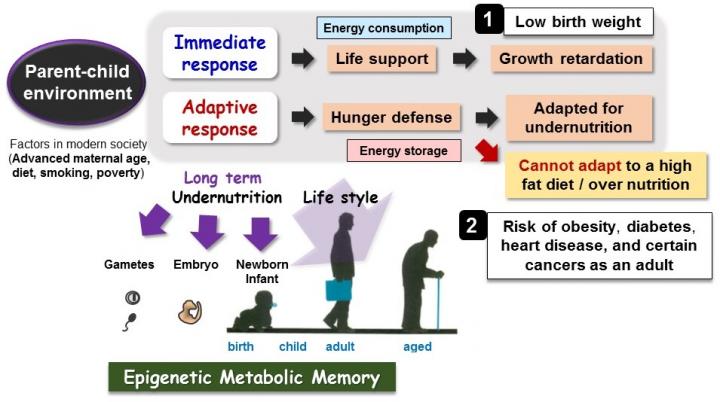
The Developmental Origins of Health and Disease (DOHaD) hypothesis is supported by multiple human epidemiological studies and animal studies. It states that the nutritional environment in early life makes people susceptible to lifestyle-related diseases, such as obesity, diabetes and heart attack, as adults. Many of those diseases exhibit reduced mitochondrial metabolism in the tissues of the body. Now, researchers from Kumamoto University in Japan reveal that two metabolic pathways involved in energy metabolism may play a role in the DOHaD hypothesis.
All cells regulate gene expression related to metabolic pathways, and adapt to environmental changes such as fluctuations in nutrition, oxygen supply, exercise, and temperature. Cells in the human body use two types of cellular metabolism, mitochondrial respiration and glycolysis. Mitochondrial respiration produces energy for the cell when oxygen is supplied (aerobic), and glycolysis is used when oxygen is scarce (anaerobic). The activity of metabolic genes changes significantly as the method of energy production shifts between these two mechanisms. Some of the most critical changes are due to histone acetylation and methylation (the addition/removal of acetyl and methyl groups) of lysine amino acids. The enzymes deacetylase SIRT1 and demethylase LSD1 are especially important in the regulation of metabolic genes because they remove the acetyl and methyl groups, respectively, of target proteins.
Two metabolic pathways, NAD+ -SIRT1 and FAD-LSD1, regulate the function of specific gene sets, and transmit nutrient signals. Recently, Kumamoto University researchers revealed that these two pathways are controlled by dietary vitamins and nutritional hormones, induce metabolic activity, and develop tissue-specific properties in fat and skeletal muscle cells. They found that FAD-LSD1 pathway represses mitochondrial metabolism and induces fat accumulation under obese condition.
DOHaD theorizes that people affected by malnutrition during early development may have a low birth weight and an increased risk of lifestyle-related diseases as adults. Although the mechanisms behind this have not been clarified, the researchers think that at least two responses work at different times. The immediate response consumes stored energy and prioritizes maintaining life, and the adaptive response “programs” the body to store energy in anticipation of future bouts of starvation. This is considered a natural survival strategy for nascent undernutrition. An adaptive response can easily adjust to undernutrition, but it makes a person more susceptible to lifestyle-related diseases, such as obesity and diabetes, under an excess of nutrition.
The NAD+-SIRT1 pathway burns energy and the FAD-LSD1 pathway stores energy, and together they can remodel metabolic tissues. In muscle development, the SIRT and LSD1 pathways selectively promote slow and fast twitch fiber formation respectively, which increases susceptibility to lifestyle-related diseases. Thus, the researchers believe that these enzymes are involved in DOHaD mechanisms. Specifically, that SIRT1 can play a role in the immediate response and that LSD1 can be involved in the adaptive response.
Speaking about future activities, research leader Professor Mitsuyoshi Nakao said, “We hope our work will help lead to new disease control and prevention strategies by improving the understanding of lifestyle-related diseases, and the nutrition of young parents and babies during perinatal periods.”
###
This work was posted online in “Trends in Endocrinology and Metabolism” on 5 May 2019.
Source
Nakao, M. et al., 2019. Distinct Roles of the NAD+-Sirt1 and FAD-LSD1 Pathways in Metabolic Response and Tissue Development. Trends in Endocrinology & Metabolism. Available at: http://dx.
Media Contact
J. Sanderson
[email protected]
Original Source
https:/
Related Journal Article
http://dx.



