• HOME
  • NEWS
  • EXPLORE
    • CAREER
      • Companies
      • Jobs
    • EVENTS
    • iGEM
      • News
      • Team
    • PHOTOS
    • VIDEO
    • WIKI
  • BLOG
  • COMMUNITY
    • FACEBOOK
    • INSTAGRAM
    • TWITTER
Friday, June 26, 2026
BIOENGINEER.ORG
No Result
View All Result
  • Login
  • HOME
  • NEWS
  • EXPLORE
    • CAREER
      • Companies
      • Jobs
        • Lecturer
        • PhD Studentship
        • Postdoc
        • Research Assistant
    • EVENTS
    • iGEM
      • News
      • Team
    • PHOTOS
    • VIDEO
    • WIKI
  • BLOG
  • COMMUNITY
    • FACEBOOK
    • INSTAGRAM
    • TWITTER
  • HOME
  • NEWS
  • EXPLORE
    • CAREER
      • Companies
      • Jobs
        • Lecturer
        • PhD Studentship
        • Postdoc
        • Research Assistant
    • EVENTS
    • iGEM
      • News
      • Team
    • PHOTOS
    • VIDEO
    • WIKI
  • BLOG
  • COMMUNITY
    • FACEBOOK
    • INSTAGRAM
    • TWITTER
No Result
View All Result
Bioengineer.org
No Result
View All Result
Home NEWS Science News Chemistry

A benchmark for single-electron circuits

Bioengineer by Bioengineer
January 26, 2021
in Chemistry
Reading Time: 3 mins read
0
IMAGE
Share on FacebookShare on TwitterShare on LinkedinShare on RedditShare on Telegram

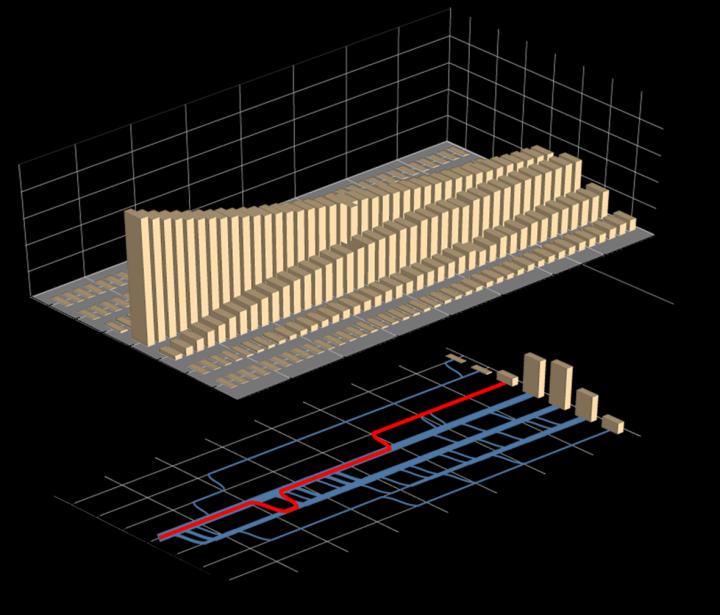
A new methodology for an abstract and universal description of the fidelity of quantum circuits
IMAGE

Credit: Ubbelohde

Manipulating individual electrons with the goal of employing quantum effects offers new possibilities and greater precision in electronics. However, these single-electron circuits are governed by the laws of quantum mechanics, meaning that deviations from error-free operation still occur – albeit (in the best possible scenario) only very rarely. Thus, insights into both the physical origin the and metrological aspects of this fundamental uncertainty are crucial for the further development of quantum circuitry. To this end, scientists from PTB and the University of Latvia have collaborated to develop a statistical testing methodology. Their results have been published in the journal Nature Communications.

Single-electron circuits are already used as electric-current quantum standards and in quantum-computer prototypes. In these miniaturized quantum circuits, interactions and noise impede the investigation of the fundamental uncertainties and measuring them is a challenge, even for the metrological precision of the measurement apparatus.

In the field of quantum computers, a testing procedure also referred to as a “benchmark” is frequently used in which the operating principle and fidelity of the entire circuit are evaluated via the accumulation of errors following a sequence of operations. Based on this principle, researchers from PTB and the University of Latvia have now developed a benchmark for single-electron circuits. Here, the circuit’s fidelity is described by the random steps of an error signal recorded by an integrated sensor while the circuit repeatedly executes an operation. The statistical analysis of this “random walk” can be used to identify the rare but unavoidable errors when individual quantum particles are manipulated.

By means of this “random-walk benchmark”, the transfer of individual electrons was investigated in a circuit consisting of single-electron pumps developed at PTB as primary standards for realizing the ampere, an SI base unit. In this experiment, sensitive detectors record the error signal with single-electron resolution. The statistical analysis made possible by counting individual particles not only shows fundamental limitations of the circuit’s fidelity induced by external noise and temporal correlations but also provides a robust measure of assessing errors in applied quantum metrology.

The methodology developed within the scope of this work provides a rigorous mathematical foundation for validating quantum standards of electrical quantities and opens new paths for the development of integrated complex quantum systems.

###

Original scientific publication

D. Reifert, M. Kokainis, A. Ambainis et al.: A random-walk benchmark for single-electron circuits. Nat Commun 12, 285 (2021), https://doi.org/10.1038/s41467-020-20554-w

Media Contact
Dr. Niels Ubbelohde
[email protected]

Original Source

https://www.ptb.de/cms/en/presseaktuelles/journalisten/news-press-releases/press-release.html?tx_news_pi1%5Bnews%5D=10802&tx_news_pi1%5Bcontroller%5D=News&tx_news_pi1%5Baction%5D=detail&tx_news_pi1%5Bday%5D=26&tx_news_pi1%5Bmonth%5D=1&tx_news_pi1%5By

Related Journal Article

http://dx.doi.org/10.1038/s41467-020-20554-w

Tags: Chemistry/Physics/Materials SciencesElectromagneticsSuperconductors/Semiconductors
Share12Tweet8Share2ShareShareShare2

Related Posts

AI and Physics Collaborate to Design Advanced Hydrogen Storage Materials

June 25, 2026

International Team Including Dresden Scientists Develops Novel Designer Proteins for Advanced Study of Living Tissue

June 25, 2026

New Study Uncovers Key Factors Driving Water Chemistry in Nanoscale Environments

June 25, 2026

Plasma Technology Extends Catalyst Lifespan in Hydrogen Production

June 24, 2026
Please login to join discussion

POPULAR NEWS

  • Saying Goodbye to PGY-6: Pediatric Fellowship Realities

    103 shares
    Share 41 Tweet 26
  • Multi-Hospital Study Reveals Long Covid Burden Is Twice as High as Current Estimates

    92 shares
    Share 36 Tweet 23
  • Detection of EDCs in Breast Milk and Infant Urine Up to Six Months Highlights Early Exposure Risks

    77 shares
    Share 31 Tweet 19
  • New Drug Candidate Developed at McMaster Shows Potential for Treating Brain Cancer

    58 shares
    Share 23 Tweet 15

About

We bring you the latest biotechnology news from best research centers and universities around the world. Check our website.

Follow us

Recent News

Tracking Lanthanide-Labeled Microplastics in Plants

POSTECH Researchers Slash Cost of Reconstituted Cell-Free Systems by 95%

AI and Physics Collaborate to Design Advanced Hydrogen Storage Materials

Subscribe to Blog via Email

Success! An email was just sent to confirm your subscription. Please find the email now and click 'Confirm' to start subscribing.

Join 82 other subscribers
  • Contact Us

Bioengineer.org © Copyright 2023 All Rights Reserved.

Welcome Back!

Login to your account below

Forgotten Password?

Retrieve your password

Please enter your username or email address to reset your password.

Log In
No Result
View All Result
  • Homepages
    • Home Page 1
    • Home Page 2
  • News
  • National
  • Business
  • Health
  • Lifestyle
  • Science

Bioengineer.org © Copyright 2023 All Rights Reserved.