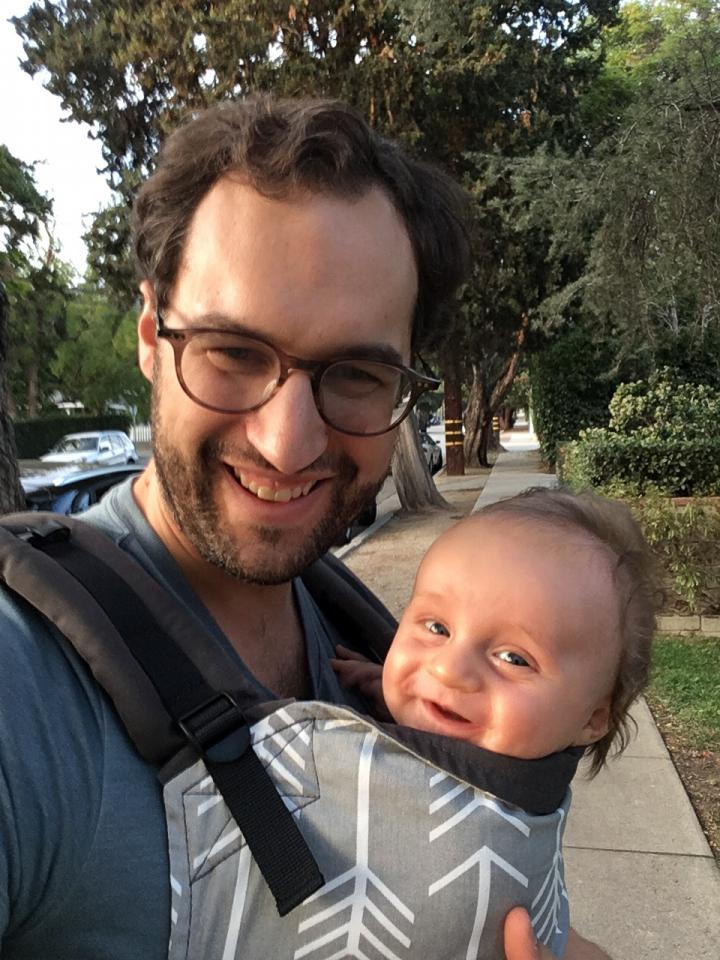
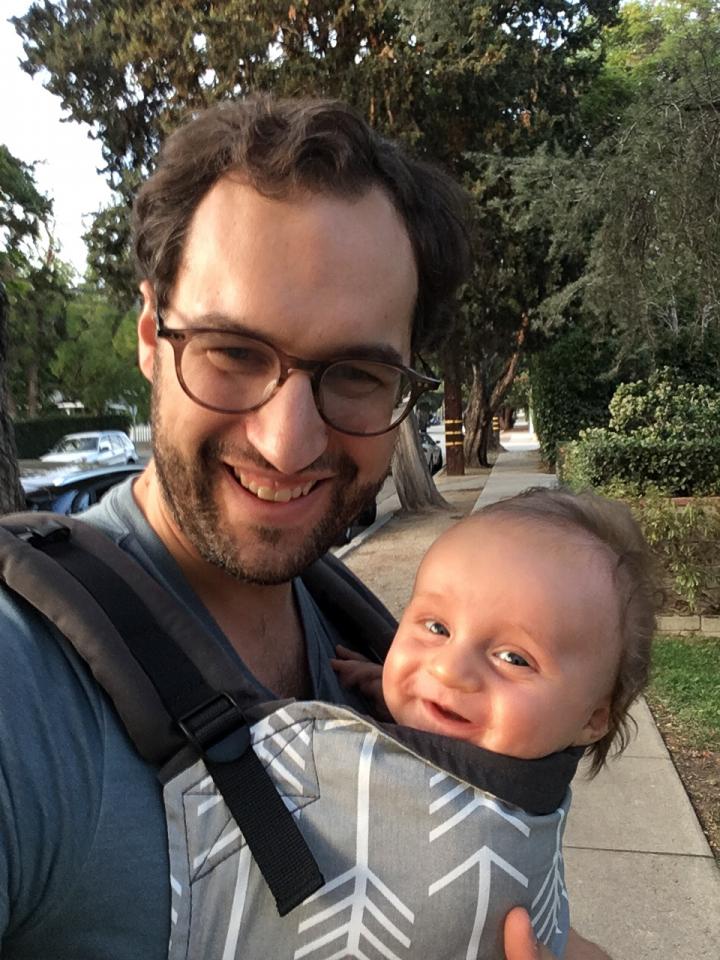
Credit: J. Franchak, UC Riverside.
RIVERSIDE, Calif. – A developmental psychologist at the University of California, Riverside, has completed a study that is the first to measure how often infants spend time in different body positions over the first year of life.
The study, published in the journal Infancy, aims to understand how the physical context of infants' everyday experiences – in particular, how much time they spend in different body positions – changes over the course of the first year and how these changes are predicted by infants' developing motor skills.
"I was surprised to find that 3-month-olds are held almost half of their waking days" said John Franchak, an assistant professor of psychology, who performed the study. "Twelve-month-olds are held much less frequently and spend most of their time on the ground. How often infants play, crawl, walk, or sit changes how they interact with objects and changes, too, the physical way in which they interact with other people."
Specifically, Franchak found that sitting, upright, and prone (belly towards the ground regardless of contact with the ground) accounted for less than 7 percent of the 3-month-old infant's day. By 12 months, these positions accounted for 62 percent of the infant's day.
The cross-sectional study sought to understand what a 12-month-old learns and how this learning differs from that of, say, a 3-month-old infant, based on their everyday experiences. Toward that end, the study tested separate groups of 3-month-olds, 6-month-olds, 9-month-olds, and babies that were a year old. It used data acquired for 95 babies from across the United States.
The study used an innovative approach to acquire this data: the infants' caregivers were sent text messages five times a day for a week to inquire on what the baby was doing at that moment. The caregivers electronically reported infant body positions immediately thereafter in brief one-minute surveys. They also reported infants' location – whether the infants were on the floor or up on a raised surface – and the onset of sitting, crawling, and walking. The study is the first to use this method, called ecological momentary assessment, to measure infants' behaviors.
"We have plenty of data on what babies do in the lab, where we measure their development by doing some assigned task," Franchak said. "What we don't know is what drives that development, what happens in the days, hours, and minutes they are at home, where they experience a number of things that lets them learn. Until this study, we didn't know how often babies sit, crawl, and stand in everyday life, outside the lab. The ecological momentary assessment the study used offers a better sense of infants' actual lives versus a slice of life in the lab, and gives a more realistic distribution of their different types of body positions and experiences. Understanding these differences allows us to build better theories about how infants develop and learn from the world."
Franchak explained that body positions change dramatically over the first year of life, and much of that change results from infants acquiring new motor skills. Typically, babies begin to sit around 6 months of age, crawl at around 8 months, stand around 11 months, and walk when they are a year old. It is important to study infant body position, he said, because changes in how babies interact with the world change their opportunities for learning. Learning to sit is linked with better object perception. Learning to walk is linked with improved language ability.
"The amount of time infants spend in different positions shapes their visual and manual activity – impacting perceptual, cognitive, and social development – and reflects opportunities to practice and develop motor skills," Franchak said. "For example, infants rarely see faces while playing on the ground in sitting, upright, and prone positions, but see faces more often when held or sitting off the ground as in a high chair.
"Further, infants who can sit independently at 6 months spend more time sitting in daily life. This allows them to manipulate objects more frequently and receive nearly twice as much opportunity to experience the richer visual-manual exploration of objects than prone or supine infants," he added. "Learning to walk changes social interactions with caregivers and predicts improvement in infants' spatial cognition."
Franchak cautioned that caregivers play an important role in influencing the study's results. The study's youngest infants are entirely dependent on caregivers to change their body position. For older infants, choosing to sit or stand is often an option only if their caregivers provide the opportunity.
"I can't say enough about how much caregivers are doing in determining what positions their babies are in," he said. "Caregivers act in response to how they perceive their children. When they see their babies have acquired certain skills, they take action accordingly to accommodate these skills. Caregivers and their babies then negotiate constantly on how best to proceed thereafter."
###
The study, titled "Changing opportunities for learning in everyday life: Infant body position over the first year," was supported by UCR through a Regents Faculty Fellowship to Franchak.
The University of California, Riverside is a doctoral research university, a living laboratory for groundbreaking exploration of issues critical to Inland Southern California, the state and communities around the world. Reflecting California's diverse culture, UCR's enrollment is now nearly 23,000 students. The campus opened a medical school in 2013 and has reached the heart of the Coachella Valley by way of the UCR Palm Desert Center. The campus has an annual statewide economic impact of more than $1 billion. To learn more, call (951) UCR-NEWS.
Media Contact
Iqbal Pittalwala
[email protected]
951-827-6050
@UCRiverside
http://www.ucr.edu