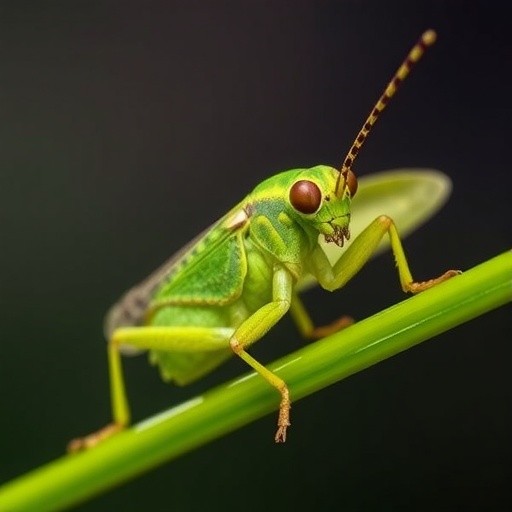
In a groundbreaking study published in the prestigious journal Proceedings of the Royal Society B, researchers from the University of St Andrews have unveiled a remarkable dual function of leaf mimicry in tropical katydids, specifically in the species Viadana brunneri. This study challenges the long-held assumption that survival adaptations and sexually selected traits inherently conflict with one another, demonstrating instead a rare synergy where a single morphological trait simultaneously enhances camouflage and acoustic signaling, thereby benefiting both survival and reproductive success.
Leaf mimicry is a fascinating example of evolutionary adaptation, primarily understood as a survival strategy where insects disguise themselves as leaves to evade predation. The katydids studied possess wings where the majority of the surface area consists of intricate “leafy” structures that visually blend into their rainforest habitat. Yet, until now, the significance of these leaf-like structures in mating communication remained largely unexplored. The latest research reveals that these same leafy extensions on the male katydid wings play a critical role in modulating and amplifying their acoustic mating calls, making these males more attractive to females.
Katydids produce their songs through a process known as stridulation, which involves rubbing specialized ridges on their forewings together. In many tropical species, the wings’ broad surfaces include leaf-like patterns that contribute aesthetically to camouflage but are also acoustically active. By conducting precise bioacoustic and biophysical experiments, the researchers demonstrated that these leafy wing portions act as natural amplifiers, vibrating sympathetically with the sounds generated by the stridulatory organs. This phenomenon enhances the sound’s resonance and modifies the pitch, effectively improving the male’s ability to broadcast their calls over the ambient noise of the rainforest.
The interplay of natural and sexual selection outlined in this research is particularly striking because it defies the classical perspective that traits favored by one form of selection often incur costs under the other. For instance, while peacock tails increase mating success due to their showy displays, they also raise predation risk due to conspicuousness. The katydid wings’ leaf mimicry, however, serves the dual purpose of enhancing concealment while boosting mating call attractiveness, merging the evolutionary interests of survival and reproduction into a unified trait.
Behavioral assays further illuminated these findings by examining female responses to male calls with and without their leafy wing structures. When males had the leafy portions of their wings experimentally removed, the characteristics of their calls altered significantly—the pitch increased and loudness diminished. Females showed a clear preference for the calls emanating from males with intact leafy wings, favoring the lower pitch and stronger amplitude. This preference implies the leaf-like structures not only camouflage but provide an acoustic advantage that improves reproductive success.
Another confounding aspect of katydid communication is the remarkably fleeting nature of female calls. In an environment saturated with competing sounds, female Viadana brunneri produce only sporadic and ultra-short signals in the ultrasonic range, spanning a mere two seconds in total across entire nights. These infrequent and high-frequency responses pose a unique challenge for males, emphasizing the evolutionary pressure on males to optimize their sound production for maximum detectability and attractiveness.
The study bridges a gap in evolutionary biology by highlighting a novel multifunctional adaptation. It underscores that complex traits can evolve through intertwined natural and sexual selection pressures to optimize multiple fitness outcomes. This discovery opens new avenues for exploring how communication signals evolve when subjected to the competing demands of predator avoidance and mate attraction. It also raises fascinating questions about the biomechanical design of insect wings and their integration into both survival and reproductive strategies.
Dr. Benito Wainwright, the lead researcher, expressed excitement over these findings, emphasizing the rarity of natural and sexual selection converging to favor the same morphological trait. His team is poised to further investigate the evolutionary history and genetic underpinnings that led to the emergence of these acoustically active leafy wings in katydids. Such studies promise to enrich our understanding of how multifunctional traits evolve and are maintained in complex ecological contexts.
The implications of this research extend beyond katydids, suggesting that multifunctionality in morphological and behavioral traits may be a more common evolutionary solution than previously appreciated. By integrating camouflage and acoustic enhancement within the same structure, these insects exemplify evolutionary ingenuity, with potential parallels in other taxa where natural and sexual selection pressures coincide.
This research also underscores the importance of interdisciplinary approaches, combining bioacoustics, behavioral experiments, and biophysical analyses to unveil the multifaceted roles of morphological traits. The detailed scrutiny of how leaf-like wing structures modulate sound waves offers novel insights into insect communication mechanics and may even inspire biomimetic applications in acoustic technology or material science.
Ultimately, this study reshapes textbook understandings of sexual and natural selection dynamics. It exemplifies the subtle complexities of evolutionary adaptations where the boundaries between survival and reproduction blur, allowing organisms like Viadana brunneri to thrive amidst the challenges of predation, environmental noise, and mate competition within the biodiverse tropical rainforests.
Subject of Research: Animals
Article Title: Naturally-selected and sexually-selected wing structures synergistically enhance attractiveness of katydid acoustic signals
News Publication Date: 3 June 2026
Web References: http://dx.doi.org/10.1098/rspb.2026.0952
Image Credits: Christian Ziegler
Keywords: Evolutionary biology, bioacoustics, sexual selection, natural selection, katydid, leaf mimicry, acoustic signaling, tropical rainforest, insect communication
Tags: acoustic signaling in insectsdual function morphological traitsevolutionary adaptation in insectsinsect acoustic communicationinsect camouflage and reproductionleaf mimicry in katydidsleaflike wing patterns in katydidsrainforest insect survival strategiessexually selected traits in katydidsstridulation in katydidstropical katydid mating callsViadana brunneri camouflage