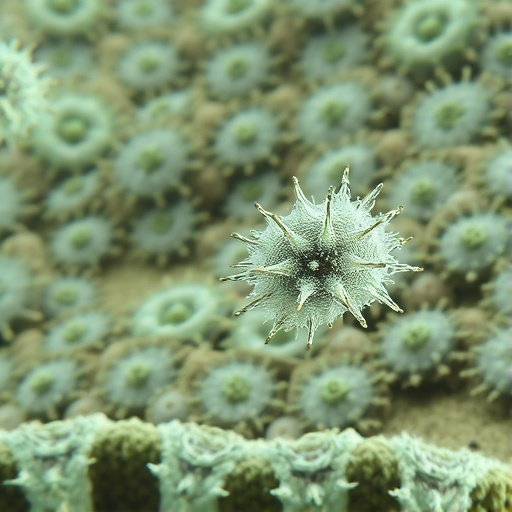
In the unforgiving landscape of the Dead Sea, where salinity exceeds 30% and temperatures fluctuate dramatically between 10 and 50 degrees Celsius, survival is a monumental challenge for almost all life forms. Yet, some organisms not only endure but thrive under these extreme conditions. Among these hardy survivors is a single-celled archaean known as Haloarcula marismortui. Recent pioneering research by an international team from the Okinawa Institute of Science and Technology (OIST) and the Institute of Protein Research of the Russian Academy of Sciences has unraveled intricate details about the structural adaptations that enable this microorganism to navigate its hostile environment.
Powered by the cutting-edge technique of single-particle cryo-electron microscopy (cryo-EM), the team meticulously visualized the proteins constituting the archaeal filament, or archaellum—a whip-like appendage crucial for locomotion. This filament acts essentially as a molecular propeller, driving the microbe’s movement through the viscous, saline waters of the Dead Sea. The researchers report a novel finding: H. marismortui possesses a unique outer sheath architecture enveloping its archaellum, a feature previously unknown in archaea.
Dr. Vladimir Meshcheryakov, lead author and specialist in molecular cryo-EM at OIST, emphasizes the biological importance of this discovery. He explains that cellular motility is heavily compromised in high-salinity environments due to increased fluid viscosity. To overcome this, H. marismortui has evolved a distinct sheath on its archaellum, conferring enhanced structural stiffness and mechanical strength. This adaptation improves propulsion efficiency, allowing the archaeon to maintain effective swimming capabilities even in dense, salty waters where mobility might otherwise be severely reduced.
Complementing this insight, co-author Professor Matthias Wolf highlights the broader evolutionary significance. Studying organisms that flourish in planetary extremes not only deepens our understanding of terrestrial life but also informs the search for extraterrestrial biology. “If we ever detect life beyond Earth, it is likely to resemble these resilient microorganisms, equipped with specialized adaptations tailored to their environments,” Wolf suggests, underscoring the astrobiological implications of their findings.
At the heart of motility in archaea lies the archaellum, a helical filament powered by a basal motor embedded in the cellular membrane. In H. marismortui, this filament is not monolithic but exhibits molecular diversity: it can be constructed from either ArlA2 or ArlB protein subunits, depending on gene expression patterns. This molecular variability likely offers an evolutionary advantage, such as evading immune detection or phage attack by altering surface epitopes on the filament.
Delving deeper, the researchers discovered that while ArlA2 and ArlB filaments share a common core structure—comprising a long polypeptide chain, an inner core, and an outer sheath—the architecture of their outer sheath differs substantially. ArlB subunits show a remarkable ability of their D2 domains to reorient themselves upon polymerization, enabling strong intermolecular interactions that produce a robust and rigid sheath. This rigidity is particularly advantageous under elevated salt conditions, enhancing motility through a structural reinforcement of the archaellum.
In contrast, the ArlA2 filaments display weaker D2 domain interactions. This flexibility suggests ArlA2 is adapted for a broader range of environmental parameters—operating effectively across varying temperature and salinity conditions. ArlB’s specialization for high salinity and cooler temperatures explains why ArlA2 predominates in wild-type populations of H. marismortui, where environmental parameters can fluctuate but often remain within intermediate ranges.
This dual-filament strategy offers a fascinating glimpse into microbial environmental adaptation. By toggling between two distinct filament architectures, H. marismortui modifies its motility apparatus to optimize swimming under changing external stresses. Such molecular plasticity exemplifies evolutionary ingenuity, allowing survival in a habitat where only the most adaptable can persist.
From an evolutionary perspective, the presence of an outer sheath on the archaellum in H. marismortui represents a striking case of convergent evolution. Despite bacteria and archaea diverging over four billion years ago, many bacterial flagella feature comparable outer sheaths to enhance motility, yet archaea had not been observed to develop such a structure until now. This convergence indicates that analogous environmental pressures can drive distantly related organisms to develop similar functional solutions, albeit via distinct molecular architectures.
Professor Wolf reflects on the broader implications, noting that the study enriches understanding of how life evolves structural complexity across domains. “Archaea, as ancestors of eukaryotic cells, hold keys to decoding cellular evolution,” he states. Insights into their motility systems may shed light on the origins of eukaryotic cell components and the evolutionary pressures shaping them. As scientists uncover the molecular basis for survival strategies in extreme environments, these ancient microorganisms illuminate pathways of biological innovation that have echoed through billions of years of evolution.
The research also highlights the power of advanced imaging techniques like cryo-EM in revealing life’s molecular machinery in unprecedented detail. By capturing the fine structures of the archaellum’s outer sheath, scientists can now better model how physical forces at the nanoscale influence microbial locomotion, informing biomimetic design and synthetic biology applications.
In sum, Haloarcula marismortui demonstrates a remarkable combination of molecular versatility and environmental adaptation. Its dual archaellum filaments with differing sheath architectures enable it to traverse some of Earth’s most inhospitable waters. This finding not only advances microbiology and structural biology but also enriches our understanding of life’s resilience and adaptability in extreme environments, offering exciting avenues for future research in evolutionary biology, astrobiology, and bioengineering.
Subject of Research: Cells
Article Title: Two types of sheathed archaellum structures from Haloarcula marismortui differ in their outer layer architectures
News Publication Date: 6-Jun-2026
Web References: http://dx.doi.org/10.1038/s41467-026-72670-8
References: Pyatibratov et al., Alternative flagellar filament types in the haloarchaeon Haloarcula marismortui, Can. J. Microbiol., 2008, 54, 10, pp835-844. DOI: 10.1139/W08-076 © Canadian Science Publishing or its licensors
Image Credits: Pyatibratov et al.
Keywords: Haloarcula marismortui, archaellum, archaeal filament, cryo-electron microscopy, environmental adaptation, Dead Sea, extreme environments, convergent evolution, protein structure, cellular motility, molecular biology, astrobiology
Tags: adaptations to fluctuating temperature and salinityarchaellum structure and functionextreme adaptation in single-celled organismsHaloarcula marismortui locomotioninternational research on extremophile microorganismsmicrobial motility in the Dead Seamolecular propellers in microorganismsnovel outer sheath in archaeaprotein architecture of archaeal filamentssingle-particle cryo-electron microscopy applicationsstructural biology of extremophilessurvival mechanisms in high-salinity environments