A comprehensive transcriptomic study of post-mortem human brain tissue has revealed that diverse forms of hereditary ataxia share a pronounced and unexpected activation of neuroimmune and inflammatory signalling pathways across multiple brain regions. Researchers investigating both bulk-tissue and single-nucleus gene expression identified widespread transcriptional alterations that extend well beyond the cerebellum, the primary site of motor pathology, into the frontal cortex. Across multiple distinct genetic subtypes caused by repetitive DNA sequences, as well as in clinically affected individuals without identified monogenic mutations, immune-related transcriptional programmes were consistently upregulated. Concurrently, the analyses identified marked downregulation of neuronal and synaptic processes specifically within cerebellar tissue. Single-nucleus resolution demonstrated that these neuroimmune transcriptional signatures were concentrated primarily within non-neuronal glial cell populations, notably microglia and astrocytes, accompanied by evidence of cerebellar neuronal loss and relative glial expansion. These observations identify shared immune activation as a core biological feature across diverse repeat expansion ataxias and suggest that neuroinflammatory mechanisms could represent shared targets for therapeutic intervention.
Hereditary ataxias constitute a clinically debilitating family of progressive neurodegenerative disorders characterised by uncoordinated movement and balance loss resulting from the degeneration of the cerebellum and its connecting neural circuits. Collectively affecting approximately ten in every one hundred thousand individuals, these disorders currently lack disease-modifying therapies, and the downstream molecular processes culminating in neuronal loss remain incompletely understood. The most common forms share an underlying genetic architecture involving pathogenic expansions of short tandem DNA repeats, ranging up to six bases in length. These genomic repeat lesions account for roughly three-quarters of molecularly diagnosed autosomal dominant spinocerebellar ataxias worldwide, as well as Friedreich’s ataxia, the most prevalent autosomal recessive ataxia among Europeans. Despite originating from different causative genes possessing diverse native physiological roles, more than half of the approximately sixty established monogenic repeat expansion conditions exhibit ataxia. Because many causative genes participate in transcriptional regulation or RNA processing, transcriptome-wide perturbation has emerged as an important potential driver of pathology, raising the fundamental biological question of whether divergent repeat expansions converge upon common molecular pathways in the human brain.
To determine whether diverse repeat expansion disorders share common transcriptional cascades, an international research team assembled one of the largest post-mortem human brain cohorts studied for hereditary ataxias, incorporating ninety-one tissue samples derived from forty-six unique donors. The cohort comprised twenty-three donors clinically diagnosed with ataxia alongside twenty-three age- and sex-matched neuro-typical control individuals. Tissue specimens were sourced exclusively from two repositories, the Queen Square Brain Bank in the United Kingdom and the Victorian Brain Bank in Australia, enabling researchers to control for tissue origin as an explicit analytical covariate. Sixteen ataxia donors possessed confirmed molecular diagnoses corresponding to specific genetic entities, including spinocerebellar ataxia type 1, spinocerebellar ataxia type 2, spinocerebellar ataxia type 6, Friedreich’s ataxia, and individual donors with spinocerebellar ataxia type 7 and type 17. The remaining seven donors presented with clear hereditary ataxia phenotypes but lacked identifiable pathogenic variants across a comprehensive clinical panel of three hundred eighteen ataxia-associated genes and whole-exome sequencing, providing an unresolved cohort to test for shared molecular signatures across clinical presentations.
To ensure diagnostic fidelity across historic brain bank specimens collected prior to modern diagnostic standards, investigators performed rigorous molecular re-testing on high-molecular-weight genomic DNA extracted from frontal cortex tissue using specialised extraction kits. Allele lengths of short tandem repeats across causative genes were systematically estimated using tethered polymerase chain reaction assays and flanking polymerase chain reaction protocols. The screening targeted repeats in ATXN1 for spinocerebellar ataxia type 1, ATXN2 for type 2, ATXN3 for type 3, CACNA1A for type 6, ATXN7 for type 7, and TBP for type 17, alongside the biallelic GAA repeat expansion in FXN underlying Friedreich’s ataxia. Unresolved cases were further screened against newly identified repeat expansions including NOTCH2NLC, RFC1, and FGF14, before being categorised as molecularly undiagnosed. Neuropathologists dissected matched paired tissue blocks of anterior superior frontal cortex and superior medial cerebellar cortex at the mid-level of the dentate nucleus from each individual, yielding forty-six cerebellar cortex and forty-five frontal cortex samples for parallel molecular profiling.
Bulk-tissue ribonucleic acid was isolated using automated extraction kits incorporating on-membrane deoxyribonuclease digestion, yielding high-quality extracts with a median integrity number of 6.0 across samples. Messenger RNA libraries were constructed using magnetic oligo-dT bead selection, fragmented with heat and magnesium, and sequenced on the NovaSeq 6000 platform to achieve a median read depth exceeding one hundred twenty million paired-end reads per sample. After filtering low-quality bases and adapter sequences, transcripts were aligned to the GRCh38 human reference genome using STAR software and quantified using Salmon with selective alignment to exclude intronic decoy mapping. Principal components analysis applied to twenty thousand four hundred ninety filtered genes demonstrated that brain region was the primary driver of transcriptional variance, prompting separate differential expression modelling for each brain region. Linear models implemented through DESeq2 controlled for biological and technical covariates, including donor sex, age at death, RNA integrity number, post-mortem interval, and brain bank origin, applying a false discovery rate significance threshold below 0.05.
Differential expression analyses demonstrated substantial transcriptomic perturbation in ataxia brains, with cerebellar samples exhibiting the greatest overall numbers of altered genes compared to matched controls, consistent with primary regional neuropathology. Surprisingly, the frontal cortex also displayed extensive transcriptional alterations, featuring high counts of both upregulated and downregulated genes, particularly in donors diagnosed with spinocerebellar ataxia type 6. Because spinocerebellar ataxia type 6 is clinically characterised as a predominantly cerebellar syndrome, the pronounced cortical gene dysregulation was unexpected, potentially reflecting compensatory cellular adaptations or circuit-level dysfunction. Across all diagnostic groups, cerebellar and frontal cortex gene expression changes demonstrated significant positive correlation in fold changes, with SCA6 exhibiting a correlation coefficient of 0.608. Furthermore, molecularly undiagnosed ataxia donors shared marked transcriptional similarities with molecularly diagnosed cases, particularly within upregulated cerebellar gene profiles. Conversely, Friedreich’s ataxia brains showed comparatively few differentially expressed genes relative to controls across both tissue regions, highlighting differences in the global scale of transcriptomic perturbation between distinct ataxia genotypes.
Functional pathway enrichment across bulk-tissue transcriptomes uncovered a pronounced biological convergence, characterised by the widespread upregulation of immune and inflammatory programmes in both brain regions. Frontal cortex upregulated genes were heavily enriched for innate immune response regulation, cytokine activity, and interleukin signalling pathways across diagnostic groups. Within the cerebellum, donors with Friedreich’s ataxia and spinocerebellar ataxia type 2 exhibited upregulation of interleukin-8 signalling, myeloid differentiation pathways, and infectious response programmes. Similarly, spinocerebellar ataxia type 6 cases displayed upregulation of both innate and adaptive immune cascades, including complement activation, alongside downregulation of calcium signalling pathways. In parallel, downregulated genes across ataxia cerebellar tissues were enriched for transmembrane transporter activity and synaptic transmission pathways, confirming region-specific functional impairment. Independent differential splicing analyses using Leafcutter identified fifty-seven thousand seven hundred ninety-seven intron clusters across fifteen thousand four hundred sixty-four genes, revealing subtype-specific alterations in pre-messenger RNA processing that affected protein transport, nervous system development, and actin cytoskeleton organisation.
To resolve whether the observed immune activation originated from specific cell types, researchers performed single-nucleus RNA sequencing on nuclei isolated from frozen cerebellar and frontal cortex tissue, generating profiles for approximately one hundred thirty-three thousand high-quality nuclei. Unsupervised clustering identified nine distinct cell types in the cerebellum, including granule cells, Purkinje cells, molecular layer interneurons, astrocytes, and immune cells, alongside seven distinct cortical cell populations. Pseudobulk aggregation using Dreamlet permitted statistically robust differential expression testing while accounting for donor-level variability. Cell proportion modelling through Crumblr demonstrated a trend toward reduced cerebellar neuronal populations, particularly Purkinje cells, alongside relative expansions of non-neuronal astrocytes, endomural cells, and oligodendrocytes in ataxia cases. Ranked gene set enrichment analysis showed that immune cells displayed the highest enrichment of upregulated immune pathways, including interferon-mediated signalling and B-cell differentiation in the cerebellum, while non-neuronal glial cell populations contributed substantially to neuroinflammatory signatures across cerebellar and cortical tissues.
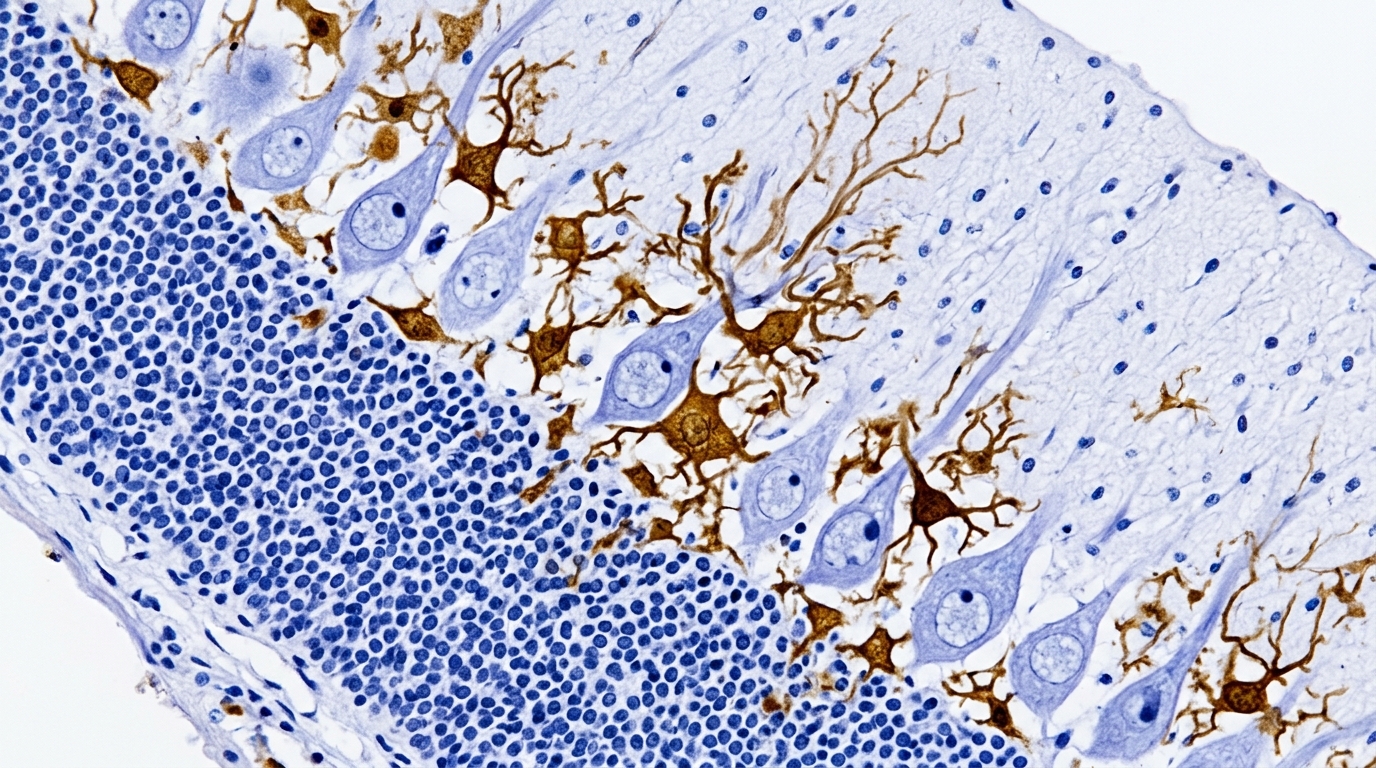
Investigation of causative Mendelian genes revealed that only FXN demonstrated significant downregulation at the bulk-tissue level, showing reduced expression in Friedreich’s ataxia cortex and cerebellum consistent with repeat-mediated transcriptional silencing. Single-nucleus profiling also identified significant FXN downregulation within frontal cortical inhibitory neurons across diagnosed donors, whereas other causative repeat expansion genes, such as ATXN1, ATXN2, and CACNA1A, did not show reduced transcript abundance in their corresponding disease states. Furthermore, intersecting differentially expressed genes with three hundred eighteen known ataxia-causing loci revealed a significant enrichment of established ataxia genes among downregulated cerebellar transcripts, especially in spinocerebellar ataxia type 2. Independent immunohistochemical staining of formalin-fixed tissue sections confirmed the molecular findings at the protein level, demonstrating marked increases in CD68-positive microglial and macrophage activation and elevated GFAP-positive astrocytic gliosis within cerebellar cortex, cerebellar white matter, and frontal regions of affected donors, confirming active in situ glial neuroinflammation.
The study provides critical evidence from human post-mortem brain tissue that neuroimmune activation and non-neuronal glial involvement represent shared molecular features of repeat expansion ataxias. Because animal and cell culture models often fail to capture complex cell-type-specific human brain processes, these human data provide mechanistic insights directly relevant to human disease biology. The identification of cortical inflammatory signatures supports clinical observations of cognitive and affective symptoms in ataxia, which may arise from disruption of reciprocal cerebro-cerebellar neural circuits. Study authors noted several important constraints, including the relatively small donor sample sizes inherent to rare genetic disorders, the lack of recorded donor race and ethnicity data in historical brain repositories, and reliance on short-read sequencing platforms. The findings indicate that neuroimmune pathways may serve as measurable indicators of disease progression, supporting further evaluation of fluid biomarkers such as glial fibrillary acidic protein and pointing toward neuroinflammatory signalling as a potential therapeutic target across hereditary ataxias.
Subject of Research: Transcriptomic profiling of neuroimmune and glial activation across repeat expansion ataxias in human post-mortem brain tissue
Article Title: Neuroimmune transcriptional signatures across repeat expansion ataxias in the human brain
Article References: Chen, Z., Hicks, A. R., Brenton, J., Grant-Peters, M., Reynolds, R. H., Rocca, C., Rocamora-Perez, G., Garza, R., Garcia-Ruiz, S., Dominik, N., Anderson, C., Curless, T., Montgomery, K., Macpherson, H., Nethisinghe, S., Gavriouchkina, D., Blunskyte-Hendley, M., Benotmane, H., Ugolini, H., … Ryten, M. (2026). Neuroimmune transcriptional signatures across repeat expansion ataxias in the human brain. Acta Neuropathologica, 152(1), Article 70. https://doi.org/10.1007/s00401-026-03115-1
Image Credits: AI Generated
DOI: 10.1007/s00401-026-03115-1
Keywords: Hereditary ataxia, Spinocerebellar ataxia, Friedreich's ataxia, Repeat expansion, Neuroinflammation, Microglia, Astrocytes, Single nucleus RNA sequencing, Bulk RNA sequencing, Cerebellum, Frontal cortex, Gene expression profiling, Differential splicing, FXN gene, Neurodegeneration, Transcriptomics, Post mortem brain, Gliosis
News Source: Cassandra Pierce. (November 17, 2026). Human Brain Study Reveals Shared Immune Activation Across Repeat Expansion Ataxias. Scienmag.