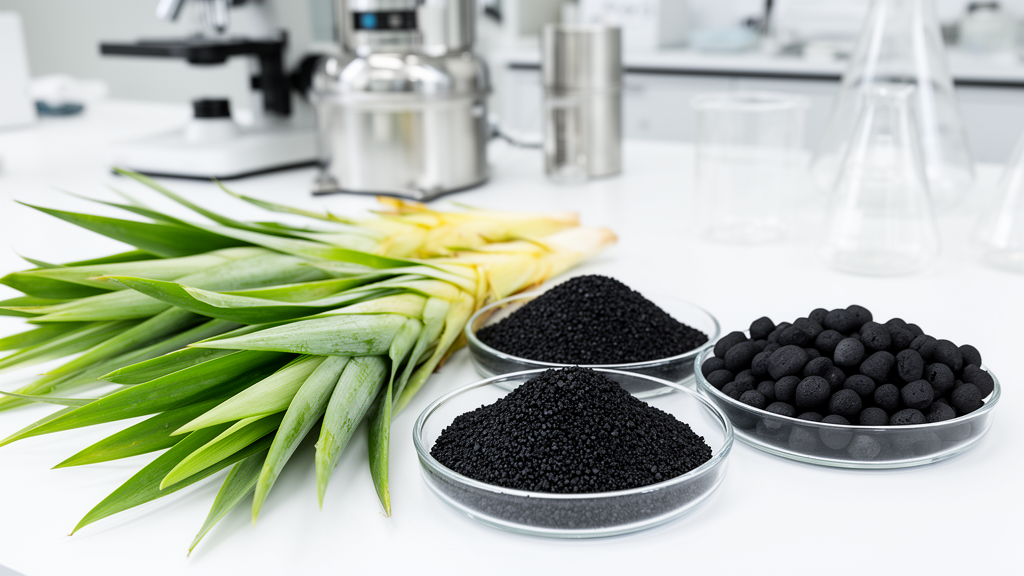
Researchers have developed a scalable method for converting pineapple leaf-derived activated carbon, known as PLAC, via controlled pyrolysis and purification for potential food-contact and biomedical applications. The study reports that toxic regulated heavy metals and polycyclic aromatic hydrocarbons were below detectable limits after ethylenediaminetetraacetic acid-assisted chelation purification. This approach offers a sustainable pathway for valorizing agricultural waste into functional carbon materials that can be integrated into alginate-based formulations.
The production process begins with the controlled pyrolysis of pineapple leaves to create activated carbon. This ethylenediaminetetraacetic acid-assisted chelation step was applied to reduce residual heavy metals. The resulting material was subjected to comprehensive physicochemical and biosafety assessments to evaluate its suitability for direct contact with food and biological systems.
Chemical analysis using inductively coupled plasma mass spectrometry and gas chromatography-mass spectrometry confirmed that the purified PLAC contained no detectable levels of regulated toxic heavy metals, specifically lead, cadmium, arsenic, and mercury. The analysis also showed that polycyclic aromatic hydrocarbons were below detectable limits after the purification process. However, the researchers noted that trace amounts of copper remained measurable.
In vitro biosafety testing was conducted using rat intestinal epithelial cells, designated IEC-6, and human gastric epithelial cells, designated GES-1. These assays demonstrated high cytocompatibility and minimal lactate dehydrogenase release. Additionally, the tests revealed negligible apoptotic activity.
To evaluate acute in vivo safety, the study utilized Sprague-Dawley rats subjected to oral exposure to PLAC at doses up to 100 mg/kg. Serum biochemical markers, including GOT, GPT, and creatinine, showed no significant changes.
Measurements of inflammatory cytokines, including IL-6, TNF-α, and IL-10, showed no significant changes. Histopathology of the liver, kidney, and ileum showed no significant changes. These findings demonstrate that integrating controlled pyrolysis with EDTA-assisted purification and alginate-based formulation supported favorable in vitro and acute in vivo biosafety.
The study highlights the integration of controlled pyrolysis with EDTA-assisted purification and alginate-based formulation as an effective strategy for producing safe carbon materials. By reducing toxic regulated heavy metals to below analytical detection limits, the researchers demonstrated that agricultural waste can be transformed into a material with favorable biosafety profiles.
Despite the positive acute safety results, the authors emphasize that further long-term safety evaluations are necessary before the material can be widely adopted. The study demonstrates the potential of PLAC as a sustainable and biocompatible carbon material for future food-contact and biomedical applications, while further long-term safety evaluations remain necessary.
Subject of Research: Conversion of pineapple leaf waste into biocompatible activated carbon for biomedical and food applications
Article Title: Sustainable valorization of pineapple leaf waste into biocompatible activated carbon for biomedical and food applications
Article References: Chen, Y.-W., Hou, C.-Y., Bhat, A. A., Tain, Y.-L., Fan, H.-J., Liu, C.-S., & Hsieh, C.-W. (2026). Sustainable valorization of pineapple leaf waste into biocompatible activated carbon for biomedical and food applications. npj Science of Food. https://doi.org/10.1038/s41538-026-01215-6
Image Credits: AI Generated
DOI: 10.1038/s41538-026-01215-6
Keywords: pineapple leaf waste, activated carbon, biocompatibility, agricultural valorization, EDTA chelation, heavy metal reduction, food-contact materials, biomedical applications, cytocompatibility, oral toxicity, Sprague-Dawley rats, IEC-6 cells, GES-1 cells, pyrolysis, alginate formulation, polycyclic aromatic hydrocarbons, histopathology, inflammatory markers, sustainable materials, npj Science of Food
News Source: Alan Morgan. (November 13, 2026). Pineapple leaf waste converted to safe activated carbon. Scienmag.