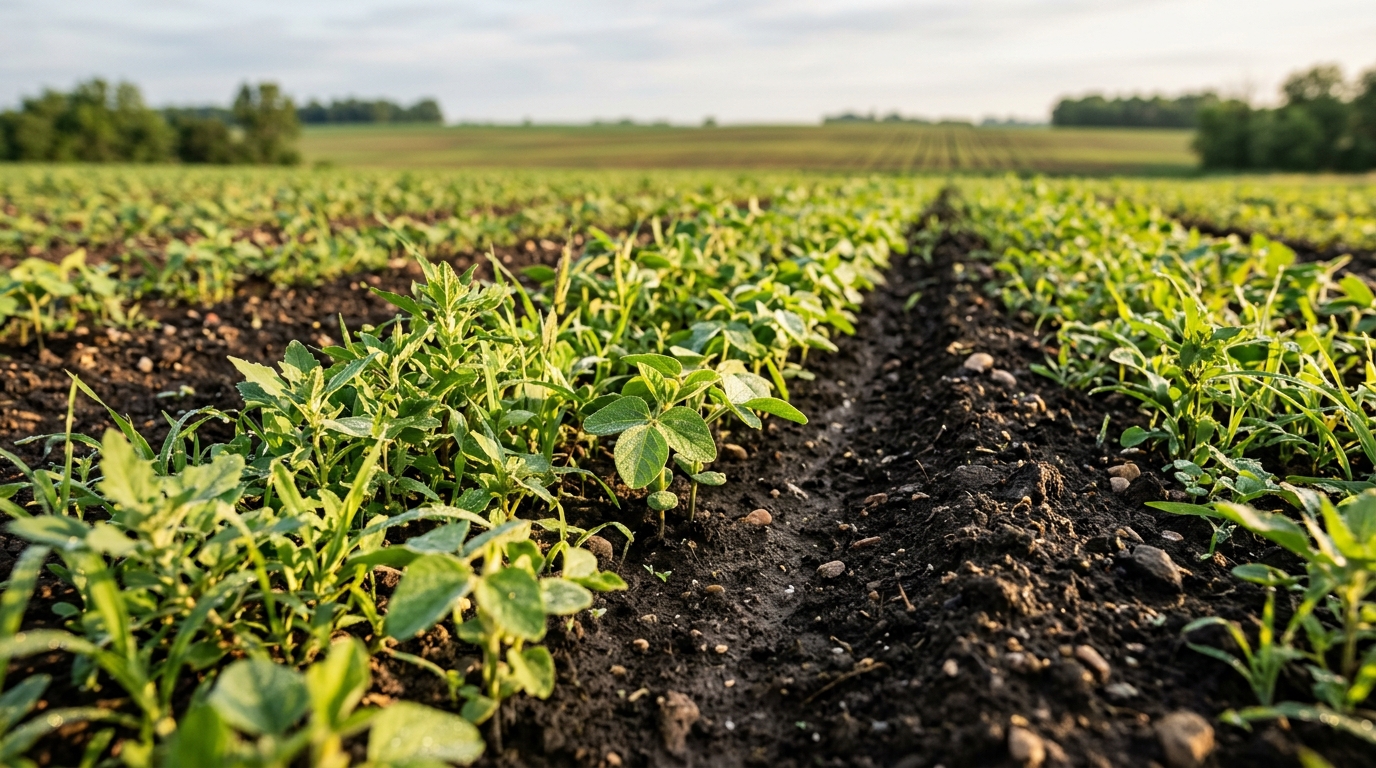
A deep learning framework that integrates species classification, conditional pixel segmentation, and ecological proxy modeling can quantify weed competition pressure and stratify field-level crop risk from standard red-green-blue imagery, according to an experimental investigation published in Discover Life. The research team, led by G. V. S. Narayana alongside Murali Gopal Kakita, Punyaban Patel, Sanjay Kumar Kuanar, Sudheer Babu Punuri, and Kranthi Kumar Singamaneni, designed the computational pipeline to bridge the operational gap between visual weed detection and actionable agronomic decision-making. Operating across three diverse agricultural image collections, the architecture achieved a 99 percent classification accuracy on multi-species weed benchmarks and demonstrated strong regression consistency in computing a composite multi-feature risk index, yielding coefficient of determination values exceeding 0.91 on large-scale field imagery and 0.996 on fine-grained sugar beet datasets. The investigators emphasized that the pipeline provides deterministic, proxy-derived assessments of relative weed pressure without relying on ground-truth crop yield measurements or biomedical experimentation.
The agronomic foundation of the study is rooted in addressing weed competition, which represents a persistent biotic stress that depresses crop productivity by competing directly with cultivated plants for essential, finite resources including soil moisture, sunlight, physical space, and critical macronutrients such as nitrogen, phosphorus, and potassium. In India, where agriculture serves as a foundational pillar of economic support and revenue generation, sustaining crop yields is vital to ensuring long-term food security amid population growth and resource limitations. Earlier agricultural evaluations cited in the investigation demonstrate that weed interference can induce harvest losses ranging from 5 percent to 50 percent, with exact reductions depending on crop variety and the severity of field infestation. Conventional management strategies frequently rely on the uniform broadcast spraying of chemical herbicides across entire fields. However, real-world farmlands exhibit highly patchy and irregular spatial weed distributions, causing whole-area spraying to treat non-infested zones unnecessarily, which escalates operational costs, damages farmland biodiversity, contaminates soil and water resources, and challenges broader food safety.
Although computer vision and machine learning techniques have emerged as scalable alternatives to labor-intensive and subjective manual weed scouting, the authors noted that existing automated frameworks predominantly focus on binary weed-versus-crop differentiation or coarse bounding-box object localization. Such mainstream architectures achieve high detection accuracy but fail to output interpretable, quantitative indices that reflect spatial distribution, vegetative coverage, or the competitive intensity exerted by weeds on adjacent crops. To resolve this disconnect, the researchers formulated an end-to-end modular pipeline that processes input field imagery through a sequential progression consisting of standardized image pre-processing, attention-enhanced deep classification, conditional pixel-level semantic segmentation, mathematical indicator extraction, and regression-based risk modeling. This design aims to move automated agricultural analysis beyond basic visual identification toward an interpretable, decision-centric evaluation of weed impact suitable for precision herbicide application.
The methodological workflow begins by standardizing input images to a uniform spatial resolution of 224 by 224 pixels and normalizing raw pixel intensity values to the continuous range between 0 and 1. To address the visual variability caused by fluctuating natural field lighting, images are converted from the red-green-blue color space to the Commission Internationale de l’Éclairage LAB color space, where the luminance channel undergoes contrast enhancement via Contrast Limited Adaptive Histogram Equalization prior to color space reconstruction. Additionally, auxiliary structural inputs are generated by computing edge magnitude maps with the Sobel operator, applying horizontal and vertical convolution kernels to capture plant leaf venation and boundary contours. The curated training datasets undergo targeted data augmentation routines, including ninety-degree rotations to simulate perpendicular camera angles over symmetric weeds, horizontal flips, and central zoom transformations. These augmentation pipelines were implemented using standard TensorFlow ImageDataGenerator and PyTorch Transform libraries strictly on training subsets to prevent data leakage into evaluation splits, while all partitioning adhered to a seventy percent training, fifteen percent validation, and fifteen percent testing division initialized with a fixed random seed of 42.
For the primary classification phase, the authors implemented a deep convolutional neural network built upon a ResNet-50 residual backbone augmented with a Convolutional Block Attention Module. Residual skip connections within ResNet-50 resolve vanishing-gradient phenomena during deep layer optimization, enabling robust feature extraction across field scenes characterized by severe occlusion, variable illumination, and cluttered soil backgrounds. The integrated attention module sequentially applies channel-wise and spatial attention mechanisms, focusing network representations onto salient morphological structures such as the elongated, parallel-veined leaves characteristic of narrowleaf monocots or the broader, reticulate-veined leaves of broadleaf dicots. To overcome the constraints of limited agricultural training annotations, the ResNet-50 backbone was initialized with weights pre-trained on the large-scale ImageNet database, followed by fine-tuning on domain-specific crop-weed datasets to accelerate convergence and bolster class separability.
Following classification, images identified as containing weed infestation are directed into a conditional segmentation stage executed by a light SegNet convolutional network. SegNet was trained for fifty epochs with a batch size of 32, utilizing the Adam optimizer configured with a learning rate of 0.0001 and cross-entropy loss. For benchmarks providing semantic ground truth, annotated pixel masks were directly applied, whereas unannotated images were segmented into binary vegetation masks using hue-saturation-value thresholding and morphological filtering. From these segmented masks, the authors extracted three biologically sensible indicators: Weed Density Estimation, Weed Spatial Entropy, and Weed Growth Rate Estimation. Weed density is computed either as the cumulative bounding-box area relative to total image area when object-level labels are available, or as the direct ratio of weed-classified pixels to total image pixels for semantic masks. Weed Spatial Entropy evaluates spatial heterogeneity by partitioning binary masks into non-overlapping spatial patches and computing the mean Shannon entropy across patches, where low values indicate clustered patches and elevated values denote widespread, scattered dispersion.
Because the evaluated datasets lacked multi-temporal or phenology-based growth annotations, the authors formulated Weed Growth Rate Estimation as an area-based proxy that multiplies the local proportion of weed pixels relative to total vegetation by patch entropy, capturing competitive pressure and spatial dominance without requiring longitudinal time-series imagery. These three metrics are subsequently integrated into a Proxy-Based Weed-Impact Assessment score via a linear weighting scheme assigning weights of 0.4 to density, 0.3 to spatial entropy, and 0.3 to growth rate, balancing coverage, spatial distribution, and localized dominance. To synthesize overall field status into a unified metric, the framework defines the Multi-Feature Composite Risk Index, which averages normalized scores of density, spatial entropy, growth rate, and the proxy assessment using equal weights of 0.25. Field conditions are subsequently categorized into low, medium, and high risk based on the thirty-third and sixty-sixth percentiles of the empirical composite distribution, establishing an objective stratification without manual threshold bias.
The empirical viability of the proposed framework was validated across three complementary benchmark datasets reflecting distinct crop types, acquisition modalities, and labeling structures. The primary large-scale evaluation utilized the MH-Weed16 dataset, comprising 19,141 natural field images collected across soybean fields in Maharashtra, India, over a five-month span from July to November 2023, capturing 16 diverse weed species under authentic agricultural variations. The second benchmark, the Crop and Weed Field Image Dataset, provided 60 calibrated sugar beet field images paired with 60 binary masks and 120 detailed annotation files, offering ground-truth pixel-level semantic masks to assess segmentation precision. The third source, the Weed Image Detection dataset, contributed 1,906 images across varied geographic locations, climates, and crop environments accompanied by two JavaScript Object Notation annotation files, enabling rigorous verification of model stability across heterogeneous agricultural settings.
Experimental outcomes demonstrated robust quantitative performance across all evaluated tasks. On the MH-Weed16 benchmark, the ResNet-50 and attention model achieved an overall species classification accuracy of 99 percent, exhibiting clear class separability in confusion matrix evaluations alongside balanced precision, recall, and F1-scores across all sixteen weed varieties. In downstream regression analysis, gradient boosted decision trees implemented via XGBoost were trained with three-fold cross-validation grid search to predict the Multi-Feature Composite Risk Index from extracted features, outperforming baseline models including Linear Regression, Ridge Regression, Support Vector Regression, Random Forest, and k-Nearest Neighbors. The XGBoost model attained a coefficient of determination exceeding 0.91 on the unseen test split of MH-Weed16 while maintaining minimal mean squared error, root mean squared error, and mean absolute error. On the finer-grained Crop and Weed Field Image Dataset, the regression framework achieved an R-squared value above 0.996, while tests on the Weed Image Detection collection confirmed that low-, medium-, and high-risk groupings aligned consistently with measured weed density and growth proxies.
Despite these favorable numerical results, the authors outlined key technical boundaries and operational limitations inherent to their experimental setup. Because downstream risk scoring depends directly on segmented vegetation regions, environmental interferences such as dense foliage overlap, severe leaf occlusions, shifting field illumination, and complex soil clutter introduce segmentation noise that can propagate into computed risk indices. Furthermore, the Multi-Feature Composite Risk Index constitutes a deterministic computational proxy derived from two-dimensional image features rather than an agronomic yield forecasting tool verified against real-world harvest weights, and the framework currently omits critical agronomic variables such as soil fertility, moisture availability, and biological growth stages. Future developments outlined in the report include transitioning toward segmentation-first architectures for fine species delineation, integrating multispectral bands, incorporating temporal data to track weed development dynamically, and deploying the computational models directly onto field-scale edge hardware for localized, site-specific weed management.
Subject of Research: Deep learning framework for image-based weed pressure quantification and agricultural crop risk assessment
Article Title: An image-driven deep learning framework for proxy-based weed-impact assessment and crop-risk analysis
Article References: Narayana, G. V. S., Kakita, M. G., Patel, P., Kuanar, S. K., Punuri, S. B., & Singamaneni, K. K. (2026). An image-driven deep learning framework for proxy-based weed-impact assessment and crop-risk analysis. Discover Life, 56(1), Article 27. https://doi.org/10.1007/s11084-026-09746-4
Image Credits: AI Generated
DOI: 10.1007/s11084-026-09746-4
Keywords: deep learning, precision agriculture, weed management, image segmentation, ResNet-50, XGBoost, crop risk assessment, computer vision, image-driven, deep, learning, framework
News Source: Alan Morgan. (November 6, 2026). Deep Learning Pipeline Evaluates Weed Competition Pressure and Crop Risk from Field Images. Scienmag.