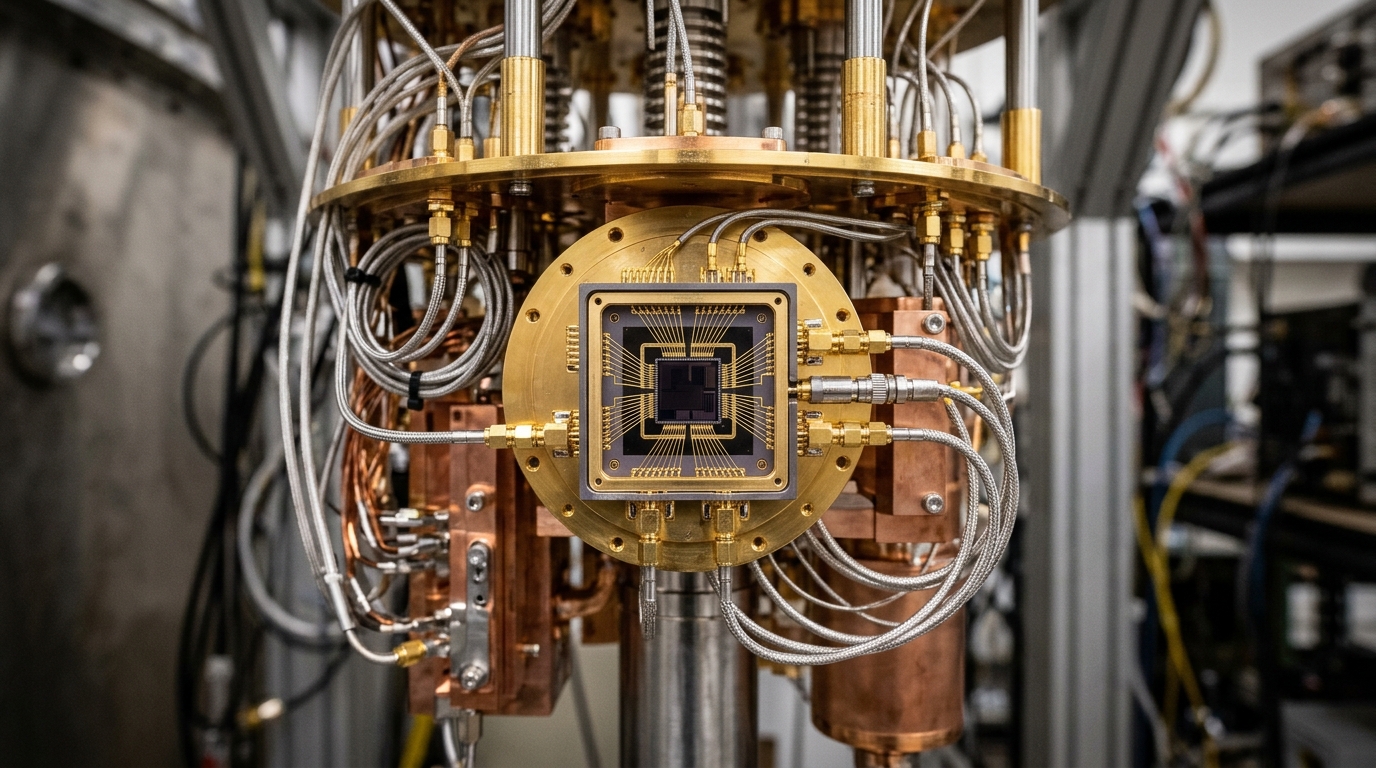
Researchers have successfully executed a 49-qubit quantum convolutional neural network on physical quantum hardware, classifying full-resolution handwritten images without relying on classical dimensionality reduction preprocessing. Conducted on IBM’s 156-qubit Heron r2 superconducting quantum processor, the hardware demonstration achieved a 96.08 percent classification accuracy on the MNIST zero-versus-one benchmark while demonstrating approximately 70 percent faster convergence relative to an optimized classical convolutional neural network baseline trained under identical conditions. Developed by an engineering team including Peter Röseler, Oliver Schaudt, Helmut Berg, Christian Bauckhage, and Matthias Koch, the study addresses a persistent challenge where noisy intermediate-scale quantum devices lacked physical resources to process high-dimensional visual data directly. By introducing an architectural technique called fragment encoding, the investigators compressed entire 28-by-28 pixel image arrays into a 49-qubit quantum register. The physical realization confirmed that simplified image-classification workloads can operate directly on contemporary quantum processing units today.
The foundational motivation for quantum convolutional neural networks stems from their capacity to execute high-dimensional transformations within complex Hilbert spaces that remain computationally intractable for traditional classical networks. While standard deep learning frameworks have revolutionized artificial intelligence through hierarchical feature extraction, deploying analogous quantum convolutional circuits on current noisy intermediate-scale quantum hardware has been severely constrained by hardware limitations. Existing quantum feature embeddings typically present acute trade-offs: standard qubit encoding requires an impractical one-to-one mapping between input pixels and physical qubits, whereas amplitude encoding introduces deep quantum circuits that are not feasible on current devices. Consequently, earlier quantum image classification demonstrations frequently resorted to classical preprocessing procedures such as principal component analysis, convolutional autoencoders, or image resizing. However, the study authors emphasize that classical dimensionality reduction risks discarding essential fine visual details, disrupts spatial structures that convolutional filters exploit, and obscures whether the quantum circuit or classical preprocessing performs the classification.
To overcome these structural limitations without compromising spatial data, the researchers formulated fragment encoding, a quantum mechanical compression pipeline that hierarchically compresses input pixels during the quantum encoding stage itself. Fragment encoding mimics classical convolution operations by partitioning the input image into discrete spatial fragments that are processed in parallel across individual qubits. Instead of allocating an independent physical qubit to every individual pixel or relying on external mathematical transformations, the method applies sequences of data-dependent single-qubit rotations interleaved with trainable parameterized unitaries. This spatial arrangement preserves local pixel relationships and translational equivariance while drastically curtailing the overall qubit requirement. Crucially, the authors proved mathematically through Proposition 1 that every sequential chain of single-qubit operations belonging to the special unitary group SU(2) can be compiled into a single equivalent universal U3 gate. Because all operations associated with a single image fragment consist strictly of single-qubit rotations, multi-layer logical fragment encodings collapse into a single universal physical gate per qubit.
In the mathematical architecture of fragment encoding, classical image convolutions that compute weighted sums of adjacent pixels are systematically mapped to associative matrix products of single-qubit operators. In a traditional convolutional layer, the output element represents a linear combination of receptive field inputs multiplied by kernel weights. Within the fragment-encoded framework, each input value and corresponding kernel weight is instantiated as a parameterized unitary gate acting on a quantum state. Leveraging matrix associativity, sequential executions of input encodings and trainable unitaries implement continuous feature convolutions directly on the qubit register. The authors examined several baseline encoding strategies, including basic qubit encoding, dense qubit encoding, universal encoding, and weighted universal encoding. Under dense qubit encoding, two distinct pixel values are embedded into a single qubit state, allowing a two-by-two convolution window to be represented by two parameterized quantum gates. The weighted universal encoding approach achieved superior expressive performance, structuring local hierarchical feature extractions with shared parameters.
To maintain computational efficiency across both quantum and classical model evaluations, the investigators implemented a bin-based single output classification framework, denoted as BSOC, which utilizes a single output neuron producing bounded values between zero and one. Rather than deploying traditional multinomial cross-entropy loss functions, which the researchers noted can cause vanishing gradients or local minima for single-output configurations, the classification problem was transformed into a regression task. For a target set of distinct classes, the interval between zero and one is partitioned into equally sized consecutive bins, where each designated segment corresponds to a specific class label. Training labels are projected to the precise center of their corresponding class bin, augmented with a normal distribution having a small standard deviation of 0.02 to avoid degenerate plateaus. The optimization minimizes the mean absolute error between model predictions and target distributions, establishing higher classification confidence as the scalar output approaches the bin center.
Alongside the coherent fragment-encoded architecture, the study systematically investigated a complementary hybrid alternative designated as the layerwise-measured quantum convolutional neural network, or LM-QCNN. In the LM-QCNN design, physical quantum measurements are executed immediately following each quantum convolutional kernel application, collapsing intermediate states so that the required physical qubit count scales strictly with local kernel dimensions rather than overall input image dimensions. The authors explored two distinct topological variations: Type I, which applies parameterized quantum circuits row-wise across the input mask before processing the final column in a tree-like hierarchy, and Type II, which applies parameterized quantum circuits across all input qubits simultaneously prior to measuring the designated readout qubit. While the LM-QCNN successfully executes within minimal physical registers on noisy intermediate-scale hardware, experimental results revealed notable operational compromises. The repeated intermediate measurements incurred significant execution overhead and sacrificed global entanglement effects, ultimately yielding empirical classification accuracies that matched or fell below the classical baseline.
To construct rigorous and equitable baselines for benchmarking, the researchers utilized Bayesian optimization powered by Optuna’s tree-structured Parzen estimator sampler to discover optimal classical neural network designs and automated parameterized quantum circuit ansätze. For the classical benchmark, 50,000 optimization trials explored network depths, kernel dimensions, output channels, and pooling layers under a lexicographic cost function using Adam optimization and exponential linear unit activations. This automated search identified an extraordinarily compact classical baseline containing merely 22 trainable parameters that achieved greater than 90 percent cross-validation accuracy on binary MNIST. For quantum convolution kernels, Bayesian optimization guided an ansatz search by evaluating candidate parameterized circuits against three metrics: expressibility measured via Kullback-Leibler divergence against uniform target distributions, entanglement capability quantified through the Meyer-Wallach entangling metric, and circuit complexity computed from total gate counts, trainable parameters, and circuit depth. This automated structural search discovered specialized quantum ansätze that consistently outperformed previously published literature circuits across multi-qubit configurations.
Before embarking on full-scale physical hardware executions, the researchers conducted an extensive scalability grid search evaluating coherent fragment-encoded models across 1-qubit, 4-qubit, and 16-qubit configurations on padded 32-by-32 pixel MNIST images. In these preliminary scaling evaluations, the 1-qubit, 4-qubit, and 16-qubit configurations compressed 1024, 256, and 64 pixels into individual qubits, respectively. The resulting empirical accuracy displayed a decisive scaling trend: while the single-qubit architecture performed near random chance, classification accuracy increased systematically by approximately 10 percentage points with each incremental expansion in the physical qubit allocation. Motivated by this clear positive scaling trajectory, the team expanded beyond the initial grid search boundaries. Although exact classical state-vector simulations of 64-qubit architectures proved computationally infeasible, the investigators leveraged matrix product state tensor network simulations to analyze 49-qubit fragment-encoded models with low entanglement. This 49-qubit architecture compressed 16 original image pixels per qubit for raw 28-by-28 MNIST inputs, successfully demonstrating that larger quantum registers unlock superior representational accuracy.
Simulated performance of the 49-qubit fragment-encoded network across diverse classification tasks revealed both compelling convergence advantages and clear architectural boundaries compared against task-specific classical baselines. On binary classification of handwritten digits zero and one, the fragment-encoded model utilizing weighted universal encoding achieved 98.7 percent test accuracy with a 0.2 percent standard deviation, outperforming the 22-parameter classical baseline which reached 93.4 percent accuracy with a 10.6 percent standard deviation. On distinguishing digits seven and eight, the quantum model maintained a slight advantage, attaining 92.1 percent accuracy compared to 90.0 percent for a 27-parameter classical network. However, on more complex workloads, the minimally parameterized quantum architecture struggled: on four-class classification of digits zero through three, the quantum network reached only 55.1 percent accuracy versus 89.2 percent for a 263-parameter classical network, and on greater-than-four classification, the quantum model achieved 63.2 percent compared to 88.5 percent for a 307-parameter classical baseline.
Physical validation of the 49-qubit fragment-encoded architecture on IBM’s Heron r2 ibm_fez quantum processor provided direct verification of these computational principles on real superconducting hardware. Operating with its trainable parameter count trimmed to 20 to ensure a fair comparison against the classical baseline, the quantum processor completed 50 training batches of 4,096 measurement shots each without employing external error mitigation. The physical processor converged smoothly to a final test loss of 0.079 and a 96.08 percent accuracy, outperforming the classical model’s 0.175 loss and 71.74 percent accuracy at the 50-batch mark. Hardware measurements closely matched classical matrix product state simulations, exhibiting an average deviation of only 0.037 across all batches. Despite these successes, the authors emphasize that simple binary digit discrimination represents a restricted domain, noting that quantum circuits remain classically simulatable unless operating in deeply entangled Hilbert spaces. Nonetheless, the demonstration confirms that fragment encoding provides a viable mathematical blueprint for executing end-to-end quantum machine learning models on physical hardware today.
Subject of Research: Quantum convolutional neural networks for image classification on superconducting hardware
Article Title: Efficient quantum convolutional neural networks for image classification: overcoming hardware constraints
Article References: Röseler, P., Schaudt, O., Berg, H., Bauckhage, C., & Koch, M. (2026). Efficient quantum convolutional neural networks for image classification: overcoming hardware constraints. Quantum Machine Intelligence, 8(2), Article 121. https://doi.org/10.1007/s42484-026-00452-y
Image Credits: AI Generated
DOI: 10.1007/s42484-026-00452-y
Keywords: quantum computing, quantum convolutional neural networks, image classification, fragment encoding, IBM Heron r2, quantum machine learning, Bayesian optimization, NISQ devices, Efficient, quantum, convolutional, neural
News Source: Katie Riggs. (November 6, 2026). Quantum Convolutional Networks Classify Images Directly on Superconducting Hardware. Scienmag.