Since the late 1990s, cancer drug development has quietly undergone a structural transformation. Rather than testing new therapies in broad, unselected patient populations, developers increasingly pair each drug with a laboratory test that identifies the molecular subset of patients most likely to benefit. A new survey of US Food and Drug Administration data, published in Frontiers in Medicine, quantifies just how far this shift has gone — and reveals a striking trade-off at its core. By the end of 2025, 87 cancer drugs had been approved in association with a companion diagnostic assay, and for nearly four-fifths of the 62 solid-tumor drugs among them, the entire efficacy case rested on a single clinical trial.
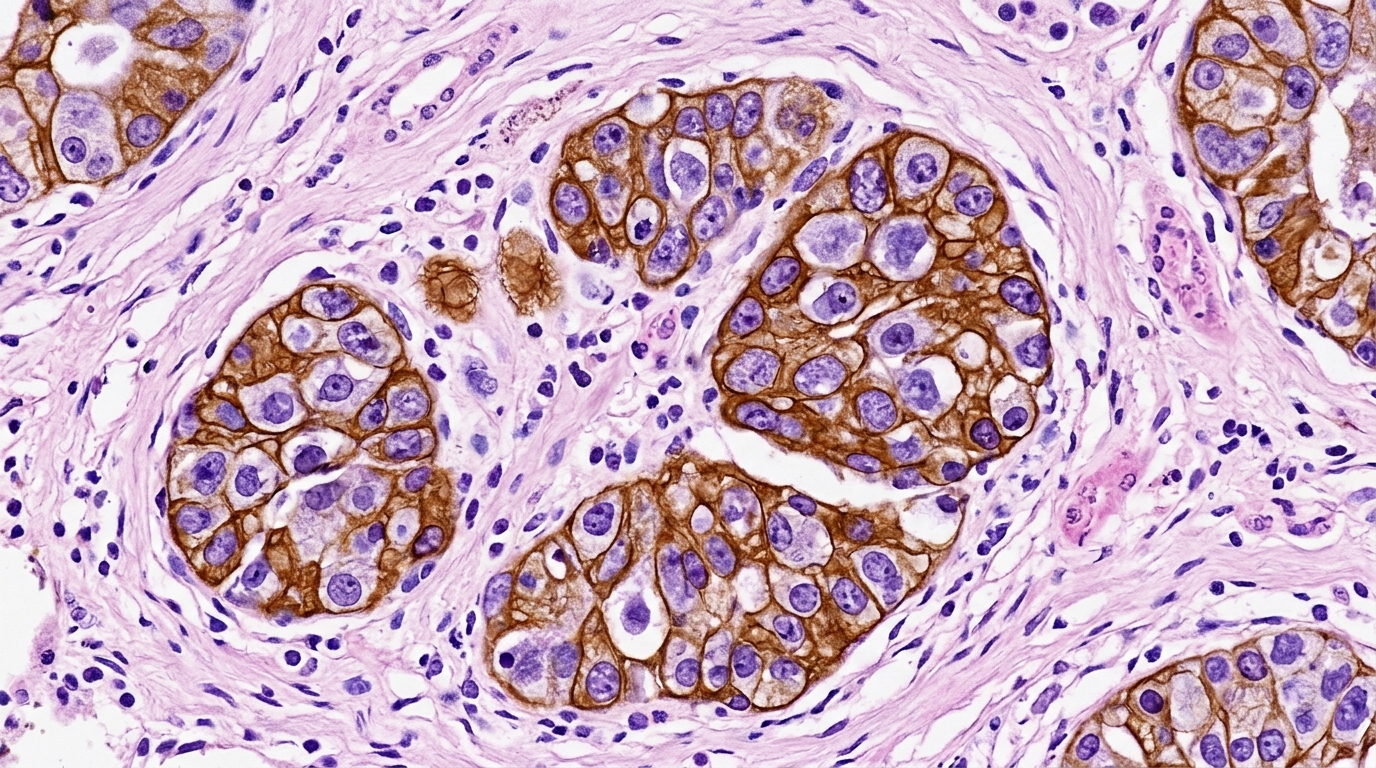
The drug-diagnostic codevelopment model traces its origins to trastuzumab, the monoclonal antibody developed in the 1990s for metastatic breast cancers that overexpress the HER2 protein. An immunohistochemical assay to detect HER2 was built alongside the drug, allowing clinicians to select the patients most likely to respond. When trastuzumab and its test were approved simultaneously in 1998, they established a template that would come to dominate targeted oncology. The FDA and other regulators now define a companion diagnostic as an in vitro diagnostic device providing information essential for the safe and effective use of a corresponding therapeutic product, and the number of cancer drugs tied to such assays has grown to more than 80.
For the new survey, the author mined the FDA’s list of cleared or approved companion diagnostic devices, covering the period from 1998 through the end of 2025, and cross-referenced each drug’s approval record in the agency’s Drugs@FDA database. Orphan drug status was drawn from the FDA’s designation database, while expedited pathways — Priority Review, Breakthrough Therapy, Accelerated Approval and Fast Track — were extracted from the regulatory histories of individual New Drug Applications and Biologics License Applications, supplemented by the Friends of Cancer Research database for breakthrough designations. Descriptive analyses were performed in Excel.
The results sketch a field dominated by targeted agents. Of the 87 drugs identified, 62, or 71 percent, were indicated for solid tumors, with the remainder used mainly against hematological malignancies. Among the solid-tumor drugs, kinase inhibitors were the largest class, accounting for 34 drugs, or 55 percent, followed by monoclonal antibodies at 12 drugs (19 percent) and small-molecule inhibitors at 10 (16 percent). The remaining six drugs were antibody-drug conjugates or bispecific antibodies. This distribution reflects the underlying biology: as tumor molecular pathophysiology has been mapped in increasing detail, drugs designed to interfere with specific molecular targets critical for cancer cell growth, survival and dissemination have proliferated.
The trial designs behind these approvals diverge sharply from the randomized, double-blind studies long considered the scientific standard. For the 62 solid-tumor drugs, the single-arm open-label design dominated, used for 32 drugs, or 52 percent. Randomized trials supported 27 drugs (44 percent), and for three drugs — the kinase inhibitor vemurafenib and the monoclonal antibodies trastuzumab and cetuximab — both designs were employed. Blinding was rare: 53 drugs (85 percent) were evaluated in open-label settings, with only nine (15 percent) assessed double-blind. The author notes that for many of these targeted therapies, relevant comparator drugs simply did not exist at the time of development, making single-arm designs a pragmatic necessity rather than a methodological shortcut.
The patient numbers are equally revealing. The mean number of patients in the clinical efficacy documentation for the 62 solid-tumor drugs was 279, a figure that excludes patients in a large retrospective analysis of panitumumab trials regarding KRAS mutations. At the low end, dordaviprone, a small-molecule inhibitor approved in 2025 for diffuse midline glioma harboring an H3 K27M mutation, was cleared on an efficacy population of just 50 patients enrolled across five small, open-label, single-arm trials. At the high end, zolbetuximab, a monoclonal antibody approved in 2024 for metastatic HER2-negative gastric or gastroesophageal junction adenocarcinoma expressing claudin-18.2, drew on 1,072 patients across two double-blind randomized trials. Sixteen of the 62 drugs — 26 percent — were approved on the basis of fewer than 100 patients.
Endpoints tell a similar story of expedited evidence. Efficacy documentation came from a single trial for 49 of the 62 drugs (79 percent), from two trials for 10 drugs (16 percent), and from three or more trials for three drugs (5 percent). The primary endpoint was objective response rate for 37 drugs (60 percent), while progression-free survival and overall survival served as primary endpoints for 25 drugs (40 percent). Objective response rate is a surrogate measure, and the author emphasizes that its use does not exempt companies from verifying clinical benefit; for oncology drugs this typically means overall survival and further safety data, stipulated as postmarketing requirements by the FDA.
Regulatory expedients were heavily deployed. Orphan drug status had been granted to 39 of the 62 drugs (63 percent), a designation available when a drug targets a disease affecting no more than 200,000 individuals in the US. Breakthrough Therapy designation, intended to expedite development of drugs showing preliminary evidence of substantial improvement over available therapy, went to 48 drugs (77 percent). Accelerated Approval, which permits earlier approval based on surrogate endpoints for serious conditions filling an unmet need, was granted to 35 drugs (56 percent). Priority Review, which commits the FDA to act within six months rather than the standard ten, applied to 39 drugs (63 percent), and Fast Track status to 15 (24 percent). Many drugs accumulated several designations; dordaviprone, for instance, received all four.
The survey’s central tension lies in what these small, fast trials cannot deliver. While efficacy can be demonstrated relatively efficiently in enrichment designs — the ability of companion diagnostics to select likely responders increases the statistical power of individual trials — the author argues that safety evaluation is the casualty. It is challenging, the paper notes, to obtain even a rough estimate of a new drug’s safety profile in patient populations of this size, particularly for rare adverse events. Safety information must therefore be gathered in the post-approval phase, which the author characterizes as suboptimal. The compromise, in most situations deemed ethically justifiable for life-threatening diseases, is rapid patient access to more effective treatment at the cost of limited pre-approval safety data — a trade-off that regulators in the US, Europe and elsewhere appear to share when prioritizing efficacy and speed.
The author also situates the findings within the broader history of oncology drug development. Since the Orphan Drug Act was passed in 1983, oncology has accounted for 38 percent of all designations and approvals, a share the paper attributes to the increasing molecular subdivision of cancers enabled by technologies such as next-generation sequencing, polymerase chain reaction and immunohistochemistry. The trend shows no sign of abating: in 2025, 16 new small-molecule drugs and biologics were approved for cancer treatment, with the majority developed using a companion diagnostic assay. As the enrichment trial design continues to shape both the clinical and regulatory dimensions of oncology, the survey suggests that the model’s efficiency in proving benefit will keep colliding with its limitations in proving safety — a tension that postmarketing surveillance will increasingly be asked to resolve.
Subject of Research: A survey of FDA data on cancer drugs developed with companion diagnostic assays, examining drug classes, trial designs, endpoints, patient numbers and expedited review pathways.
Article Title: Companion diagnostics and clinical drug development in oncology: a survey based on US FDA data
Article References: Jørgensen, J. T. (2026). Companion diagnostics and clinical drug development in oncology: a survey based on US FDA data. Frontiers in Medicine, 13, Article 1938709. https://doi.org/10.3389/fmed.2026.1938709
Image Credits: AI Generated
DOI: 10.3389/fmed.2026.1938709
Keywords: companion diagnostics, oncology, FDA, enrichment trial design, kinase inhibitors, orphan drug, breakthrough therapy, accelerated approval, clinical trials, drug development, biomarkers, precision medicine
News Source: Nathaniel Bowman. (November 6, 2026). Small trials, big approvals: FDA data reveal how companion diagnostics reshaped cancer drug development. Scienmag.