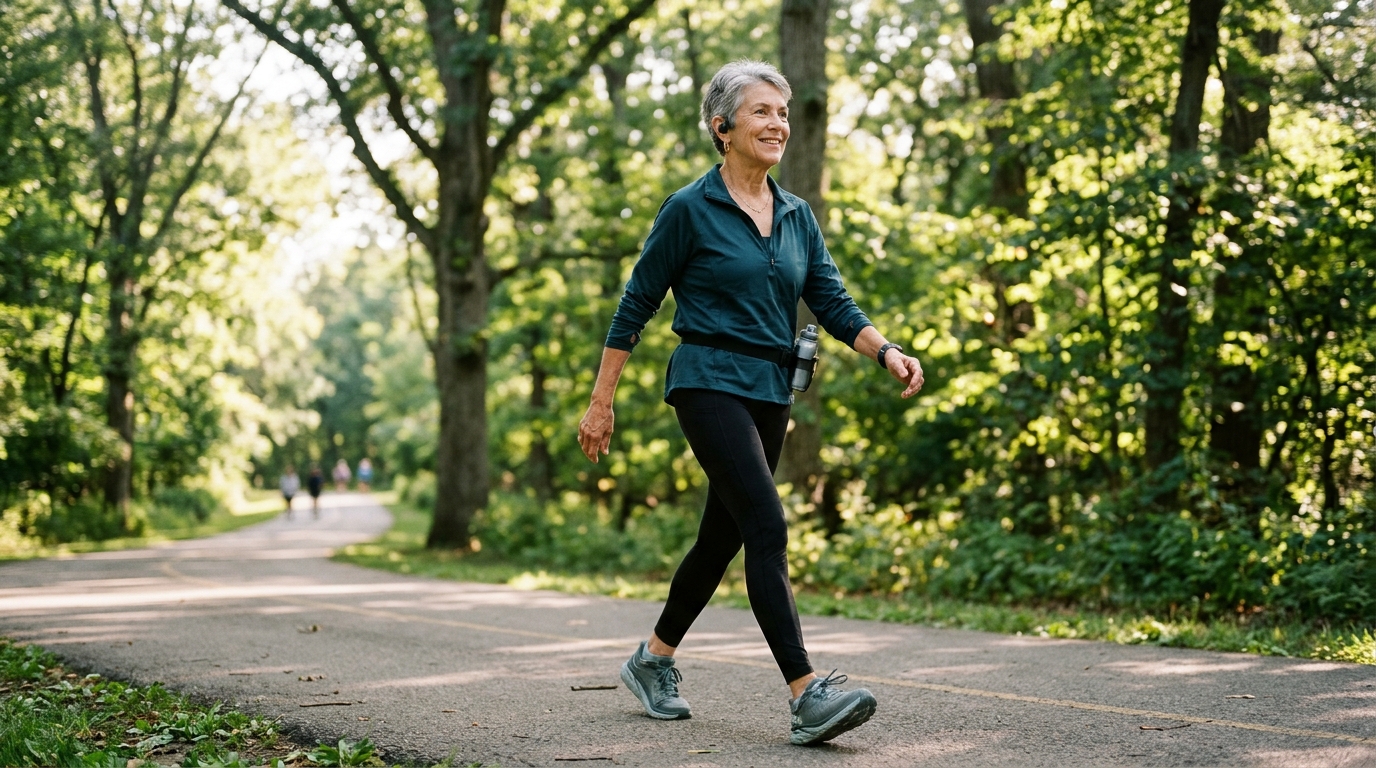
Older adults who can walk much faster than they usually do pay a smaller price when they must think and walk at the same time, according to a large analysis of 4,443 healthy people aged 60 to 97 published in the European Review of Aging and Physical Activity. Its central result is that functional reserve, defined as the fractional difference between a person’s preferred walking speed and their fast walking speed, predicted lower costs in both the motor and the cognitive domain. Higher reserve was linked to smaller motor costs (p < .001) and smaller cognitive costs (p = .006), supporting the idea that spare locomotor capacity can be shared with mental work.
They first walked at a self-selected speed and then as fast as possible without running. Next came two dual-task walking trials: one in which they counted backward aloud from 50 in steps of two, a working memory task, and one in which they named animals aloud, a semantic memory task drawing on long-term memory. Finally, they performed each cognitive task while seated, with the duration matched to the walking time of the corresponding dual-task trial. Walking speed came from the distance between the first and last footstep divided by ambulation time, and cognitive output was normalized as correct numbers or animal names per second. Dual-task costs were expressed as the percentage decline from single-task performance.
The costs were real and measurable. In the semantic task, animal naming produced 0.584 correct names per second while walking versus 0.599 while sitting, a small but significant decline (mean difference −0.016, 95% CI [−0.023, −0.008], t(1638) = −4.25, p < .001). Working memory showed a much larger drop: 0.747 numbers per second while walking against 0.908 while sitting (mean difference −0.165, 95% CI [−0.173, −0.157], t(1586) = −39.65, p < .001). Walking speed told the mirror-image story. Normal walking averaged 115.94 cm/s, but fell to 87.69 cm/s during animal naming and to 96.95 cm/s during backward counting. All paired comparisons between single- and dual-task walking speeds were significant at p < .001. The authors note that the statistical significance of the cognitive declines was likely aided by the sheer size of the sample.
The interference was domain-specific rather than uniform. Walking interfered more with the working memory task than with the semantic task, while adding the semantic task to walking slowed gait more than adding the working memory task did. In the models, task type significantly predicted motor costs (β = −0.19, p < .001 in the final mixed model), whereas it did not significantly predict cognitive costs (β = 0.04, p = .076). This asymmetry suggests that semantic retrieval and working memory computation compete differently with the control of gait, a pattern the authors say large-scale comparisons had rarely addressed before in healthy older adults.
Functional reserve emerged as the clearest protective factor. In the linear mixed model for motor costs, higher reserve predicted lower costs (β = −0.11, p < .001), alongside significant effects of task type, cohort (β = 0.05, p = .003), age (β = 0.04, p = .018), and the Stops Walking When Talking observation (β = 0.03, p = .020). For cognitive costs, reserve again showed a significant negative association (β = −0.07, p = .006). The interpretation offered by the researchers is grounded in a resource-sharing framework: an individual whose usual walking demands leave a large gap up to their maximum speed has spare capacity available to absorb the added load of thinking while walking, and therefore sustains both gait and cognition better under dual-task conditions.
Age and birth cohort told a more complicated story. Age significantly predicted motor costs but was not associated with cognitive costs (β = −0.02, p = .502). Cohort, residualized against year of birth to remove its collinearity with age, significantly predicted both: more recent cohorts showed higher motor costs (β = 0.05, p = .003) and higher cognitive costs (β = 0.06, p = .011) at comparable ages. In the fall-history model, cohort (β = 0.51), age (β = 0.47), and fear of falling (β = 0.39, all p < .001) were significant predictors. The authors flag this positive cohort effect as counterintuitive, since it runs against assumptions of uniform generational improvement in mobility, and they list possible contributors including longer survival with multimorbidity, more sedentary lifestyles, and heightened awareness of fall risk, while cautioning that unmeasured secular trends may confound the finding.
One of the study’s most striking behavioural observations concerns Stops Walking When Talking, the spontaneous halting of gait during conversation. It was recorded ecologically, as participants were accompanied from the reception area to the gait laboratory, and it appeared in only 2.8% of this healthy cohort, far below the 41% reported elsewhere for patients with a history of stroke. SWWT was associated with higher motor dual-task costs but showed no link to fall history (β = 0.01, p = .951 in the fall model). The authors interpret this as evidence that, in healthy older adults, pausing walking to talk may act as a proactive reallocation of resources, a compensatory strategy rather than a red flag, though they acknowledge it could also signal reduced dual-task capacity and say longitudinal work is needed to separate the two possibilities.
Equally notable is what the study did not find: no fixed trade-off between the motor and cognitive domains. After accounting for the model predictors, the correlation between standardized residuals of cognitive and motor dual-task costs was small and non-significant (r = −0.024, p = .270). If resources were rigidly shared in a zero-sum fashion, high cognitive costs should pair with low motor costs or vice versa; the data do not show that. Exploratory indices pointed the same way. The modified attention allocation index was positive for the semantic task (M = 26.92, SD = 36.12), indicating a shift of attention toward the motor task, but near zero for the working memory task (M = −0.01, SD = 26.11), indicating no clear priority. The authors read this as flexible, context-dependent allocation rather than rigid competition.
Fall history itself resisted prediction by performance metrics. In the final generalized model, fitted without a random intercept after overdispersion arose, neither combined dual-task costs (β = −0.11, p = .170) nor functional reserve (β = 0.18, p = .110) significantly predicted whether a participant reported prior falls. Fear of falling, by contrast, was a strong predictor (p < .001), a relationship the authors note is known to be bidirectional in prospective and longitudinal research. The practical implication they draw is that behavioural and demographic markers track fall history more closely than the magnitude of dual-task costs does, at least in this relatively healthy sample.
The study’s limitations frame how far these conclusions travel. The design is cross-sectional, so the associations between reserve, costs, and falls cannot be read as causal. The fixed trial order may have introduced practice, fatigue, or carry-over effects, for example when animal naming in the dual-task trial partially relies on names already retrieved, which the authors say could underestimate cognitive costs. The sample was relatively healthy and more educated than the general older population, which may have compressed the range of functional reserve and contributed to the low SWWT prevalence, and SWWT was an informal observation that may have been missed or biased. Cognitive screening used the MMSE (score ≥ 24/30) and, for some participants, the MoCA (score ≥ 18/30), with Memory Clinic classification of normal cognition, but the authors call for broader assessments. Gait speed alone, they add, may miss subtler dual-task effects visible in stride variability or step length, data they are already analysing. Within those bounds, the message stands: how much faster you can walk than you usually do may shape how well you walk and think at the same time, and functional reserve stands out as a candidate target for interventions aimed at keeping older adults steady and sharp.
Subject of Research: Dual-task walking costs and functional reserve in healthy older adults
Article Title: Functional reserve mitigates cognitive-motor dual-task costs in older adults: insights from age, cohort, and behavioural strategies
Article References: Zhou, T., Straub, E., Kiesel, A., Gehring, D., Granacher, U., Haslbauer, A., Kressig, R. W., & Rössler, R. (2026). Functional reserve mitigates cognitive-motor dual-task costs in older adults: insights from age, cohort, and behavioural strategies. European Review of Aging and Physical Activity, 23(1), Article 24. https://doi.org/10.1186/s11556-026-00423-z
Image Credits: AI Generated
DOI: 10.1186/s11556-026-00423-z
Keywords: dual-task cost, functional reserve, gait speed, older adults, cognitive-motor interference, working memory, semantic memory, fall history, fear of falling, Stops Walking When Talking, cohort effects, Basel Motor-Cognition Dual-Task Paradigm
News Source: Ophelia Keating. (November 5, 2026). Spare Walking Speed Shields Older Brains and Bodies from Dual-Task Interference. Scienmag.