A hydrothermally grown ternary nanocomposite that combines cobalt ferrite nanoparticles, a separate cerium oxide phase, and molybdenum disulfide nanosheets has delivered some of the strongest supercapacitor electrode numbers reported for ferrite-based materials. In a study published in Results in Chemistry, researchers report that the composition containing 40 mol% ceria relative to cobalt ferrite reached a gravimetric specific capacitance of 1141.41 F g−1 at a current density of 1.8 A g−1 in 3 M potassium hydroxide, compared with 900.15 F g−1 for the 25 mol% counterpart. The same 40% electrode retained 97.1% of its initial capacitance after 6000 consecutive charge-discharge cycles at 8 A g−1, while the 25% sample kept about 82.3% after 4000 cycles.
The team, led by Mohammad Mehdi Kaviani and Fatemeh Davar with collaborators in Iran and China, synthesized cobalt ferrite nanoparticles through a surfactant-assisted hydrothermal route, then built ceria/cobalt ferrite composites at two ceria loadings before growing MoS2 nanosheets in situ around the oxide particles. Cobalt ferrite was chosen for its stable spinel framework and accessible Co2+/Co3+ and Fe2+/Fe3+ redox couples, while cerium oxide contributes its facile Ce3+/Ce4+ interconversion and oxygen-vacancy chemistry. MoS2, a two-dimensional material with a layered structure analogous to graphene, supplies high surface area, abundant edge sites, and electrical double-layer capacitance that complements the faradaic processes of the metal oxides.
Structural characterization confirmed that all three phases coexist without impurity reflections or peak shifts. X-ray diffraction indexed the cobalt ferrite peaks to cubic spinel (JCPDS No. 22-1086), the MoS2 (002) reflection at 14.4° to hexagonal 2H-MoS2 (JCPDS No. 75–1539), and additional peaks at about 28.5°, 33.1°, 47.5°, 56.3°, and 69.4° to the cubic fluorite structure of CeO2. The clear presence of these ceria reflections, without shifts, demonstrated that cerium oxide exists as a distinct crystalline entity rather than being incorporated into the cobalt ferrite lattice through cationic substitution. Scherrer analysis of instrumentally corrected line widths gave crystallite sizes of roughly 20 nm for cobalt ferrite and 31 nm for ceria.
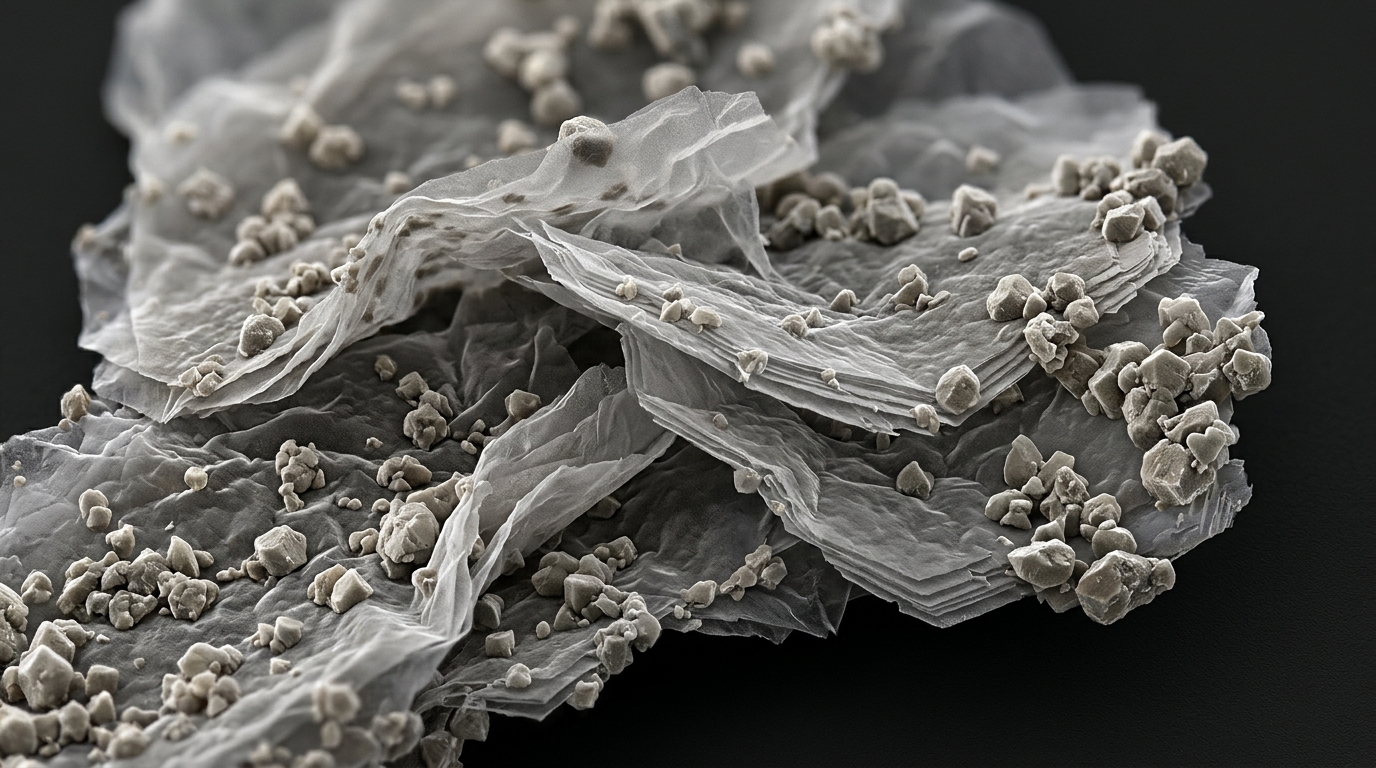
Electron microscopy showed a hierarchical 0D/2D/3D architecture. Nearly spherical cobalt ferrite particles averaged about 22 nm in diameter, growing to roughly 28 and 30 nm in the 25% and 40% ceria composites. The MoS2 nanosheets extended laterally over several micrometers with thicknesses below 30 nm and assembled into flower-like clusters, with the oxide nanoparticles anchored across the sheet surfaces and interlayer spaces. Energy-dispersive X-ray mapping showed Co, Fe, O, Ce, Mo, and S distributed without large-scale segregation. Point EDS analysis failed to detect sulfur reliably, reporting 0.01 wt%, an artifact the authors attribute to overlap between the S Kα line at 2.307 keV and the Mo Lα line at 2.293 keV plus partial sulfur sublimation under vacuum; the mapping data, which sample larger areas, gave 30 wt% sulfur for the 25% sample and 39 wt% for the 40% sample.
Density functional theory calculations with Hubbard U corrections provided a mechanistic picture. Using a substitutional model in which cerium atoms replace iron sites at the cobalt ferrite/MoS2 interface—a qualitative proxy, since the experimental system contains ceria as a separate phase—the researchers found that the hollow stacking configuration was most stable at −362.52 eV. Bader charge analysis showed that charge accumulation on interfacial sulfur atoms increased from 0.48 e in the pristine interface to 0.62 e in the high-cerium system, a roughly 29% enhancement in interfacial charge redistribution. Density-of-states calculations revealed that Fe-3d states dominate the pristine interface while Ce-4f states become increasingly involved at higher cerium concentration, and S-3p states shifted toward the Fermi level in the high-cerium case. The authors note that oxygen vacancy formation energies were not computed directly; the charge redistribution serves as indirect evidence that cerium facilitates a more reactive electronic environment.
Cyclic voltammetry in the −0.1 to 0.5 V window versus Ag/AgCl showed well-defined redox peaks for both composites, arising from reversible Co2+/Co3+ and Fe2+/Fe3+ reactions in the spinel along with possible Ce3+/Ce4+ transitions. The 40% ceria electrode displayed a markedly larger integrated area. Power-law fitting of peak currents versus scan rate gave b-values of 0.90 (R2 = 0.997) for the 25% electrode and 0.75 (R2 = 0.989) for the 40% electrode, indicating mixed charge storage with dominant capacitive character. Dunn’s method at 20 mV s−1 separated the contributions: approximately 80% capacitive and 20% diffusion-controlled for the 25% sample, versus 72% capacitive and 28% diffusion-controlled for the 40% sample. The larger diffusion contribution in the 40% electrode was attributed to oxygen-vacancy-facilitated ion transport at the ceria/cobalt ferrite interfaces.
Galvanostatic charge-discharge confirmed the trend. At 1.8 A g−1, the 40% ceria electrode discharged for 380.47 s, yielding the 1141.41 F g−1 capacitance and a corresponding areal capacitance of 2282.8 mF cm−2, while the 25% sample discharged for 300.15 s and reached 900.15 F g−1 (1800.3 mF cm−2). Both curves deviated from the ideal triangular shape of pure double-layer capacitors, showing plateaus consistent with faradaic storage, and exhibited minimal ohmic drop even at higher current densities. Energy and power densities calculated from the three-electrode GCD data reached 57.07 Wh kg−1 for the 40% electrode at approximately 540 W kg−1, compared with 45.01 Wh kg−1 for the 25% sample at the same power density.
Electrochemical impedance spectroscopy supported the kinetic picture qualitatively. Both electrodes showed a depressed high-frequency semicircle and a low-frequency linear tail, but the semicircle for the 40% ceria sample was visibly smaller and its tail steeper, indicating improved charge-transfer kinetics and reduced diffusion resistance. The authors connect this to the conductive MoS2 scaffold, which constitutes roughly 64–66 mol% of the composite, and to oxygen-vacancy-mediated interfacial charge redistribution. Raman spectroscopy at 785 nm excitation provided partial, qualitative support for oxygen vacancies: defect-related to F2g intensity ratios of about 0.95 for the 25% sample and 0.88 for the 40% sample, though the weak, overlapped bands were explicitly not used to quantify vacancy concentration.
Cycling durability separated the two compositions most sharply. The 25% ceria electrode declined to about 82.3% retention over 4000 cycles, a fade the authors link to possible active-material detachment, volume-change-driven loss of active sites, and metal-ion dissolution into the alkaline electrolyte. The 40% electrode, by contrast, retained 97.1% after 6000 cycles, which the authors attribute to oxygen vacancies buffering volume changes and the mechanically robust MoS2 scaffold preventing detachment. Notably, magnetic dilution did not track capacitance: saturation magnetization fell from about 77 emu g−1 for pristine cobalt ferrite to roughly 12.5 and 11 emu g−1 for the 25% and 40% composites, yet the 40% sample showed the higher capacitance, indicating the enhancement is not governed by magnetic ordering.
Against benchmarks compiled in the paper, the ternary electrode outperformed Ce0.5CoFe1.5O4 (937.5 F g−1), MnCoFe2O4 (675 F g−1), CoFe2O4@rGO (713.82 F g−1), MoS2@CoFe2O4 (528.60 F g−1), CoFe2O4/MoS2 (1013 F g−1), and MoS2/Yb,Er-doped CeO2 (660 F g−1), though a few systems such as CeO2/MXene (1459 F g−1) and carbon-based CoFe2O4 (1453 F g−1) reported higher values under different conditions. The authors emphasize that all energy and power figures here derive from three-electrode measurements of intrinsic material performance, not from assembled two-electrode devices, and that full-cell assembly, mass balancing, and scalable fabrication remain necessary steps before this material-level performance can translate into practical supercapacitors.
Subject of Research: Ternary MoS2/cobalt ferrite/ceria nanocomposite electrodes for supercapacitor energy storage
Article Title: Synergistic enhancement of supercapacitive performance in ceria/cobalt ferrite nanocomposite decorated with MoS 2 nanosheets via hydrothermal method
Article References: Kaviani, M. M., Wang, H., Allafchian, A., Karbasi, M., Davar, F., Li, Z., & Loghman Estarki, M. R. (2026). Synergistic enhancement of supercapacitive performance in ceria/cobalt ferrite nanocomposite decorated with MoS2 nanosheets via hydrothermal method. Results in Chemistry, 32, Article 104008. https://doi.org/10.1016/j.rechem.2026.104008
Image Credits: AI Generated
DOI: 10.1016/j.rechem.2026.104008
Keywords: supercapacitor, cobalt ferrite, CeO2, MoS2, nanocomposite, hydrothermal synthesis, oxygen vacancies, DFT, specific capacitance, cycling stability, pseudocapacitance, heterostructure
News Source: Bethany Barker. (November 6, 2026). Ceria-rich cobalt ferrite on MoS2 nanosheets lifts supercapacitor capacitance and durability. Scienmag.