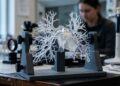
Bone lives under pressure. Every step you take squeezes the mineralized lattice of your skeleton, drives fluid through channels thinner than a human hair, and drags shear stress across the membranes of the cells that build and dismantle bone tissue. Recreating that double hit of hydrostatic pressure and fluid flow in the laboratory has long been a stubborn engineering problem, because most devices can apply one stimulus at a time, and the few that combine them have been restricted to flat, two-dimensional cell layers. A team reporting in Bioengineering & Translational Medicine now describes an automated, parallelized bioreactor that delivers tunable fluid shear stress and intermittent hydrostatic pressure simultaneously to three-dimensional bone tissue models, and shows that the combination pushed bone marrow stromal cells toward the osteogenic lineage more strongly than perfusion alone over a seven-day culture.
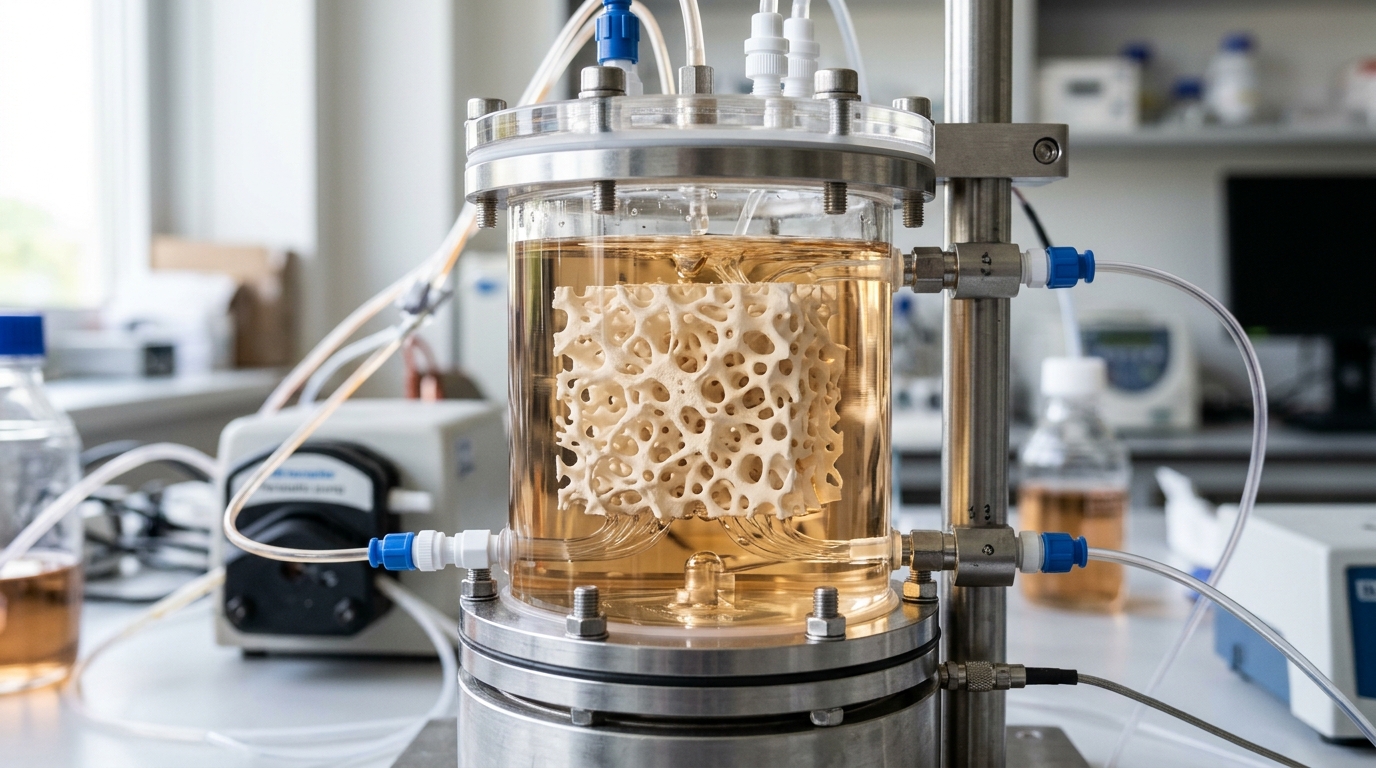
The device builds on a direct perfusion bioreactor the group had previously developed for controlled shear stimulation of 3D constructs. The upgrade centers on a custom intermittent hydrostatic pressure unit bolted into each hydraulic circuit. Each of the three independent culture chambers sits in its own closed loop, fed by a multichannel peristaltic pump that can sweep flow rates from 0.024 to 24 milliliters per minute. Downstream of each chamber, a three-way solenoid pinch valve fitted with dedicated silicone tubing periodically clamps the outflow. When the valve is open, medium perfuses the scaffold from bottom to top and returns to the reservoir, exposing cells to fluid shear stress. When the valve snaps shut, flow is blocked and pressure inside the chamber climbs progressively until the valve releases. A compact controller built around an Arduino microcontroller board, custom printed circuit boards, an LCD interface and two potentiometers lets the user set the stimulation period from 0.25 to 30 seconds and the duty cycle from 1 to 100 percent, with the whole assembly small enough to run inside a standard incubator.
To find out what pressures the system actually generates, the researchers characterized it with two biomimetic polylactic acid scaffolds produced by 3D printing. The PLA600 design replicates trabecular architecture from the human iliac crest, with about 60 percent porosity, 350 micrometer trabeculae and 531 micrometer spacing measured by micro-computed tomography. The P3S3 design mimics jawbone architecture, with 44.7 percent porosity, 258 micrometer trabeculae and 284 micrometer spacing. Scaffold samples were pretreated, loaded with collagen gel in place of cells, and sealed into the chambers with all air bubbles removed. An in-line pressure sensor recorded the response across ten experimental conditions, each tested in triplicate with randomized ordering. Mean peak pressures spanned roughly an order of magnitude: 1.81 to 15.09 kilopascals for PLA600 and 4.53 to 30.59 kilopascals for P3S3, the higher values reflecting the denser, less permeable jawbone-like architecture. Those ranges bracket the pressures bone cells experience in vivo, roughly 3 to 8 kilopascals during daily activity and up to about 35 kilopascals during intense exercise.
Shear stress was characterized analytically rather than measured directly. The team first measured scaffold permeability on a custom test bench, obtaining 2.36 × 10⁻¹⁰ square meters for PLA600 and 2.14 × 10⁻¹⁰ square meters for P3S3, values consistent with published permeabilities for human trabecular bone. They then applied a formulation for effective wall shear stress in porous constructs, accounting for porosity, to calculate the shear delivered at each pump setting. Across the full flow range, PLA600 scaffolds experienced 0.48 to 481.99 millipascals and P3S3 scaffolds 0.68 to 683.26 millipascals, a window that covers the 0.55 to 24 millipascal range previously reported to promote osteogenic differentiation of human mesenchymal stromal cells in 3D models. The authors note the model provides scaffold-scale estimates and neglects cells and any extracellular matrix that develops during culture, so local shear inside the pore network may vary.
For the biological test, the team chose PLA600 scaffolds because they covered the pressure band of daily activity. Human telomerase reverse transcriptase-immortalized bone marrow-derived mesenchymal stromal cells, the clonal line Y201, were seeded in a cell-releasing collagen hydrogel at 2.5 million cells per scaffold. After infiltration and adhesion, the constructs were cultured for seven days under three conditions: static culture in a well plate, continuous direct perfusion at 0.3 milliliters per minute, and perfusion combined with intermittent hydrostatic pressure using a 10-second stimulation period and 50 percent duty cycle. That setting produced a mean peak pressure of 5.27 kilopascals, with peaks ranging from 2.25 to 7.84 kilopascals, closely matching the pressures of everyday loading. The corresponding shear stress at that flow rate was an estimated 6.02 millipascals, roughly an order of magnitude below levels known to detach or kill cells.
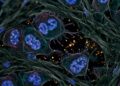
Viability results were reassuring. The resazurin reduction assay showed that both perfusion conditions significantly increased metabolic activity compared with static culture, with no significant difference between perfusion alone and perfusion plus pressure, indicating the added mechanical load did not harm the cells. Live/dead staining was dominated by green-stained viable cells in all conditions, and imaging at different depths confirmed a homogeneous distribution of cells from the scaffold surface to the inner core. Scanning electron microscopy corroborated the fluorescence findings, revealing dense cell sheets stretching across scaffold pores alongside individually adherent cells, with optimal density, infiltration and uniform distribution under every condition tested.
The molecular readout is where the combined stimulation separated itself from perfusion alone. Comparing the combined condition against the perfusion-only control using the 2−ΔΔCq method, the early osteogenic marker alkaline phosphatase was upregulated approximately 2.7-fold, collagen type I alpha 1 rose 1.4-fold, and osteopontin showed a modest increase of about one fold. The transcription factor RUNX2 and the late marker osteocalcin showed limited differences between the two conditions. The authors interpret the ALP and collagen I increases as biologically relevant given the short seven-day window, since alkaline phosphatase is an early marker of osteoblast differentiation. Chondrogenic markers argued against an alternative fate: SOX9 changed by less than one fold and collagen type II by about one fold, while the proliferation marker Ki-67 was significantly upregulated roughly 1.6-fold, suggesting the pressure profile may enhance cell proliferation during early culture.
Protein-level analysis stayed deliberately cautious. Bradford assays confirmed consistent total protein concentrations across both groups, ranging from 940 to 1390 micrograms per milliliter, and SDS-PAGE with Coomassie staining showed well-defined bands between roughly 10 and 250 kilodaltons in both conditions, indicating protein stability and equal loading. Both groups displayed a prominent band near 70 kilodaltons, attributed to a combination of serum albumins, structural proteins and early osteogenic markers such as alkaline phosphatase, which migrates as a monomer in the 70 to 80 kilodalton range. The authors emphasize that transcriptional upregulation does not automatically translate into protein deposition, because mature bone matrix proteins typically peak at later time points, and they plan targeted protein analyses in future work to validate whether the gene-level changes carry through.
The study has clear boundaries. Pressure was characterized only for these two scaffold types because the unit does not operate under closed-loop pressure control, so new scaffold architectures would require fresh calibration. The shear estimates are scaffold-scale analytical values that ignore cellular and matrix contributions and possible spatial and temporal variation within the pore network. The culture period was short, seven days, sufficient to capture early osteogenic commitment but not later-stage maturation, which the authors note would likely require higher mechanical loads, consistent with a threshold-dependent pressure switch described in prior work. The experiments used an immortalized clonal cell line rather than primary donor cells, and statistical comparisons relied on three biological replicates with two-tailed t-tests.
Even with those caveats, the platform opens a practical door. Because each stimulation modality can run independently or in combination, and three chambers operate in parallel, the system can screen multiple mechanical protocols in a single experiment. The authors suggest the bioreactor could eventually be integrated with pulsed electromagnetic fields, which their earlier perfusion device already accommodated, enabling three distinct physical cues to act on 3D bone tissue models at once. Coupled with high-throughput molecular analyses, such a setup could help identify stimulation regimes tailored to specific osteogenic responses and bring laboratory bone models closer to the mechanical reality of the skeleton they are meant to represent.
Subject of Research: A parallelized multi-stimuli bioreactor delivering combined fluid shear stress and intermittent hydrostatic pressure to 3D bone tissue models
Article Title: Parallelized multi‐stimuli bioreactor for combined, physiologically relevant fluid shear stress and intermittent hydrostatic pressure in 3D bone tissue models
Article References: Gabetti, S., Daou, F., Masante, B., Kaur, R., Israel, S., Alahmad, S., Scatena, E., Achille, C., Pecci, R., Gaudio, C. D. G., Birocco, M., Cochis, A., Rimondini, L., Bignardi, C., & Massai, D. (2026). Parallelized multi‐stimuli bioreactor for combined, physiologically relevant fluid shear stress and intermittent hydrostatic pressure in 3D bone tissue models. Bioengineering & Translational Medicine, Article e70184. https://doi.org/10.1002/btm2.70184
Image Credits: AI Generated
DOI: 10.1002/btm2.70184
Keywords: bioreactor, bone tissue engineering, fluid shear stress, hydrostatic pressure, mesenchymal stem cells, osteogenic differentiation, mechanobiology, 3D scaffolds, perfusion, PLA scaffolds, osteogenesis, mechanotransduction
News Source: Gregory Coleman. (November 5, 2026). New Bioreactor Combines Fluid Flow and Pressure to Mimic Bone’s Mechanical World in 3D. Scienmag.