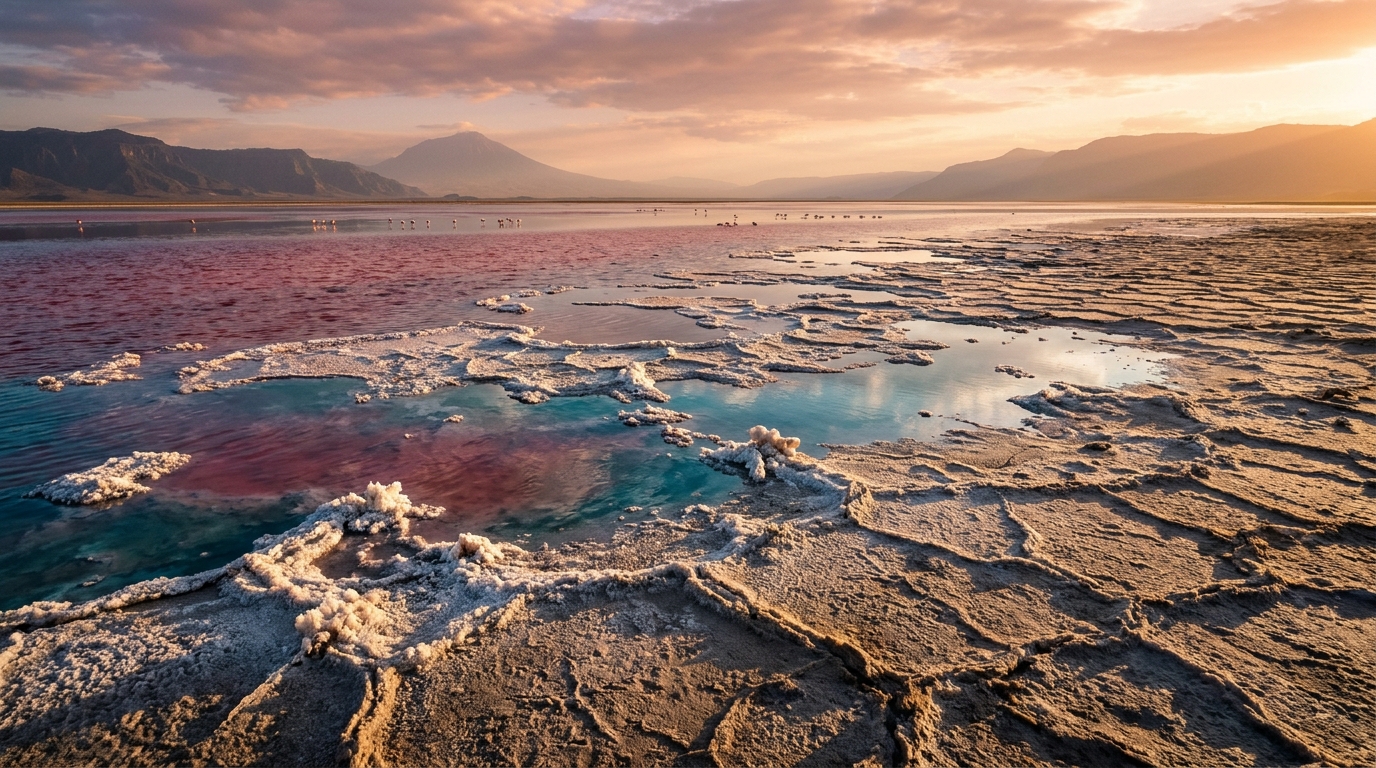
Soda lakes are among the harshest aquatic habitats on Earth, and one of the least explored sits in northern Tanzania. Small Momela Lake, a shallow alkaline basin inside Arusha National Park, has now received its first shotgun metagenomic analysis, and the results sketch a microbial community built for survival in water that registers a pH near 9.8 and salinity between roughly 12 and 14 practical salinity units. Researchers report 27 distinct bacterial species across the lake’s water and sediment, dominated by sulfur-cycling Thioalkalivibrio denitrificans and uncultured Candidatus lineages, along with a dense repertoire of genes tied to nucleotide and amino acid biosynthesis, pH homeostasis, osmotic stress tolerance and carbon fixation. Because the work is exploratory and based on pooled samples, the authors frame it as baseline data rather than a definitive map of the lake’s ecology, but it still expands the known biogeography of extremophilic bacteria in East Africa.
The study, published in Discover Life, was led by Angela A. Siima and colleagues at the University of Dar es Salaam. In July 2024 the team collected water and sediment from ten points spaced 300 to 400 meters apart along the shoreline. Each point yielded triplicate water samples of 200 milliliters taken at the surface and triplicate sediment scoops from depths of roughly 2 to 5 centimeters. Samples reached the laboratory within 24 hours in a cool box, where DNA was extracted using a commercial kit and checked for purity. Financial constraints led the team to pool all water-derived DNA into one composite sample, labeled SMW1, and all sediment-derived DNA into another, SMS1, before shipping them to Macrogen in the United Kingdom for sequencing.
On-site probes recorded temperatures between 21.05 and 23.91 degrees Celsius, pH values from 9.75 to 9.83, and salinity from 11.97 to 14.01 psu. Electrical conductivity and total dissolved salts were comparatively moderate, at 3.308 to 3.355 mS/cm and 733 to 848 ppm respectively, values the authors attribute partly to sampling timing and the particular mixture of carbonate, bicarbonate, chloride, sulfate, phosphate and nitrate salts dissolved in the water. Those measurements confirm what the lake’s flamingos and zebra-grazed shores already suggest: this is an extreme environment where only specially adapted microorganisms should thrive, and any bacteria found there must carry molecular equipment for coping with alkalinity and salt.
Sequencing on an Illumina NovaSeq platform produced about 18 million raw reads for the sediment pool and 24 million for the water pool, which after quality filtering left roughly 16.1 million and 22.1 million high-quality reads. Taxonomic profiling with MetaPhlAn4 assigned 100 percent of those reads to the domain Bacteria. No archaeal taxa passed the pipeline’s stringent marker gene coverage threshold, which requires more than 33 percent of reads to map to a species’ marker genes. The authors suggest that any archaea present may be genetically distant from reference genomes in the database or remained in the unclassified fraction, and note that pooling and shoreline-only sampling may have limited detection of niche-restricted taxa often tied to deeper sediments or localized hypersaline microhabitats.
The 27 species spanned five phyla: Pseudomonadota, Bacteroidota, Firmicutes, Cyanobacteria and Verrucomicrobia, organized into 12 classes, 20 families and 23 genera. Twelve species appeared in the sediment sample and 25 in the water sample, a reversal of the usual expectation that sediments harbor more diversity. The team attributes this partly to the sediment pool’s lower sequencing depth, which limits detection of rare taxa, and partly to the poorer representation of benthic soda lake communities in reference databases, which can leave more sediment reads unclassified. They caution that the reported sediment richness likely underestimates the true diversity of the lake floor.
Dominance patterns differed sharply between the two habitats. Thioalkalivibrio denitrificans, a haloalkaliphilic bacterium that cycles sulfur and nitrogen, made up 49.9 percent of the sediment community and 14.3 percent of the water community. The uncultured lineage Ca. GGB45747 SGB63468 accounted for 36.8 percent of sediment and 21.4 percent of water, while Ca. GGB59200 SGB80967 comprised 43 percent of the water sample. T. denitrificans was previously reported from Lake Bogoria in Kenya, so this study marks its first detection in a Tanzanian soda lake. High relative abundances of Candidatus species, which have not yet been isolated in culture, indicate that these poorly characterized lineages are potentially dominant members of the community and likely play key ecological roles in haloalkaline conditions.
Subdominant species shared by water and sediment included Glycocaulis profundi, Natronoflexus pectinivorans and Thioalkalivibrio sulfidiphilus. Based on currently available literature and reference databases, the authors report that G. profundi may represent a first detection in a soda lake habitat anywhere, while N. pectinivorans may be only the second global observation in soda lake ecosystems and the first putative report from an African soda lake; the species was originally described from sediments in Russia’s Kulunda Steppe. Other low-abundance species detected in both habitats included Alkalicaulis satelles, Desulfurivibrio alkaliphilus, Thioalkalivibrio thiocyanodenitrificans and Bacillus lacisalsi, with A. satelles possibly a first global soda lake record and B. lacisalsi and Methylophaga lonarensis possibly first for an African soda lake. The authors stress that all these species-level assignments rest on marker gene profiling and should be treated as tentative until confirmed by genome-resolved metagenomics, targeted molecular validation or cultivation.
Functional profiling with HUMAnN3 detected 350,147 UniRef90 gene families across the lake, a slightly lower count than the 525,000 and 550,000 reported for the larger Ethiopian lakes Chitu and Shala, but still evidence that African soda lakes hold a genetic reservoir far beyond what culturing alone reveals. Sediment contributed 84,674 unique gene families absent from water, and water contributed 167,607 unique families, pointing to a shared core of metabolic functions alongside niche-specific differentiation. The most abundant pathways were superpathways PWY-7220 and PWY-7222, linked to de novo synthesis of the DNA precursors dAMP and dGMP, followed by PWY-7228 and PWY-7221 for guanosine nucleotide biosynthesis. Amino acid biosynthesis pathways, including those for valine, L-isoleucine, L-methionine, L-arginine, L-histidine, branched-chain amino acids and L-serine with glycine, were more highly represented in water than sediment, a pattern also seen in Kulunda Steppe soda lakes where reduced sediment representation has been linked to maintenance-oriented metabolic strategies under prolonged hyperalkaline conditions.
Marker gene analysis sharpened the functional picture. Cation/proton antiporter genes (mrp and nha), central to keeping cytoplasmic pH neutral against alkaline surroundings, were more abundant in water at 56.79 copies per million than in sediment at 29.85 CPM, suggesting a high metabolic cost of pH regulation in the water column. The gene for L-ectoine synthase (ectC), which cells use to build compatible solutes against osmotic stress, was twice as enriched in water at 1.55 CPM versus 0.71 CPM, hinting that lake bacteria actively synthesize ectoine rather than relying solely on import. Genes for dissimilatory sulfate and sulfite reductase (dsr) were abundant in both habitats at 92.13 CPM in water and 55.14 CPM in sediment, while sulfur oxidation genes of the sox enzyme complex were higher in water at 14.98 CPM than in sediment at 5.86 CPM, indicating a complete, bidirectional sulfur cycle. The likely carriers are sulfate-reducing bacteria such as Desulfohalovibrio alkalitolerans and Desulfonatronovibrio hydrogenovorans and sulfur oxidizers including the three Thioalkalivibrio species detected. RuBisCO genes, the key enzyme of the Calvin-Benson-Bassham cycle favored in bicarbonate-rich soda lakes, appeared in both samples at 19.38 CPM in sediment and 27.09 CPM in water, consistent with carbon fixation by sulfur oxidizers and cyanobacteria.
The authors are explicit about the limits of what these numbers mean. Because all DNA was pooled before sequencing, the profiles describe a composite community rather than individual sampling points, and no statistical inference about within-lake variability is possible. Shoreline and surface access points may miss benthic populations in deeper water, and the beta diversity comparisons, which showed greater Bray-Curtis dissimilarity and weighted UniFrac distance in water but greater unweighted UniFrac distance in sediment, are interpreted descriptively only. Pooling may also have skewed the apparent abundance of some taxa. The team recommends analyzing individual samples separately, adding seasonal comparisons between dry and wet periods, and pursuing metatranscriptomic profiling or targeted culturomic validation of the Candidatus species. Even with those caveats, the study positions Small Momela Lake as a reservoir of novel, functional bacterial resources with potential relevance for biotechnology and bioprospecting, and adds a Tanzanian data point to a soda lake record previously dominated by Kenyan and Ethiopian systems.
Subject of Research: Shotgun metagenomic analysis of bacterial diversity and functional potential in Small Momela Lake, a soda lake in northern Tanzania
Article Title: Taxonomic diversity and functional prediction of extremophilic bacteria of small Momela Lake, Tanzania
Article References: Siima, A. A., Kaale, S. E., Mpenda, F. N., & Lyantagaye, S. L. (2026). Taxonomic diversity and functional prediction of extremophilic bacteria of small Momela Lake, Tanzania. Discover Life, 56(1), Article 28. https://doi.org/10.1007/s11084-026-09748-2
Image Credits: AI Generated
DOI: 10.1007/s11084-026-09748-2
Keywords: soda lakes, metagenomics, extremophiles, Small Momela Lake, Tanzania, Thioalkalivibrio, haloalkaliphilic bacteria, sulfur cycling, bioprospecting, microbial diversity, pH homeostasis, Arusha National Park
News Source: Drew Townsend. (November 5, 2026). Tanzanian Soda Lake Reveals 27 Bacterial Species in First Metagenomic Survey. Scienmag.