A research team has recorded, revalidated, and provided an updated taxonomic description of the springtail species Ballistura fitchioides from the Wayanad district of Kerala in India’s Western Ghats, accompanied by the assembly of its complete mitochondrial genome. The species belongs to the family Isotomidae and forms part of the Ballistura fitchi species group, which is structurally distinguished by a reduced count of chaetae on both the anterior and posterior surfaces of the dens.
Taxonomic classification within the genus traces back to 1906, when Carl Börner established Ballistura as a subgenus with Isotoma schoetti designated as the type species, after which Jan Stach elevated it to full generic status in 1947. Globally, twenty-one species of Ballistura have been cataloged across the Holarctic, Paleotropical, Neotropical, and Australian biogeographical realms. Prior to this investigation, only two species had been recorded from India: Ballistura bengalensis, documented in 1966, and Ballistura fitchi, which had previously been synonymized with Ballistura fitchioides in taxonomic literature.
Morphological definitions established by Mikhail Potapov place Ballistura within the Proisotoma complex based on a distinct suite of structural criteria. Members of the genus possess a smooth integument, fully separated abdominal segments IV, V, and VI, and a variable number of ommatidia ranging between 4 + 4 and 8 + 8. Additional diagnostic traits include an oval postantennal organ, the complete absence of ventromedial chaetae on the thorax, a bifurcated maxillary palp equipped with three sublobal hairs, dorsal tergal sensilla positioned near the p-row of chaetae, and a furca that ranges from well-developed with a cylindrical dens to distinctly reduced forms.
Within the genus, taxonomists provisionally separate species into two morphological groups based primarily on furcal chaetotaxy: the Ballistura schoetti group and the Ballistura fitchi group. While both lineages share broad structural similarities, they diverge sharply in the chaetal density of the dens. Species in the Ballistura fitchi group possess only one to two anterior chaetae and three to seven posterior chaetae, whereas representatives of the Ballistura schoetti group bear numerous chaetae across both dental surfaces.
The authors highlighted that relying solely on standard cytochrome c oxidase subunit I barcoding often creates ambiguities during molecular species identification in springtail genera such as Ballistura. To resolve these classification challenges, the researchers combined comprehensive morphological diagnostics with whole-mitogenome sequencing. Fieldwork was carried out in the Wayanad district, an ecologically diverse area situated on the western slopes of the Nilgiri hills at elevations between 700 and 1,500 meters, which receives an average annual precipitation of 2,322 millimeters across evergreen forests, deciduous woodlands, bamboo thickets, and agricultural plantations.
Surveys conducted between June and September 2020 sampled multiple localities across Wayanad, including forested and human-settled sectors in Meppady, Kalpetta, Meenangadi, Sultan Bathery, and Manathavady. Soil and humus cores measuring 100 cubic centimeters were excavated, and microarthropods were separated in the laboratory using Berlese extraction funnels. The specific specimens evaluated for the redescription were retrieved on September 9, 2020, from moist banana leaf litter mixed with soil in Muttil, Kolavayal, and subsequently cleared in lactic acid and mounted on glass slides using Hoyer’s medium.
For genomic analyses, DNA was isolated using a Chelex 100 extraction protocol followed by purification with a commercial spin column kit, allowing the post-extraction exoskeleton to be mounted as an anatomical voucher specimen. Sequencing was performed on an Illumina MiSeq platform utilizing paired-end chemistry, generating approximately 12.72 gigabases of raw sequence data. Following quality trimming with Trimmomatic to eliminate adapters and low-quality reads, 11.36 gigabases of filtered sequence reads were retained for genomic reconstruction.
De novo mitochondrial assembly using NOVOPlasty software yielded a circularized mitochondrial genome spanning 13,492 base pairs with an overall guanine-cytosine content of 31.20 percent. Gene annotation through MITOS identified thirty-three coding elements, comprising twelve protein-coding genes, nineteen transfer RNA genes, and two ribosomal RNA genes. The annotated mitogenome sequence was deposited in the NCBI GenBank repository under accession number PV710478, providing a genetic baseline for comparative analyses within the genus.
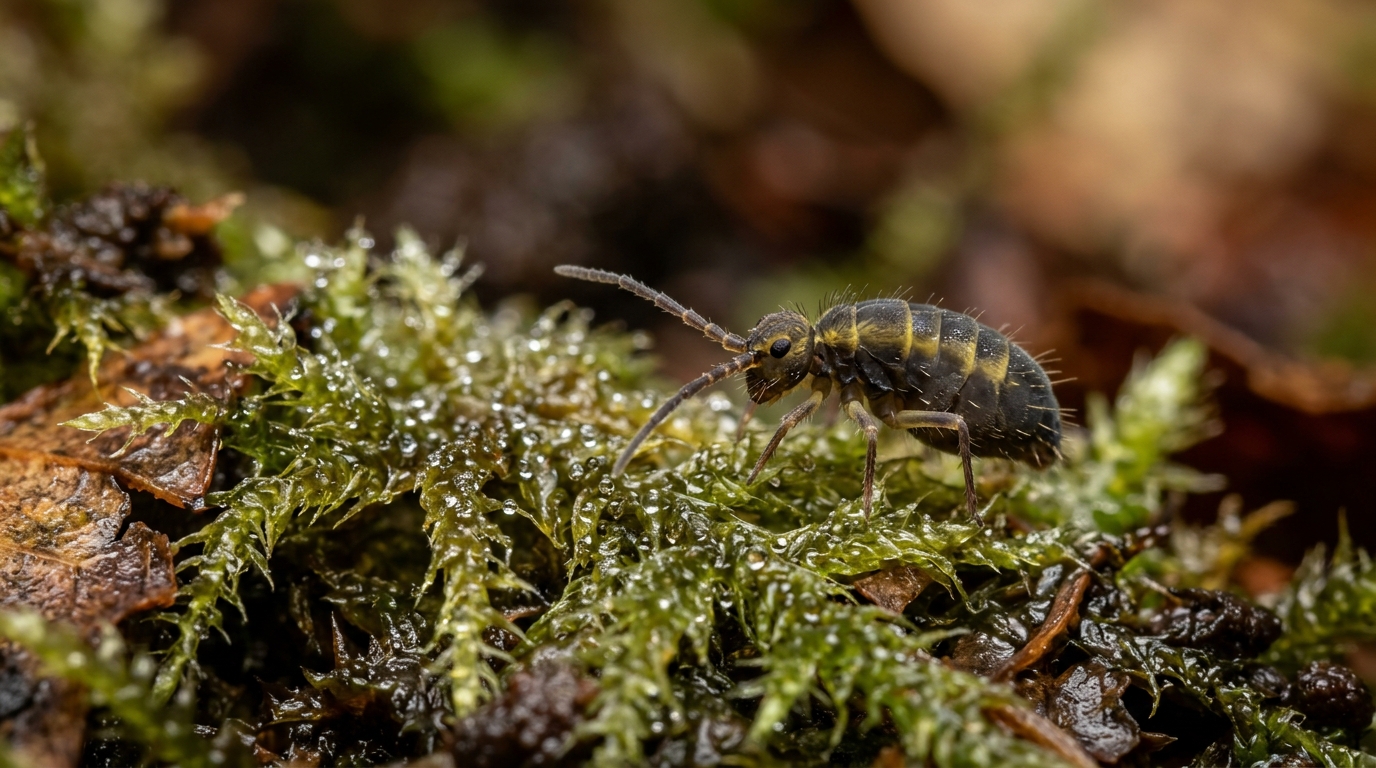
Morphological examination of the adult specimens revealed an overall body length ranging from 0.9 to 1.1 millimeters, characterized by a plump habitus and dark blue living coloration that fades to pale grey in alcohol. Dark grayish-brown pigmentation covers the body, leaving only the tips of appendages and the furca unpigmented, while secondary integumentary granulation is absent. The head bears 8 + 8 subequal ocelli and an elliptical, unconstricted postantennal organ approximately 2.5 times the length of ocular diameter B.
Microscopic evaluation defined specific chaetal distributions across the body and appendages, including precise leg formulas and clavate tenent hairs on the tibiotarsi. The furcal apparatus features a manubrium bearing nineteen to twenty-two posterior chaetal pairs and lacking anterior chaetae, connected to a posteriorly crenulated dens carrying seven or six posterior chaetae and a single anterior chaeta. The furca terminates in a bidentate mucro supported by a pronounced basal membrane, matching the diagnostic anatomy expected of the species.
In comparative evaluations, the Wayanad material matched the original description of Ballistura fitchioides provided by Denis in 1947 from Devarshola in the Nilgiris, a location situated approximately 35 kilometers from the current collection site. Morphological comparisons also revealed close structural affinities with Ballistura fitchi from Costa Rica and Ballistura veletensis from Spain, though differences in ventral tube chaetotaxy and tenent hair structure separate these forms. While earlier taxonomic publications proposed synonymizing Ballistura fitchioides with Ballistura fitchi, original type specimens preserved in Paris appear to be lost, meaning topotypic material would be required before formal synonymy could be established.
The study concludes that the newly assembled mitogenome of Ballistura fitchioides provides an essential reference point for the genomic characterization of the genus Ballistura, where genetic data has historically been restricted almost entirely to Ballistura schoetti. The authors noted that expanded sampling and molecular analysis across additional species remain necessary to fully map the evolutionary pathways and phylogenetic architecture of these soil-dwelling microarthropods.
Beyond general body dimensions, the investigation established an anatomical baseline for the antennae and cephalic structures of the Wayanad specimens. The antennae equal the head in length, demonstrating a segment length ratio of 1:1.2:1.2:2.4 from base to apex. The fourth segment carries numerous thin-walled sensory structures resembling ordinary chaetae. The third segment lacks basal microsensilla, bears 21 ordinary chaetae, and houses an antennal sense organ of two rod-like sensilla flanked by two guard chaetae. The second segment possesses one dorsal basal microsensillum, one ventro-lateral distal sensillum, and 15 ordinary chaetae, while the first segment incorporates dorsal and ventral basal microsensilla, two ventral sensilla, and a whorl of 11 ordinary chaetae. The head displays three interocellar chaetae across the ocular area and three guard chaetae surrounding the postantennal organ.
The researchers also delineated the mouthparts and ventral cephalic chaetotaxy, providing diagnostic features that aid in distinguishing the species from allied taxa. The prelabral and labral chaetotaxy follows a formula of 2/5, 5, 4, terminating in a smooth distal margin. Each maxillary palp is bifurcated, bearing three sublobal hairs and one basomedian chaeta, while maxilla lamella 1 is narrow, ciliate along its outer margins, and surpasses the capitulum tip. The labium presents papillae A through E, wherein papilla E possesses a blunt lateral process and six guard chaetae, with guard chaeta e7 absent. The labial base is supported by three proximal, four basomedian, and five basolateral chaetae, while the ventral head surface features 3+3 postlabial chaetae.
Axial and sensillar mapping across the body segments further refined the taxonomic profile of the species. Across thoracic segment II through abdominal segment IV, axial chaetal counts were recorded as 5–6,5/4,4,4,7, with the posterior rows of the second and third thoracic segments each carrying 16 to 18 ordinary chaetae. The dorsal surface is covered by short, smooth chaetae without differentiated tergal macrochaetae, and the thoracic venter lacks chaetae. Tergal sensilla are noticeably shorter and thinner than ordinary chaetae. The formal microsensillar and sensillar distribution follows the formula 1, 1/1, 1, 1 ms and 3, 3/2, 2, 2, 2, 4 s, respectively. On the sixth abdominal segment, the lateral valve carries 17 chaetae and one h microchaeta, while the ventral tube bears 3+3 apical and 1+1 posterior chaetae.
Appendicular morphology and furcal dimensions supplied further diagnostic precision. Across legs one through three, chaetal numbers are cataloged as 1, 3, 3 on the upper subcoxae; 1, 5, 5 on the lower subcoxae; 3–4, 5, 5 on the coxae; 7, 7, 6 on the trochanters; 15, 14, 14 on the femora; and 21, 21, 22 on the tibiotarsi. Tibiotarsal whorl B includes position B4/5, and the claw features an untoothed unguis alongside a lanceolate unguiculus. The tenaculum possesses 3+3 teeth and a single chaeta. The furcal apparatus exhibits a length proportion of 3.5:2.4:1 across the manubrium, dens, and mucro, supported by anterior and posterior furcal subcoxae carrying 12 to 14 and 5 chaetae, respectively.
To ensure reproducibility and long-term curation, the examined specimens and genomic vouchers were distributed across international and national repositories. Six primary specimens, comprising four males and two females collected under accession number 3790/H14, were placed in the Zoological Survey of India in Kolkata, alongside the mounted voucher cuticle recovered following Chelex DNA extraction. An additional series of four slide-mounted individuals, consisting of three males and one female, was deposited in the Molecular Biodiversity Lab repository at the Government Arts College in Ooty, India, while four comparative specimens were integrated into the collections of the Museo Nacional de Ciencias Naturales in Madrid, Spain.
Subject of Research: Redescription and complete mitochondrial genome characterization of the springtail Ballistura fitchioides
Article Title: Description of Ballistura fitchioides (Collembola; Isotomidae) from the Wayanad, Kerala, India with its mitogenome
Article References: Anjooriya, J., Arbea, J. I., Narmatha, S., Mandal, G. P., & Sanil, R. (2025). Description of Ballistura fitchioides (Collembola; Isotomidae) from the Wayanad, Kerala, India with its mitogenome. Current Genetics, 71(1), Article 14. https://doi.org/10.1007/s00294-025-01316-x
Image Credits: AI Generated
DOI: 10.1007/s00294-025-01316-x
Keywords: Ballistura fitchioides, Collembola, Isotomidae, mitochondrial genome, Western Ghats, taxonomy, entomology, phylogenetics, Description, Ballistura, fitchioides, Wayanad
News Source: Juliet Wilcox. (November 6, 2026). Researchers Revalidate Indian Springtail Species and Sequence Its Complete Mitochondrial Genome. Scienmag.