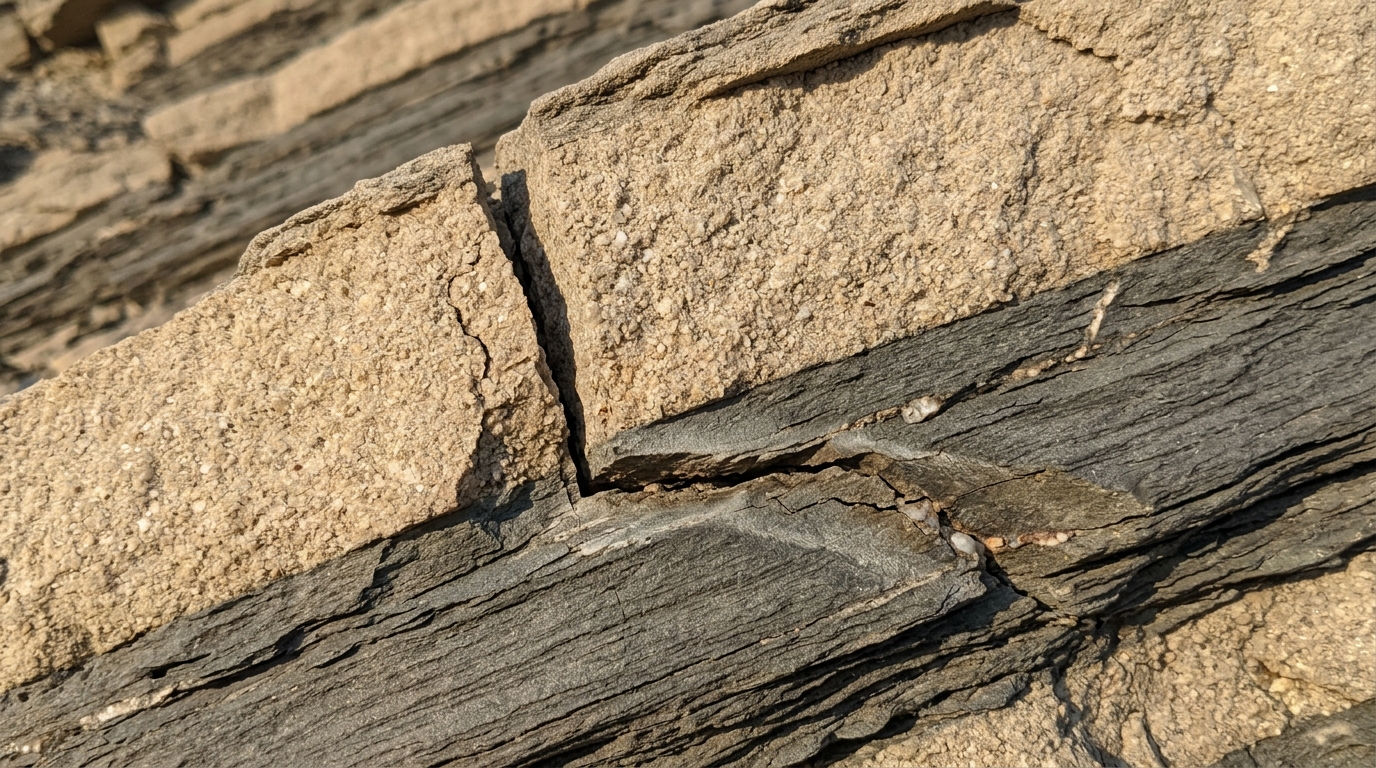
Sandstone-shale-sandstone interbedded reservoirs are common targets in unconventional oil and gas development, yet the mechanisms by which fractures propagate and deflect under the influence of interfacial shear stress during hydraulic fracturing have remained poorly understood. A new study addresses this gap with a three-dimensional discrete lattice–fluid network coupled model, analytically validated, designed to reveal how fractures behave when driven by shear stress at layer interfaces. The work systematically examined the effects of formation dip angle and fracture initiation position on propagation paths.
Under parallel stacking conditions, the model showed that fractures exhibit regular double-wing propagation, and the dip angle has a negligible influence on deflection behavior. The picture changes dramatically in stacking configurations, where the fracture deflection angle increases nonlinearly with the dip angle. The deflection angle rises from 3.7° at a 5° dip to 8.6° at a 12.5° dip, a nonlinear expansion that the authors link directly to amplified interfacial shear stress at steeper dips.
The study reveals that fracture networks tend to propagate along the normal direction of the sandstone, a trend that intensifies at steeper dips. Interfacial shear stress is identified as the dominant mechanical factor controlling deflection, regulating the stress intensity factor ratio through the dip angle and thereby determining the propagation path. This mechanism explains how interlayer dip angle differences drive mixed-mode fracture propagation via interfacial shear.
To translate these findings into practice, the researchers established a quantitative prediction model and a response-surface-based design chart for fracture deflection angles. Using Response Surface Methodology, they identified an optimal dip angle range of 6° to 8° and a mid-shale initiation location to maximize Stimulated Reservoir Volume. The work also demonstrates that inclined geological stacking configurations inherently promote fracture network complexity, offering theoretical and practical foundations for optimizing hydraulic fracturing in multi-layer reservoirs.
The modeling framework itself represents a methodological advance: a novel 3D discrete lattice–fluid coupled numerical framework capable of simulating dynamic mixed-mode fracture propagation and deflection behaviors within sandstone–shale–sandstone stacked interlayers. Its analytical validation lends credibility to the simulated fracture paths and deflection angles reported across the tested dip configurations.
For engineers designing fracturing treatments in multi-layer stacked reservoirs, the results suggest that dip angle is not a passive geological detail but an active control on fracture geometry. By choosing initiation positions within the mid-shale layer and operating within the identified optimal dip range, operators may be able to steer fracture networks toward greater complexity and larger stimulated volumes, according to the study’s engineering recommendations.
The study’s quantitative prediction model and response-surface design chart provide a practical tool for anticipating deflection angles before field deployment, reducing uncertainty in treatment design. As unconventional development increasingly targets interbedded formations, understanding how interfacial shear stress governs crack-tip stress intensity factor ratios could reshape how fracturing schedules are planned across varying dip geometries.
Overall, the research elucidates the mechanism by which interlayer dip angle differences drive mixed-mode fracture propagation through interfacial shear, and it delivers both a predictive framework and optimized engineering guidance for multi-layer stacked reservoir fracturing optimization.
Subject of Research: Mechanisms of hydraulic fracture propagation and deflection in sandstone-shale interlayers using a 3D discrete lattice model
Article Title: Mechanisms of fracture propagation and deflection in sandstone-shale interlayers: a 3D discrete lattice study
Article References: Huohai, Y., Hao, L., Fuwei, L., Bin, W., & Renze, L. (2026). Mechanisms of fracture propagation and deflection in sandstone-shale interlayers: a 3D discrete lattice study. Geomechanics and Geophysics for Geo-Energy and Geo-Resources. https://doi.org/10.1007/s40948-026-01249-w
Image Credits: AI Generated
DOI: 10.1007/s40948-026-01249-w
Keywords: hydraulic fracturing, sandstone-shale interlayers, fracture deflection, interfacial shear stress, 3D discrete lattice model, formation dip angle, stress intensity factor, unconventional reservoirs, stimulated reservoir volume, response surface methodology, fracture networks, multi-layer stacked reservoirs
News Source: Violet Maxwell. (November 5, 2026). Fracture Deflection in Sandstone-Shale Layers Driven by Dip Angle and Interfacial Shear Stress. Scienmag.