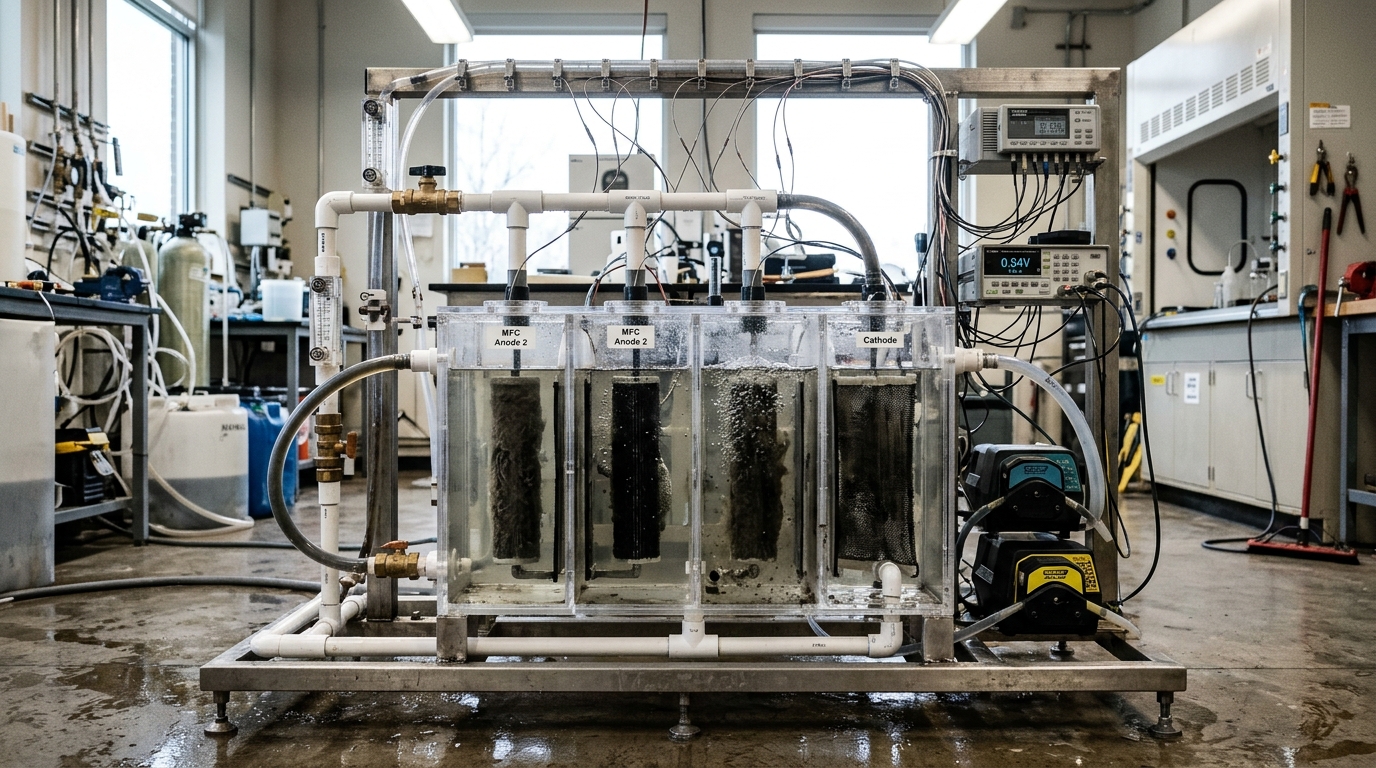
Microbial fuel cells, devices that let bacteria turn the organic matter in wastewater directly into electricity, are attracting renewed attention as a technology that could treat dirty water and generate renewable power at the same time. A critical review published in Green Technology, Resilience, and Sustainability examines how far the technology has come, what limits its performance, and what would need to change before it can move beyond laboratory prototypes. The review, authored by Abhijeet Das and Satchidananda Mishra, was published on 1 September 2025 as an open-access article in volume 5 of the journal.
The core idea is bioelectrochemical. In a typical microbial fuel cell, an anaerobic anode chamber and an aerobic cathode chamber are separated by a proton exchange membrane. Electrochemically active bacteria colonize the anode surface as biofilms and oxidize organic substrates from the wastewater, releasing electrons and protons in the process. The electrons are captured by the anode and travel through an external circuit to the cathode, producing an electric current, while the protons migrate across the membrane. At the cathode, oxygen from the air serves as the terminal electron acceptor, combining with electrons and protons to form water. The result is a continuous flow of electrons that can power small devices or be stored in batteries and capacitors, all while the organic pollutants in the wastewater are being broken down.
The organisms doing this work are known as exoelectrogens, and the review highlights several genera that dominate the field, including Geobacter, Shewanella, Pseudomonas, Desulfuromonas, and Clostridium. Species such as Geobacter sulfurreducens and Shewanella oneidensis are extensively studied because they transfer electrons directly to the electrode using outer membrane cytochromes or conductive pili, sometimes called nanowires, without needing external chemical mediators. Other microbes rely on mediated electron transfer, in which soluble redox compounds such as flavins or phenazines shuttle electrons to the anode. Mediated transfer can broaden the range of usable microorganisms, but the review notes it generally delivers lower electron transfer efficiency and raises concerns about toxicity, cost, and environmental persistence.
Why does this matter for sustainability? The review frames wastewater as an underused energy reservoir. Municipal treatment facilities commonly receive wastewater with a total chemical oxygen demand between 300 and 800 mg/L, which corresponds to an energy content of roughly 1.16 to 3.09 kWh per cubic metre. According to the cited analysis, the energy available in wastewater as chemical oxygen demand is anywhere from two to ten times larger than the energy consumed to treat it, and one cited estimate puts the energy content of municipal wastewater at 9.3 times the processing requirements of a modern treatment plant. Conventional activated sludge systems, by contrast, are described as energy-intensive, expensive, and significant emitters of greenhouse gases, while also producing sludge that requires disposal and releasing volatile compounds.
The reported performance figures are modest but real. The review states that microbial fuel cells can generate 0.026 kWh per cubic metre of normalized energy recovery, or 0.080 kWh per kilogram of chemical oxygen demand, from municipal wastewater. High Coulombic efficiency and organic matter removal allow MFCs to reduce up to 80 percent of COD, and effluent quality with COD below 20 mg per litre has been achieved. Sludge generation is another advantage: where an activated sludge system yields 0.4 to 0.8 gVS per gram of COD, an MFC produces around 0.1 gVS per gram of COD, reducing secondary contamination and the energy costs of sludge handling. MFCs also work at ambient temperature and pressure, use naturally occurring microbial communities, and require minimal chemical input, which the authors argue makes them suitable for decentralized treatment in regions with limited infrastructure.
Recent case studies reviewed in the paper show the range of substrates and designs being tested. A response surface methodology study optimized low-cost MFCs using earthen pot separators, stainless-steel mesh electrodes, and activated carbon-manganese oxide catalysts, finding ideal conditions with acidic pH, strong external resistance, and acetic acid as a co-substrate. An MFC with a microalgae-based biocathode treating ghee industry effluent reached 96 percent treatment efficiency, though abiotic cathodes produced more power at 13.7 mW per square metre. In a constructed wetland hybrid, full syphon recirculation mode tripled power output compared with other recirculation modes, achieving a peak power density of 1.15 mW per litre, a Coulombic efficiency of 19.28 percent, and normalized energy recovery of 128.15 Wh per kilogram COD. A stacked MFC using a microalgae-bacteria consortium to treat pig slurry reached 550 mV and 153 mW per square metre while recovering 100 percent of ammonium-nitrogen and over 60 percent of phosphate-phosphorus, with biomass outputs comparable to commercial fertilizers.
The obstacles, however, are substantial and the review is candid about them. Power density drops significantly as reactor size increases, driven by elevated internal resistance, longer ion transport paths, and uneven substrate distribution that creates dead zones and weak biofilm-electrode contact. Single units typically produce less than 0.5 volts, so multiple units are connected in series or parallel, but these arrangements are prone to voltage reversal caused by asymmetries in substrate loading, electrode fouling, or biofilm degradation, which can turn individual units into energy sinks. Small-scale MFCs may achieve normalized energy recovery values of 0.64 kWh per cubic metre under ideal conditions, whereas larger systems struggle to reach 0.3 kWh per cubic metre. Real wastewater, with its suspended solids and complex organic molecules, also causes fouling and clogging of electrodes, and the biofilm on the anode can become unstable over time, affecting current output and reliability.
Cost is the other persistent barrier. The review reports that MFCs incur a capital cost roughly 30 times higher than a conventional activated sludge system for domestic wastewater, with anticipated expenses ranging from three to nine dollars per kilogram of COD. Electrodes are often the most expensive components, accounting for 62.6 percent of total system costs in one 1500-litre system and 43.3 percent in another study. Platinum-catalyzed carbon cathodes accounted for 47 percent and 88 percent of overall MFC expenses in two separate studies, with projected costs between 560 and 1500 US dollars per square metre. The ion exchange membrane is the second most costly component at an estimated 38 percent of system cost, prompting proposals to replace Nafion membranes, priced around 1400 US dollars per square metre, with cheaper cation exchange membranes such as CMI-700 or non-woven carbon fabric separators costing as little as 1 US dollar per square metre.
Integration with existing infrastructure has also disappointed so far. One study evaluated inserting MFCs into the aeration tanks of current treatment plants and found only marginal COD elimination and restricted electricity production, with cathode fouling attributed to high mixed liquor volatile suspended solids and aeration possibly allowing oxygen into the anode chamber; the researchers concluded such integration is impractical. A separate study combining MFCs with anaerobic digestion found that power recovered constituted just 7 to 13 percent of the total, with the remainder coming from methane, leading that team to conclude the combination is impractical as well. The review also documents sensitivity to operating conditions: performance is generally best at pH between 7 and 8, and higher temperatures boost electricity production, though electroactive consortia can still remove COD and generate electricity even at 4 degrees Celsius, making the technology relevant for cold regions with modest wastewater flows.
The authors argue that the path forward lies in cheaper, waste-derived or bio-based electrode materials, modular and hybrid system designs, advanced modelling tools such as response surface methodology and artificial intelligence to optimize operating parameters, and genetically enriched microbial communities to enhance electron transfer and pollutant degradation. They also call for energy storage integration to smooth the intermittent power output, and for policy measures including subsidies, standards, and cross-sector cooperation to drive commercialization. Whether microbial fuel cells can deliver on their dual promise of clean water and renewable energy at scale remains an open question, but the review positions them as a technology worth continued investment, particularly for decentralized applications where conventional treatment is neither affordable nor available.
Subject of Research: Microbial fuel cells for simultaneous wastewater treatment and bioelectricity generation
Article Title: Synergizing clean water, renewable energy, and circularity: a critical study of microbial fuel cells
Article References: Das, A., & Mishra, S. (2025). Synergizing clean water, renewable energy, and circularity: a critical study of microbial fuel cells. Green Technology, Resilience, and Sustainability, 5(1), Article 3. https://doi.org/10.1007/s44173-025-00020-w
Image Credits: AI Generated
DOI: 10.1007/s44173-025-00020-w
Keywords: microbial fuel cells, wastewater treatment, renewable energy, bioelectricity, exoelectrogens, circular economy, proton exchange membrane, chemical oxygen demand, electrode materials, scalability, decentralized treatment, Synergizing
News Source: Victoria Harrison. (November 6, 2026). Microbial fuel cells promise clean water and power but scaling remains a hurdle. Scienmag.