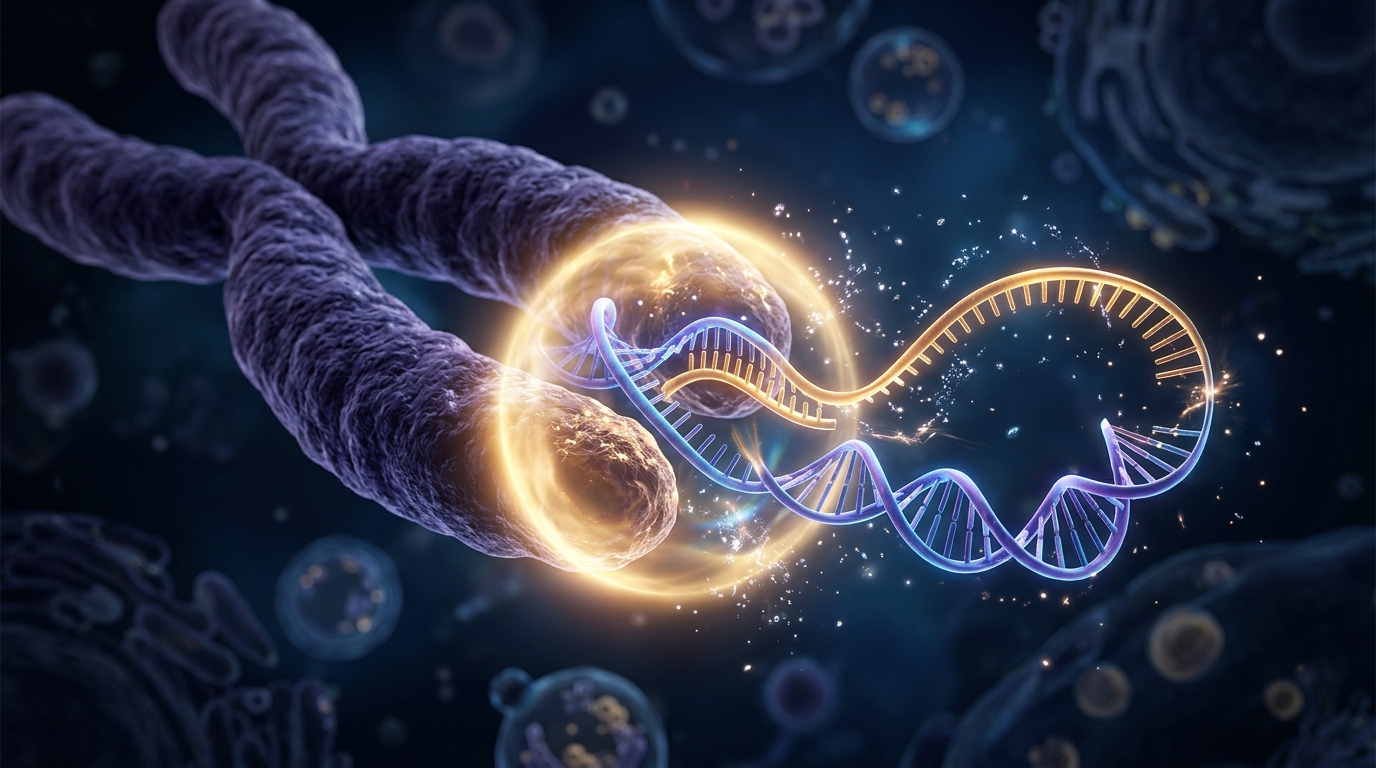
Telomeres, the protective caps at the ends of linear chromosomes, are no longer seen as silent stretches of DNA. A new review in Frontiers in Aging argues that they are active hubs where transcription, replication and chromatin regulation constantly collide, and that the long non-coding RNA TERRA sits at the center of this collision. The authors, led by Surajit Pathak of Chettinad Hospital and Research Institute in Chennai and Asim K. Duttaroy of the University of Oslo, synthesize evidence that RNA-DNA hybrids called R-loops, formed when TERRA pairs with telomeric DNA, can either help maintain chromosome ends or push them toward instability, depending on how tightly the cell controls them.
The review’s central claim is that telomeres are structurally predisposed to trouble. Vertebrate telomeric DNA consists of the 5′-TTAGGG-3′ repeat extended over several kilobases, ending in a single-stranded, guanine-rich 3′ overhang. This overhang folds into a lariat-like T-loop, in which it invades the double-stranded telomeric region, and together with the six-protein shelterin complex, comprising TRF1, TRF2, RAP1, TIN2, TPP1 and POT1, it prevents chromosome ends from being recognized as DNA breaks by the ATM and ATR kinases that coordinate the DNA damage response. Yet the same repetitive, guanine-rich sequence readily forms secondary structures such as G-quadruplexes, and standard DNA polymerases cannot fully copy the very ends of linear chromosomes, the so-called end-replication problem, so telomeres shorten with each cell division.
Replication at telomeres is also unusually exposed. In mammalian cells, telomeres are copied during mid-to-late S phase and, unlike most of the genome, are replicated unidirectionally from subtelomeric origins, leaving no opposing fork to rescue a stalled one. The review notes that telomeric replication stress arises from G-quadruplexes, T-loop resolution, TERRA-induced R-loops and chromatin compaction, and that protective factors such as TRF1 and the helicases BLM, WRN and RTEL1 normally help forks push through. When these safeguards fail, stalled forks collapse, producing fragile telomeres and break-induced replication, a recombination-based repair pathway that is especially active in ALT cancers.
TERRA itself is a product of this activity. Once thought to be transcriptionally silent, telomeres are now recognized as transcribed regions where RNA polymerase II produces TERRA, a long non-coding RNA generated from subtelomeric promoters and composed of subtelomeric sequences plus UUAGGG repeats. TERRA transcripts are guanine-rich, predominantly capped and partially polyadenylated, and their transcription is tightly regulated across the cell cycle, peaking in G1 and dropping in S phase to limit RNA-DNA hybridization during replication. Subtelomeric DNA methylation and repressive histone marks such as H3K9me3 suppress TERRA transcription, while loss of the chromatin remodeler ATRX, common in ALT cancers, permits high TERRA levels and telomere instability.
R-loops form when newly synthesized RNA hybridizes back onto its DNA template, displacing the single-stranded strand. At telomeres, TERRA binds the C-rich telomeric DNA strand and displaces the G-rich strand. The review emphasizes that these structures are well characterized in yeast, telomerase-deficient cells and especially ALT cancers, and can arise either locally through RNA-DNA hybridization or via RAD51-mediated strand invasion that supports homology-directed repair of short telomeres. Controlled hybrid formation is part of telomere maintenance, but stable R-loops, particularly in ALT cells or cells lacking RNase H1, can block replication fork movement, trigger transcription-replication conflicts and generate DNA double-strand breaks. Cells counter this with RNase H1 and H2 enzymes and helicases such as Senataxin and DDX proteins, which require BRCA1/2 assistance.
Transcription-replication conflicts at telomeres occur when replication forks meet RNA polymerase II during TERRA transcription, most damagingly in head-on collisions where the two machineries travel in opposite directions. Co-directional collisions are less deleterious but still challenging under high transcriptional stress. The review describes how unregulated TERRA transcription, especially in telomerase-negative and ALT cells, contributes to these conflicts, telomere dysfunction-induced foci and telomere instability. Cells respond with fork reversal and recruitment of R-loop-resolving enzymes including RNase H1, FEN1, UPF1 and the helicases BLM, WRN and RTEL1 through the shelterin proteins TRF1 and TRF2. If protection fails, forks collapse into single-ended double-strand breaks that are mostly repaired by break-induced replication, with unresolved stress also driving mitotic DNA synthesis or telomere relocation to the nuclear pore complex.
The shelterin complex, rather than blocking R-loops outright, mediates a dynamic equilibrium between their formation and resolution. TRF2 promotes and stabilizes TERRA R-loops by interacting with TERRA and recombination proteins such as RAD51, while RAP1 indirectly regulates TERRA expression and subtelomeric transcription. TRF1 limits the number of TERRA R-loops, particularly during S and G2 phases, through interactions with tankyrase and RNA-processing proteins, allowing telomere replication to proceed. POT1 protects the single-stranded portion of telomeres from inappropriate nucleic acid interactions, and its deficiency is linked to accumulation of telomeric R-loops and DNA damage. The authors argue that disruption of this shelterin-TERRA balance, in cells already marked by high replication stress and alternative telomere maintenance, may drive genomic instability and tumor development.
Cancer exploits this vulnerability in two distinct ways. Most cancers reactivate telomerase, a ribonucleoprotein reverse transcriptase that adds TTAGGG repeats to chromosome ends and enables unlimited division. However, 10% to 15% of cancers use the alternative lengthening of telomeres pathway, which relies on recombination and is associated with high R-loop levels, break-induced replication and loss of ATRX/DAXX. In ALT cells, persistent telomeric R-loops and transcription-replication conflicts become the raw material for recombination-mediated telomere elongation, so the same structures that would push a normal cell into p53-mediated senescence instead fuel continued proliferation. Oncogene activation compounds the problem: RAS, MYC, Cyclin E1 and Cdc25A accelerate entry into S phase, excessively fire replication origins and raise transcription levels, while RAS-driven reactive oxygen species damage guanine-rich telomeric DNA, collectively producing telomere dysfunction-induced stress marked by fork instability, telomere shortening and DNA damage.
The review also highlights FANCM as a key regulator at ALT telomeres. FANCM localizes to ALT telomeres and cooperates with BRCA1 and BLM to resolve replication stress there. Its depletion causes failure of telomeric DNA replication and accumulation of replication stress markers, and further work showed that FANCM loss specifically leads to accumulation of TERRA R-loops at ALT telomeres, with elevated C-circle formation, PML bodies and replication stress. Reducing TERRA R-loops alleviated these effects, positioning FANCM as a potential ALT-specific therapeutic vulnerability. A summary table in the review catalogues the broader regulatory network, including RNase H1 and H2, RAD51, ATRX, TRF1, TRF2, RTEL1, BLM, WRN, Senataxin, UPF1, FEN1, TCOF1, ADAR1 and BRCA1/2, whose dysregulation contributes to telomere fragility and ALT-associated cancer progression.
Therapeutically, the review frames telomeric R-loop burden as an exploitable weakness. Tumors deficient in homologous recombination, such as BRCA1/2-mutated tumors, are highly sensitive to R-loop-induced DNA damage and respond well to PARP and ATR inhibitors, though the authors note there is no evidence that PARP inhibition itself causes accumulation of TERRA R-loops. Tumors with highly transcriptionally active oncogenes, such as Ewing sarcoma, show elevated R-loop levels and sensitivity to DNA damage, and excessive R-loops can activate the cGAS-STING pathway, potentially inducing antitumor immunity. Some anticancer therapies, including BRD4 inhibitors, induce R-loops as a killing mechanism, and altering R-loop-resolving helicases such as SETX has emerged as a strategy to sensitize tumors to radiation and chemotherapy. The authors caution that standard chemotherapy and radiotherapy, including agents such as doxorubicin, etoposide and platinum compounds, can themselves accelerate telomere shortening, reduce telomerase activity, destabilize shelterin and increase transcription-replication conflicts, with long-term adverse effects on normal tissues. New single-molecule and R-loop mapping technologies, from telomere PNA-FISH and DNA fiber analysis to R-loop CUT&Tag, long-read sequencing and super-resolution microscopy, are reshaping the field, and the authors suggest that therapies designed to rebalance the R-loop equilibrium may hold the key to treating cancers that depend on replication stress tolerance.
Subject of Research: The role of TERRA R-loops and transcription-replication conflicts at telomeres in genome instability and cancer
Article Title: Transcription–replication conflicts at telomeres: the emerging role of telomeric repeat-containing RNA (TERRA) R-loops in genome instability and cancer
Article References: Nambidi, S., Sennie, N. S., Pallatt, S., Banerjee, A., Scarpa, M., Pathak, S., & Duttaroy, A. K. (2026). Transcription–replication conflicts at telomeres: the emerging role of telomeric repeat-containing RNA (TERRA) R-loops in genome instability and cancer. Frontiers in Aging, 7, Article 1984937. https://doi.org/10.3389/fragi.2026.1984937
Image Credits: AI Generated
DOI: 10.3389/fragi.2026.1984937
Keywords: telomeres, TERRA, R-loops, transcription-replication conflicts, replication stress, alternative lengthening of telomeres, shelterin, break-induced replication, ATRX, FANCM, PARP inhibitors, genome instability
News Source: Nathaniel Bowman. (November 4, 2026). TERRA R-loops turn chromosome ends into cancer’s weak spot. Scienmag.