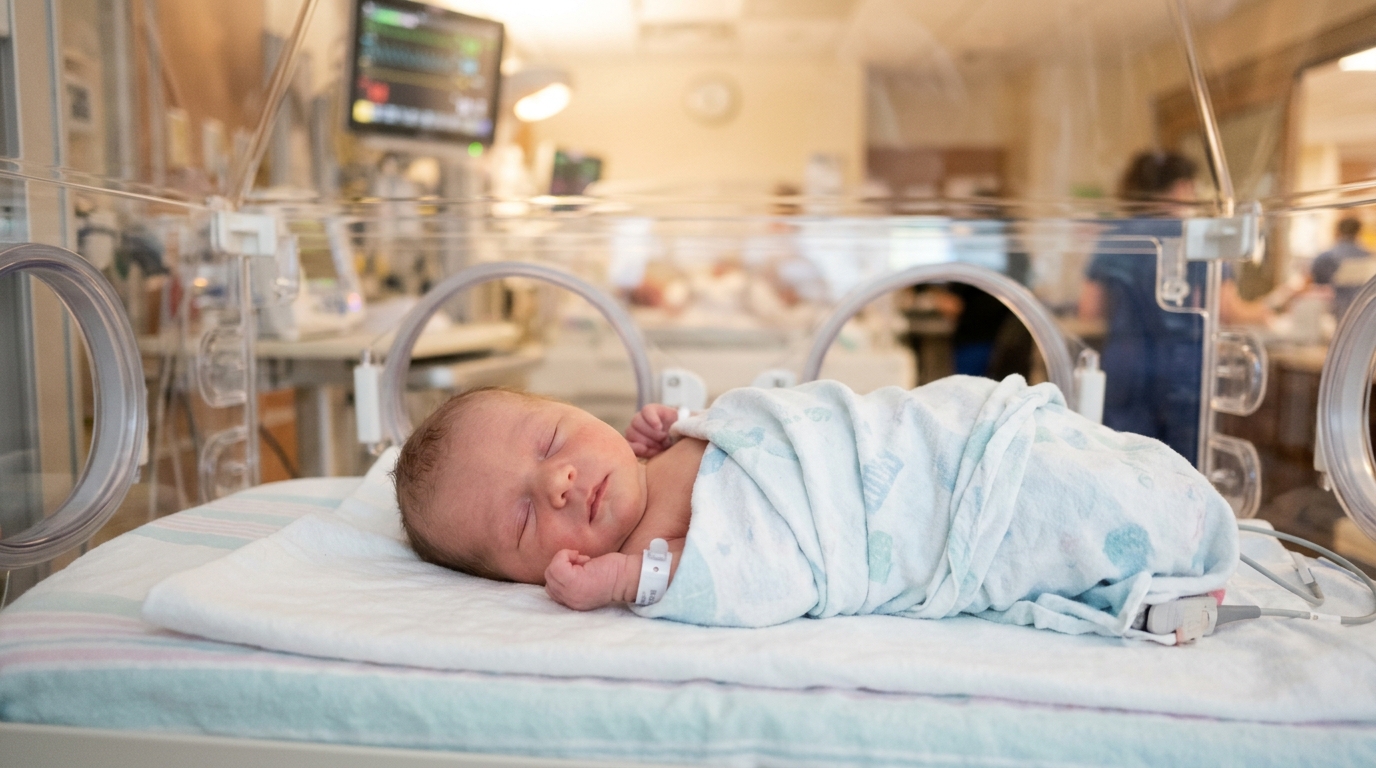
For more than three decades, parents have been told to put babies to sleep on their backs to reduce the risk of sudden infant death syndrome. Yet a nagging question has lingered among sleep specialists: in older children and adults, lying supine reliably makes sleep apnea worse, so could the same be true for newborns? A new analysis of polysomnograms from 261 neonates who required intensive care suggests that, with one striking exception, it is not. The findings, published in the Journal of Clinical Sleep Medicine, indicate that supine sleep does not appear to increase sleep apnea severity in newborns receiving hospital care, and that the life-saving “Back to Sleep” recommendation is unlikely to raise apnea risk.
The study, led by researchers at the University of Michigan and collaborators at multiple institutions, took advantage of a rare situation in neonatal intensive care units. Infants recovering from myelomeningocele repair, the most severe form of spina bifida, are often positioned on their sides or even prone to keep pressure off the surgical site, while other NICU patients also spend time in nonsupine positions. Because a randomized trial of sleep positions in newborns would raise safety concerns, the team instead leveraged observational data from three existing cohort studies in which sleep position had been recorded by technologists at the bedside during full, attended polysomnograms.
The participants included 173 infants with myelomeningocele enrolled across multiple hospitals and 88 infants without congenital anomalies who were late-preterm to term and recovering in the NICU. The latter group came from two single-center studies, one examining brain responses to maternal voice during sleep and another testing automated sleep staging, which shared identical 12-hour recording protocols and were pooled into a single “NICU recovery” cohort. The myelomeningocele group was subdivided by repair type into postnatal surgery, open fetal surgery, and fetoscopic surgery categories, reflecting the timing and technique of spinal closure chosen by local clinical teams.
Each infant underwent a polysomnogram at the bedside before hospital discharge, with a registered polysomnographic technologist present throughout to record sleep positions. The recordings captured a full neonatal montage of brain electrical activity, eye movements, muscle tone, nasal and oral airflow, chest and abdominal effort, oxygen saturation, transcutaneous carbon dioxide, and video. Sleep studies were scored according to contemporary American Academy of Sleep Medicine standards, and the apnea-hypopnea index, or AHI, was calculated as the combined number of apneas and hypopneas per hour of sleep. Indices were only counted for positions in which an infant slept at least 60 minutes, and prone observations, which were rare and concentrated at a single center, were combined with lateral positions into a nonsupine category.
Positioning patterns differed sharply between the cohorts. Infants in the NICU recovery group spent far more time supine, a median of 426.2 minutes, than nonsupine, a median of just 36 minutes. The myelomeningocele cohort showed the reverse: those with postnatal repair slept a median of 291 minutes nonsupine versus only 2.5 minutes supine, while the fetal surgery groups spent more comparable time in both positions. The distribution of sleep positions also varied significantly across the nine centers in the myelomeningocele study, reflecting differences in clinical positioning practices rather than study protocols.
To analyze the relationship between position and apnea severity, the researchers used a linear mixed model with log-transformed AHI, adjusting for gestational age and accounting for repeated observations within individual infants and for enrollment across multiple sites. The analytic sample comprised 346 observations from 255 participants, since six enrolled neonates contributed no usable sleep periods in either position. The study was powered at 94 percent to detect a clinically meaningful difference of at least 10 points in AHI between positions, and at 80 percent to detect a difference as small as 8.3 points.
The central result was a near-uniform absence of positional effect. Among the NICU recovery infants, the median AHI was 20.2 in both supine and nonsupine sleep, a statistically indistinguishable result. In adjusted analyses, AHI was similar between supine and nonsupine positions in the NICU recovery, postnatal repair, and open fetal repair groups, with all comparisons yielding p values greater than 0.33. This held true despite the fact that in older children and adults, supine sleep is consistently associated with higher AHI, a pattern so well established that its apparent absence in these newborns struck the investigators as remarkable.
The single exception came from the smallest subgroup. Infants who had undergone fetoscopic myelomeningocele repair, a relatively new minimally invasive technique, showed a substantially lower AHI when supine, with an estimated geometric mean of 7.94, compared with 22.15 when nonsupine, a difference that remained significant after adjustment and in sensitivity analyses. The positional difference was driven primarily by the hypopnea index, which had a median of zero supine versus 10.4 nonsupine, while obstructive and central apnea indices showed no within-group differences by position. The authors caution that this could be a spurious finding given the limited sample size of 34 infants in that group, and they lack a clear mechanistic explanation, though they speculate about altered postdelivery respiratory mechanics, brainstem outcomes affecting respiratory drive, or cerebral spinal fluid dynamics as possible pathways.
Notably, the myelomeningocele population did not show worse sleep apnea than the predominantly preterm NICU recovery cohort once gestational age was taken into account, suggesting that prematurity itself, with its immature respiratory control, contributes substantially to neonatal apnea severity. The researchers also place their findings in context alongside prior infant studies, including a home-monitoring study of 347 infants at high risk for sudden infant death syndrome that found nonsupine placement did not increase extreme cardiorespiratory events, and a 2008 study of 50 babies aged 8 to 12 months that found no significant supine versus nonsupine AHI difference. A more recent retrospective review of 72 infants under six months did report more obstructive events supine, but that study differed in design, population, and scoring criteria.
The mechanism protecting newborns remains uncertain, but the authors speculate that obligate nasal breathing may guard against gravity-related obstructive events such as mandibular retrusion and mouth breathing, and that adenotonsillar hypertrophy, a common positional driver of apnea in older children, is not routinely present in newborns. The study has limitations: it was a secondary analysis, sleep stage-specific AHI values were unavailable, positioning was not randomized so residual confounding cannot be excluded, and the findings come from hospital settings that may not translate directly to home. Still, the practical implications are considerable. The results support the reliability of polysomnographic data obtained during nonsupine sleep for most NICU infants, meaning assessment in either position may yield similar results, and they serve to allay concerns that the necessary, life-saving “Back to Sleep” intervention could simultaneously worsen sleep apnea.
Subject of Research: The relationship between infant sleep position and sleep apnea severity in newborns requiring neonatal intensive care
Article Title: Sleep position and sleep apnea in newborns
Article References: Matlen, L. B., Chervin, R. D., Barks, J. D. E., Hassan, F., Eyerly-Webb, S. A., Rocque, B. G., Bendel-Stenzel, E., Lloyd, R. M., Pascoe, J. E., Simakajornboon, N., Anadkat, J., Gliske, S. V., Jon, C., Tauber, D., McCaffery, H., Kaciroti, N., Rau, S. M. D., & Shellhaas, R. A. (2026). Sleep position and sleep apnea in newborns. Journal of Clinical Sleep Medicine, 22(1), Article 211. https://doi.org/10.1007/s44470-026-00218-0
Image Credits: AI Generated
DOI: 10.1007/s44470-026-00218-0
Keywords: sleep apnea, infants, sleep position, polysomnography, neonatal intensive care, myelomeningocele, Back to Sleep, apnea-hypopnea index, prematurity, SIDS, Sleep, position
News Source: Ophelia Keating. (November 4, 2026). Supine sleep does not worsen apnea in NICU newborns, study finds. Scienmag.