When a magnitude 6.9 earthquake struck northern Armenia in December 1988, it killed more than 25,000 people and left hundreds of survivors pinned under collapsed buildings. Among those pulled alive from the rubble, several hundred developed acute kidney injury within a short period, a phenomenon that gave rise to the term “renal disaster” — a simultaneous surge of crush-related kidney injury cases that overwhelms available dialysis resources. A new narrative review in the Journal of Emergency and Disaster Medicine revisits that catastrophe and compares it with outcomes from later major earthquakes to identify what has changed in disaster nephrology, and what the evidence still cannot prove.
The review, authored by Narine Muradyan, Samvel Hovhannisyan and Hasmik Haroyan, draws on an unpublished institutional analysis of the Spitak earthquake originally prepared at Yerevan State Medical University, supplemented by a targeted literature search covering crush syndrome and acute kidney injury across major earthquakes from 1988 through 2023, and archival records of the Armenian Ministry of Health. The authors describe their work as a narrative review with comparative descriptive analysis rather than a systematic synthesis, and they are explicit that the heterogeneity of the underlying data limits causal attribution of mortality differences to any single factor.
The medical logic of crush syndrome is well established in the review’s account of the pathophysiology. Prolonged compression causes skeletal-muscle ischemia and necrosis. When the compression is released, myoglobin, potassium, phosphate and other metabolites flood into the circulation during reperfusion, and this reperfusion injury is considered the critical trigger for the systemic toxicity that leads to renal failure and hyperkalemia, through vasoconstriction, direct tubular toxicity and intraluminal myoglobin cast formation. The duration of entrapment and the delay in fluid therapy are directly related to mortality, which is why immediate isotonic saline infusion before extrication is now recommended in field protocols to prevent shock and limit tubular precipitation of myoglobin.
The historical record assembled by the authors shows how badly conditions in Armenia deviated from that standard. The earthquake struck on December 7, 1988, but the first organized rescue teams did not reach the disaster zone until the evening of December 10; until then, rescue efforts were carried out primarily by military and police units, and planned rescue operations did not begin until the morning of December 12. Citing a 1998 analysis by Shoigu, Goncharov and Lobanov, the review notes that during earthquakes up to 40% of severely injured victims trapped under debris may die within the first six hours, 60% within the first day, and most of the remainder within three days, with 95% of all deaths occurring within five to six days, largely from dehydration and hypothermia.
The comparison with Neftegorsk is stark. Rescue efforts during the 1995 Neftegorsk earthquake were markedly more efficient than in Armenia: while only 9% of survivors in Armenia were extricated alive within the first 24 hours, in Neftegorsk the figure exceeded 31%; after three days, the corresponding figures were 51% and 85%. The review also reports that the incidence of crush syndrome has been estimated at 3.8% in Ashgabat and 23.8–29.0% in Armenia and Neftegorsk among patients with moderate to severe trauma. In total, 45,000 people were rescued alive during the Spitak earthquake, 12,500 were hospitalized, and 120,000 were evacuated, 75,000 of them outside Armenia. Direct material losses were estimated at approximately 10 billion USD, and 84 health-care institutions were destroyed; approximately 250 medical institutions in the Spitak area were destroyed outright, including 24 of 36 hospitals completely and 8 partially, and the loss of medical staff in some destroyed cities reached approximately 70%.
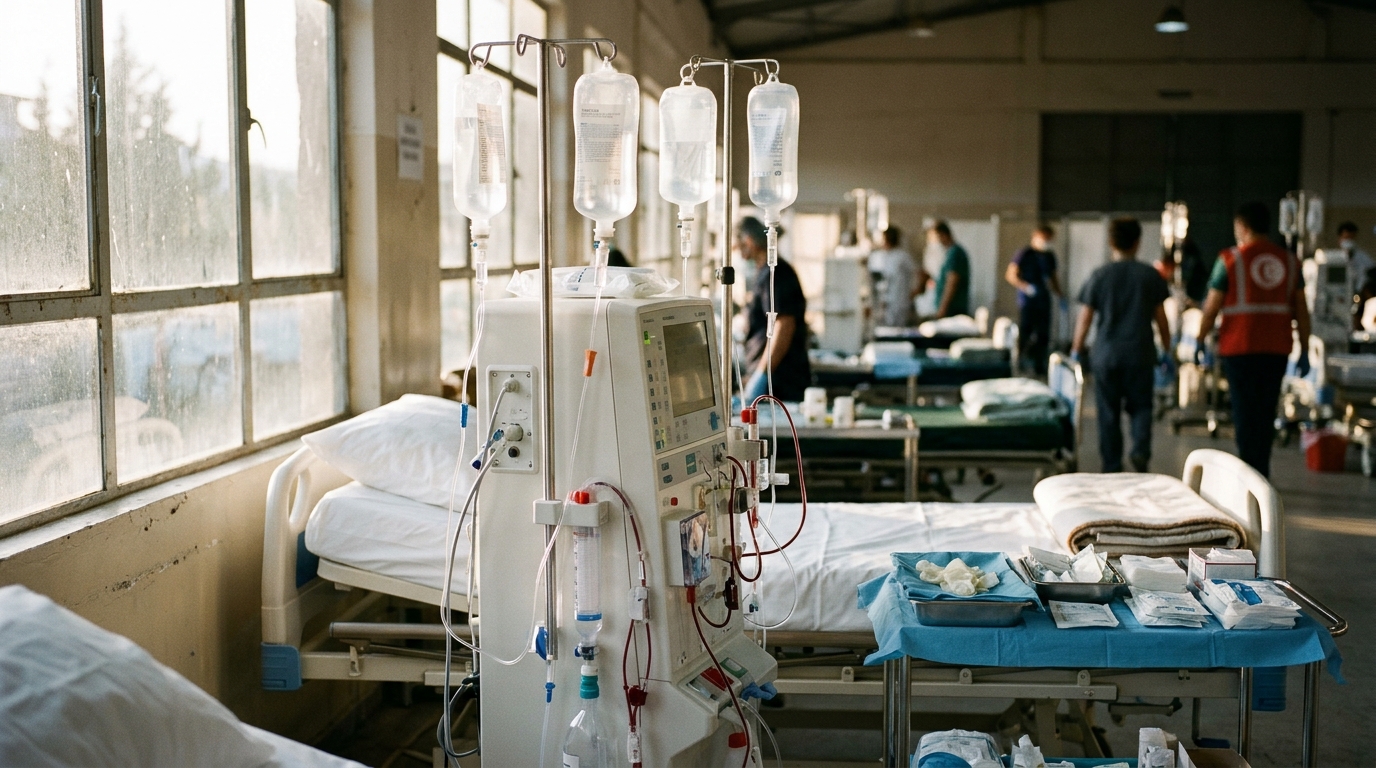
Against that backdrop, the kidney toll was severe. Among the 45,000 rescued and 12,500 hospitalized, approximately 600 patients — 4.8% — developed clinical crush syndrome, and an estimated 225 to 385 required dialysis. Contemporary reports documented an international dialysis-relief response, including delivery of dialysis equipment and personnel to Yerevan and treatment of patients with crush-related acute renal failure. Yet the review states that without coordinated triage and adequately trained renal-care teams, mortality among Armenian patients requiring dialysis is widely described as high; a precise, independently verifiable mortality figure for this cohort was not identified in the published literature, and none is reported in the review’s comparative table for that reason.
The comparative table itself is built on strict inclusion rules. Comparator earthquakes were included only if they were associated with more than 1,000 total casualties and had documented crush-syndrome or acute kidney injury outcomes in the peer-reviewed literature. That criterion added the 2008 Wenchuan earthquake to the original institutional analysis, while the 2015 Nepal earthquake was excluded because crush-syndrome-specific outcome data could not be independently verified — an omission the authors caution should not be read as evidence that crush syndrome was absent or minor in that event. The extracted variables included deaths, hospitalized and injured victims, crush-syndrome cases, dialysis utilization and reported mortality where available.
What the comparison shows — and does not show — is a central theme of the paper. Reported mortality estimates varied substantially across earthquakes and study populations, and the authors state that differences in case definitions, denominators, study populations and reporting methods prevent a reliable assessment of temporal trends or attribution of mortality differences to improvements in disaster response. Published mortality estimates for the 1990 Iran earthquake range from 7% to 14% depending on the source study, and estimates for the 2003 Bam earthquake range from 2% to 15%. A 2026 systematic review and meta-analysis of crush syndrome across earthquakes from 1988 to 2023 pooled data from 50 studies and reported substantial statistical heterogeneity driven largely by inconsistent case definitions, alongside an overall pooled mortality of 8% with a regional range of 1% to 26%.
Outliers reinforce that caution. The 2010 Haiti earthquake, despite an estimated death toll in excess of 200,000, was associated with a comparatively small documented crush-syndrome caseload, and the 2011 Christchurch earthquake was associated with what the literature describes as a notable dearth of crush-syndrome patients requiring dialysis despite substantial building collapse. The authors conclude that factors beyond medical response — including building-collapse patterns, population density and time of day — meaningfully affect crush-syndrome incidence independent of the quality of the medical response. Still, several operational factors are consistently cited in association with improved outcomes across these events: early intravenous saline injection in the field, deployment of pre-trained renal-disaster teams, and rapid establishment of mobile dialysis and laboratory capacity.
The review also traces the institutional legacy of 1988. Subsequent international experience led to structured disaster-nephrology response mechanisms, including the Renal Disaster Relief Task Force under the International Society of Nephrology, which developed recommendations for managing crush-related acute kidney injury during mass disasters. Modern frameworks such as the WHO Emergency Medical Teams initiative and INSARAG standards address the gaps the Armenian disaster exposed — destroyed hospitals, injured medical staff, lack of triage coordination and delayed international aid. Following the 2023 Turkey–Syria earthquakes, WHO and the Turkish Ministry of Health coordinated national medical team deployments within hours and, over the following weeks, the largest international Emergency Medical Team deployment in the history of the WHO European Region, though international teams generally became operational over days rather than within the first 24 hours. A 2025 systematic review and meta-analysis found a pooled probable-PTSD prevalence of 41% among adult survivors of the 2023 Kahramanmaraş earthquakes, and a 2025 study of patients relocated from damaged dialysis centers found that most resumed hemodialysis with at least a one-day delay, with emergency complications in roughly a quarter of cases. For seismically active regions such as Armenia, the authors prioritize continuous first-responder training in crush syndrome recognition and fluid management, storage of dialysis consumables and portable generators, national databases for rapid patient tracking, and simulation-based exercises connecting local hospitals to international emergency medical team networks — strategies they describe as reasonable, grounded in the Armenian experience and the broader disaster-nephrology literature, for reducing preventable deaths in future seismic events.
Subject of Research: Crush syndrome and acute kidney injury outcomes after the 1988 Spitak earthquake compared with later major earthquakes
Article Title: Crush syndrome and acute kidney injury after the 1988 Spitak earthquake: a comparative narrative review of disaster nephrology outcomes
Article References: Muradyan, N., Hovhannisyan, S., & Haroyan, H. (2026). Crush syndrome and acute kidney injury after the 1988 Spitak earthquake: a comparative narrative review of disaster nephrology outcomes. Journal of Emergency and Disaster Medicine, 2(1), Article 23. https://doi.org/10.1007/s44467-026-00027-8
Image Credits: AI Generated
DOI: 10.1007/s44467-026-00027-8
Keywords: crush syndrome, acute kidney injury, renal disaster, Spitak earthquake, disaster nephrology, dialysis, earthquake response, Armenia 1988, rhabdomyolysis, emergency medical teams, disaster preparedness, Marmara earthquake
News Source: Violet Maxwell. (November 4, 2026). Spitak earthquake’s renal disaster still shapes kidney care after quakes. Scienmag.