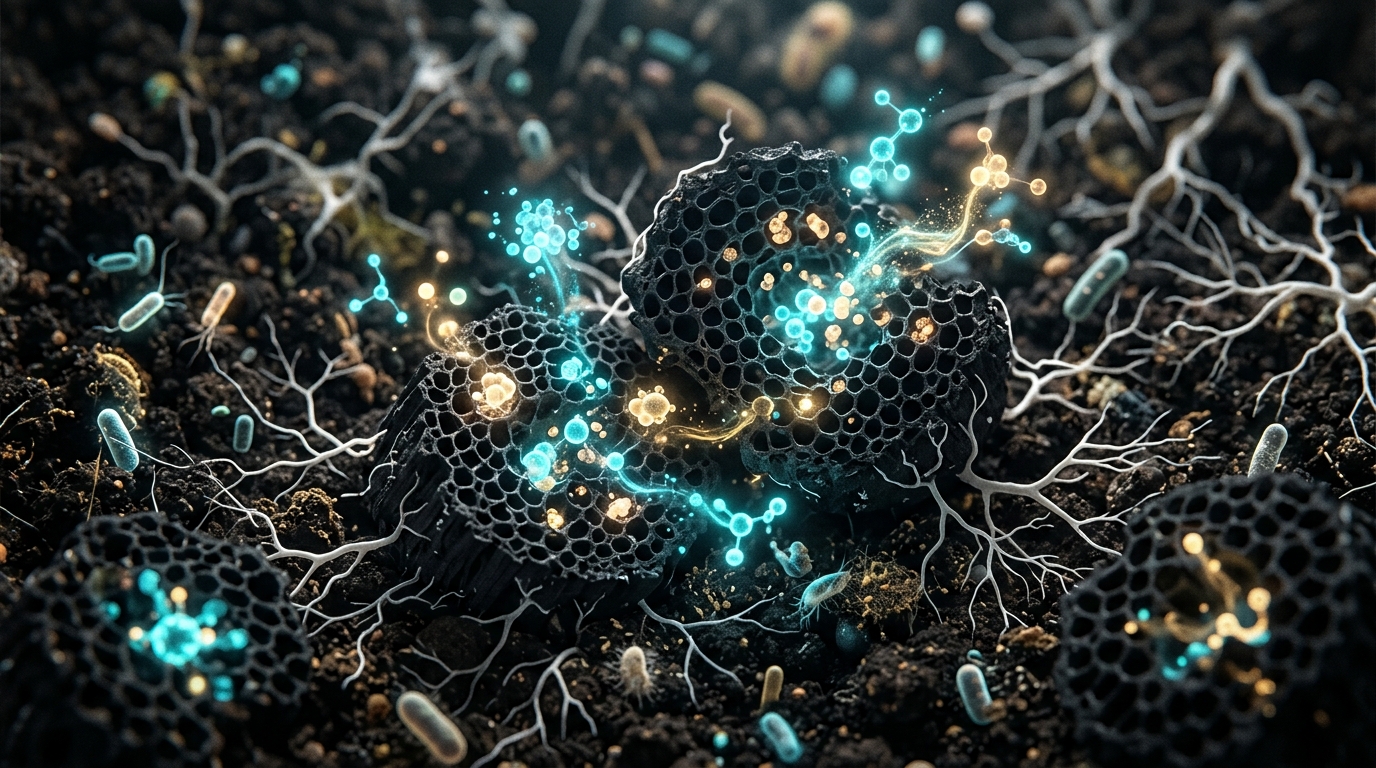
Biochar, the charcoal-like material increasingly spread on farm fields, does far more than passively improve soil structure, according to a new study published in Biochar. Researchers report that tobacco stem biochar kills the devastating soil-borne pathogen Ralstonia solanacearum by generating reactive oxygen species, and that the type of these reactive molecules shifts dramatically with the temperature at which the biochar is produced.
The team systematically evaluated biochars derived from four straw types pyrolyzed at temperatures ranging from 300 to 700 degrees Celsius, testing their direct antibacterial effects against Ralstonia solanacearum through in vitro assays, material characterization and pot experiments. Tobacco stem biochar stood out. When the researchers exposed the pathogen to these biochars for 24 hours, they found that material pyrolyzed at 300 degrees Celsius inhibited 92.91 percent of the bacteria, while biochar produced at 400 degrees Celsius reached 99.60 percent inhibition. Biochars made at 500 to 700 degrees Celsius achieved complete inhibition, eliminating 100 percent of the pathogen.
To understand what was driving this lethal effect, the researchers combined electron paramagnetic resonance spectroscopy with molecular probes and quenching experiments. They discovered that pyrolysis temperature fundamentally governs the composition of reactive oxygen species within the biochar. Material produced at the lower end of the range, 300 to 400 degrees Celsius, was dominated by free radical species, specifically hydroxyl radicals and superoxide radicals. In contrast, biochar pyrolyzed at 500 to 700 degrees Celsius contained predominantly non-radical reactive oxygen species, namely singlet oxygen and hydrogen peroxide.
The quantitative measurements revealed striking temperature-dependent patterns. Hydroxyl radical content in biochar prepared at 300 degrees Celsius measured 88.08 micromoles per kilogram and declined gradually as temperature increased. Superoxide radical concentration peaked at 400 degrees Celsius at 170.17 micromoles per kilogram, slightly higher than the 168.07 micromoles per kilogram observed at 300 degrees Celsius, before dropping sharply to 52.10 micromoles per kilogram at 500 degrees Celsius and only 2.52 micromoles per kilogram at both 600 and 700 degrees Celsius. Hydrogen peroxide content reached its maximum at 500 degrees Celsius at 379.63 micromoles per kilogram, while singlet oxygen generation consistently increased as temperature rose.
Quenching experiments confirmed that these reactive species were the principal antibacterial agents. When the researchers added scavengers that neutralize specific reactive oxygen species, the inhibition rate decreased stepwise, demonstrating that reduced reactive oxygen levels directly correlate with weakened antibacterial activity. The findings align with electron paramagnetic resonance results, confirming that biochar at lower temperatures functions mainly through free radical pathways, intermediate temperatures involve a hybrid mechanism, and the highest temperature operates solely through a non-radical pathway. Notably, biochar dominated by non-radical species proved more potent than biochar dominated by free radicals under the conditions tested.
The researchers ruled out alternative mechanisms through systematic characterization. Scanning electron microscopy revealed no morphological features capable of directly causing bacterial death. Fourier transform infrared spectroscopy showed no significant changes in surface functional groups before and after reaction. Leachate from the biochar had no notable inhibitory effect on pathogen growth, ruling out soluble components. Adsorption, pH shifts and toxic volatiles were similarly excluded as primary drivers. The persistent free radicals embedded in the biochar, generated during high-temperature pyrolysis, transform into reactive oxygen species that penetrate bacterial cells and induce oxidative stress, ultimately killing the pathogen through catalytic oxidation.
Beyond pathogen suppression, the study revealed that tobacco stem biochar reshapes the entire rhizosphere bacterial community. In artificial soil experiments designed to isolate biochar effects from environmental interference, the researchers found that biochar amendment significantly increased bacterial richness, with the Chao1 index rising by 497.77 to 951.34 compared to pathogen-contaminated soil without biochar.
Microbial co-occurrence network analysis showed that biochar-treated samples exhibited more nodes and edges, with node counts increasing by 82 to 136 and edge counts rising by 1224 to 2185 compared to untreated controls. These topological features indicate greater network complexity and stability.
In hydroponic experiments with tomato seedlings, plants inoculated with Ralstonia solanacearum alone exhibited severe wilting and desiccation, while those treated with tobacco stem biochar showed no disease symptoms. Antioxidant enzyme activities and malondialdehyde content in biochar-treated seedlings remained comparable to healthy controls, indicating that the biochar effectively mitigated oxidative stress damage induced by pathogen infection. When researchers added a comprehensive quenching agent that neutralizes reactive oxygen species, approximately 95 percent of the antibacterial efficacy was lost, and wilting symptoms returned, confirming that these reactive molecules are the primary active constituents responsible for protection.
The authors note that their findings are limited by testing a single pathogen and one beneficial bacterial strain, and that results from this highly concentrated in vitro system were designed to maximize reactive oxygen production rather than simulate actual environmental conditions. Nevertheless, the study elucidates a temperature-driven, reactive oxygen species-mediated regulatory mechanism that could guide targeted biochar applications against soil-borne pathogens while preserving beneficial soil microbiota, potentially reducing reliance on chemical fungicides and supporting sustainable agriculture.
Subject of Research: How tobacco stem biochar generates reactive oxygen species that suppress soil-borne pathogens and reshape rhizosphere microbial communities
Article Title: Biochar modulates soil microbial communities via reactive oxygen species derived from its constituents
Article References: Liu, M., Shen, S., Qiao, H., Yang, H., Zhu, Y., Zhou, Y., & Jia, H. (2026). Biochar modulates soil microbial communities via reactive oxygen species derived from its constituents. Biochar, 8(1), Article 122. https://doi.org/10.1007/s42773-026-00637-5
Image Credits: AI Generated
DOI: 10.1007/s42773-026-00637-5
Keywords: biochar, reactive oxygen species, Ralstonia solanacearum, pyrolysis temperature, soil-borne pathogens, rhizosphere microbiome, persistent free radicals, tobacco stem biochar, bacterial wilt, microbial community, singlet oxygen, hydroxyl radicals
News Source: Alan Morgan. (November 4, 2026). Biochar’s hidden weapon: reactive oxygen species reshape soil microbes. Scienmag.