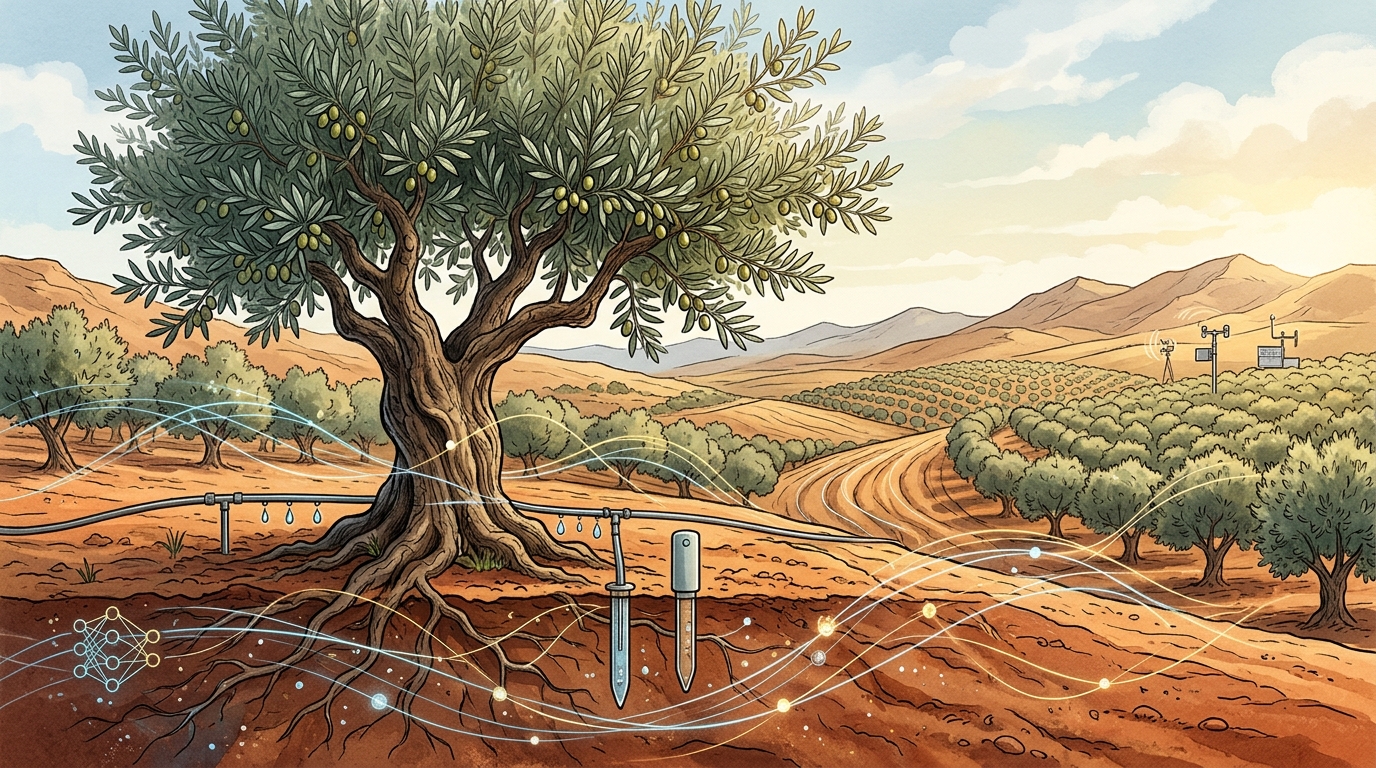
Researchers in Tunisia have built and field-tested an integrated smart irrigation platform that combines real-time water quality monitoring with deep-learning forecasts of irrigation timing and duration, deploying the complete system in a commercial olive orchard in the Sfax region under semi-arid Mediterranean conditions. The work, published in Smart Agricultural Technology, addresses a persistent gap in precision agriculture: most existing smart irrigation systems optimize how much water to apply but ignore the quality of the water itself, even though salinity, chemical contamination, and oxygen deficiency can irreversibly damage soil structure and crop health.
The platform is organized as a four-layer architecture spanning field-level sensing, wireless communication, an edge server for intelligent decision-making, and a cloud-connected service layer. At the edge node layer, an ESP32-WROOM-32 microcontroller serves as the primary controller, chosen for its dual-core processing, integrated Wi-Fi, low power consumption, and support for both analog and digital sensors, while an Arduino Uno handles simpler, stable signal acquisition. Water quality is tracked by four dedicated sensors: a DFRobot SEN0161 pH sensor accurate to within 0.1 pH units, a DFR0300-H electrical conductivity sensor covering 0 to 20 millisiemens per centimeter, a SEN0237 galvanic dissolved oxygen sensor ranging from 0 to 20 milligrams per liter, and a DS18B20 water temperature sensor accurate to within 0.5 degrees Celsius. Environmental conditions are captured through a capacitive YL-69 soil moisture sensor and an iMETOS 3.3 weather station measuring air temperature, relative humidity, and solar radiation.
Sensor readings are filtered with a moving average window of ten samples to suppress noise, and multipoint calibration is performed against reference solutions following manufacturer guidelines. The pH sensor was calibrated with standard buffers at pH 4.0, 7.0, and 10.0; the dissolved oxygen sensor used a two-point method with air-saturated water and a zero-oxygen sodium sulfite solution; and the conductivity sensor was checked against standards at 1.41 and 12.88 millisiemens per centimeter. Data are transmitted over Wi-Fi using the MQTT protocol with WPA2 encryption, and ESP32 nodes buffer readings locally during connectivity loss, synchronizing automatically upon reconnection so that irrigation control continues uninterrupted in low-connectivity agricultural settings.
Water quality assessment relies on a Mamdani-type fuzzy inference system that processes the four measured parameters in real time and produces a continuous water quality index. The membership functions are anchored in agronomic thresholds rather than arbitrary tuning: dissolved oxygen around 8 milligrams per liter is considered optimal, values below 4 milligrams per liter indicate hypoxic conditions, and levels at or below 0.5 milligrams per liter are anoxic and unsuitable for irrigation. The suitable water temperature range is 20 to 30 degrees Celsius. For olive production in Tunisia, a pH between 6.5 and 8.9 is deemed acceptable, since prolonged use of water above pH 8.9 causes phosphate precipitation while water below pH 7 can release toxic aluminum and manganese ions. Electrical conductivity thresholds follow FAO guidelines, with values below 0.7 decisiemens per meter posing no hazard, 0.7 to 3 posing moderate risk, and above 3 posing severe risk; olive-specific salinity tolerance thresholds corresponding to yield potentials of 100, 90, 75, and 50 percent are set at 1.8, 2.6, 3.7, and 5.6 millimhos per centimeter, respectively.
The fuzzy system comprises four inputs and one output, with each input represented by three membership functions and ten unweighted if-then rules formulated from expert agronomic knowledge. All rules carry equal weight, a conservative design choice motivated by the need for real-time execution on resource-constrained hardware such as the Arduino Uno and ESP32, where complex weighting could introduce latency or memory overhead. A qualitative sensitivity analysis, performed by varying each input individually while holding the others constant, revealed that electrical conductivity and dissolved oxygen exert a disproportionately higher influence on the output than pH and temperature, a finding consistent with agronomic literature identifying salinity and oxygen availability as primary determinants of irrigation water suitability in arid environments. Readings are defuzzified using the centroid method, and an LED indicator activates when the water quality index falls below 30 percent, signalling unsuitable water; the control unit can then generate an alert and automatically modify the irrigation schedule, reducing the applied volume or halting irrigation until quality recovers. The fuzzy controller has been fully implemented and validated in laboratory and semi-controlled settings and processed real-time sensor streams during the field deployment, though comprehensive quantitative field validation under diverse water sources and seasonal scenarios remains ongoing.
Irrigation scheduling is handled by a Long Short-Term Memory network trained on multivariate time-series data collected from the deployment site over approximately ten months, spanning both dry and wet seasons within a single agricultural cycle and covering the full phenological progression of the olive trees, including flowering, fruit development, and ripening. Sensor readings were recorded every 30 seconds and aggregated into daily averages, yielding roughly 300 daily samples. The dataset includes minimum and maximum air temperature, relative humidity, solar radiation, rainfall, and wind speed from the weather station; soil volumetric water content from five YL-69 sensors at depths of 10 to 50 centimeters; agronomic variables including the crop coefficient and reference evapotranspiration estimated following FAO-56 guidelines; and irrigation logs annotated by expert agronomists as ground truth. Crop coefficients of 0.3, 0.4, and 0.5 were applied for trees aged 1 to 2, 3 to 5, and beyond 5 years, respectively, and the crop water requirement was computed as evapotranspiration multiplied by the crop coefficient.
The LSTM architecture uses two stacked layers of 64 and 32 units, followed by a fully connected output layer with two neurons that simultaneously predict irrigation period in days and irrigation time in minutes for the next event. Dropout regularization at a rate of 0.2 follows each LSTM layer, training uses the Adam optimizer with a learning rate of 0.001 and a batch size of 32 over 200 epochs, and the input window spans 10 days. The model was benchmarked against linear regression, decision tree regression, a Gated Recurrent Unit network, and a Bidirectional LSTM under 5-fold cross-validation on the full ten-month dataset, a configuration chosen as a compromise between evaluation robustness and the limited sample size. The proposed LSTM achieved a root mean square error of 1.23 days for irrigation period prediction and 7.45 minutes for irrigation duration, with coefficients of determination of 0.89 and 0.87 respectively. The Bi-LSTM reached marginally higher accuracy, with R-squared values of 0.90 and 0.88, but doubles the computational parameters; the standard LSTM was therefore selected for the pilot because it delivered performance close to the bidirectional variant with a simpler architecture. Compared with linear regression and decision tree baselines, the LSTM reduced RMSE by 37 to 49 percent.
The authors place these errors in agronomic context. For olive trees, irrigation timing is particularly critical during flowering in March and April and fruit set in May and June in Tunisia, where short-term water stress can reduce fruit load by up to 30 percent. The irrigation period error of about 1.23 days falls within acceptable limits during vegetative growth but warrants closer attention during reproductive phases, while the duration error of 7.45 minutes represents roughly 8 to 12 percent of a typical drip irrigation cycle of 60 to 90 minutes; studies indicate that sustained volume deviations above 10 percent can reduce olive yield by 15 to 20 percent over a growing season. The monitored plot covers approximately one hectare with about 120 olive trees aged 5 to 15 years, and irrigation events typically occur every 3 to 5 days with durations between 60 and 90 minutes. Deployment conditions included summer temperatures up to 42 degrees Celsius and low, irregular rainfall.
The system’s user-facing components include a Flutter-based mobile application and web dashboard connected to a Firebase backend, exposing live sensor readings, automated alerts via SMS and email, historical trend visualization, and manual irrigation override. The estimated total cost of a single sensing and control unit ranges between 80 and 150 euros depending on sensor configuration and deployment scale, which the authors describe as significantly lower than conventional smart irrigation systems. The modular architecture allows additional sensing nodes to be replicated across larger plots without major infrastructure modifications, and the edge-cloud design executes irrigation decisions locally to limit cloud dependence.
Several limitations frame the results. The dataset covers roughly ten months and about 300 daily samples, which may not capture long-term seasonal variability, inter-annual climatic fluctuations, or extreme weather events. Validation was conducted at a single orchard, so variability across soil types, irrigation infrastructures, water sources, and regional climates remains untested, making this a pilot implementation rather than a generalized irrigation model. The limited dataset size also introduces potential overfitting risk for the LSTM, and fold-wise metric values and formal statistical significance analyses were not reported, so the performance metrics characterize the available observations without evidence of external generalization. Quantitative measurements of communication latency, inference time, energy consumption, and maintenance burden were not collected, and water-saving benefits remain to be established through dedicated agronomic evaluations. Future work will extend data collection over multiple seasons, deploy the system in additional Tunisian olive orchards with distinct soil and climatic conditions, and investigate cross-site model adaptation and transfer learning to improve generalization across heterogeneous agricultural environments.
Subject of Research: An AIoT-based smart irrigation system for olive farming that integrates real-time water quality monitoring with LSTM-based irrigation forecasting
Article Title: AIoT-based smart irrigation for olive farming: Real-time water quality monitoring and LSTM forecasting
Article References: Maalej, S., Boukthir, K., Chabchoub, H., Ouahada, K., & Alimi, A. M. (2026). AIoT-based smart irrigation for olive farming: Real-time water quality monitoring and LSTM forecasting. Smart Agricultural Technology, 15, Article 102647. https://doi.org/10.1016/j.atech.2026.102647
Image Credits: AI Generated
DOI: 10.1016/j.atech.2026.102647
Keywords: smart irrigation, AIoT, olive farming, water quality monitoring, LSTM forecasting, fuzzy logic, precision agriculture, Tunisia, semi-arid agriculture, edge computing, IoT sensors, drip irrigation
News Source: Alan Morgan. (November 4, 2026). Smart irrigation platform pairs water quality checks with LSTM forecasts in Tunisian olive orchard. Scienmag.