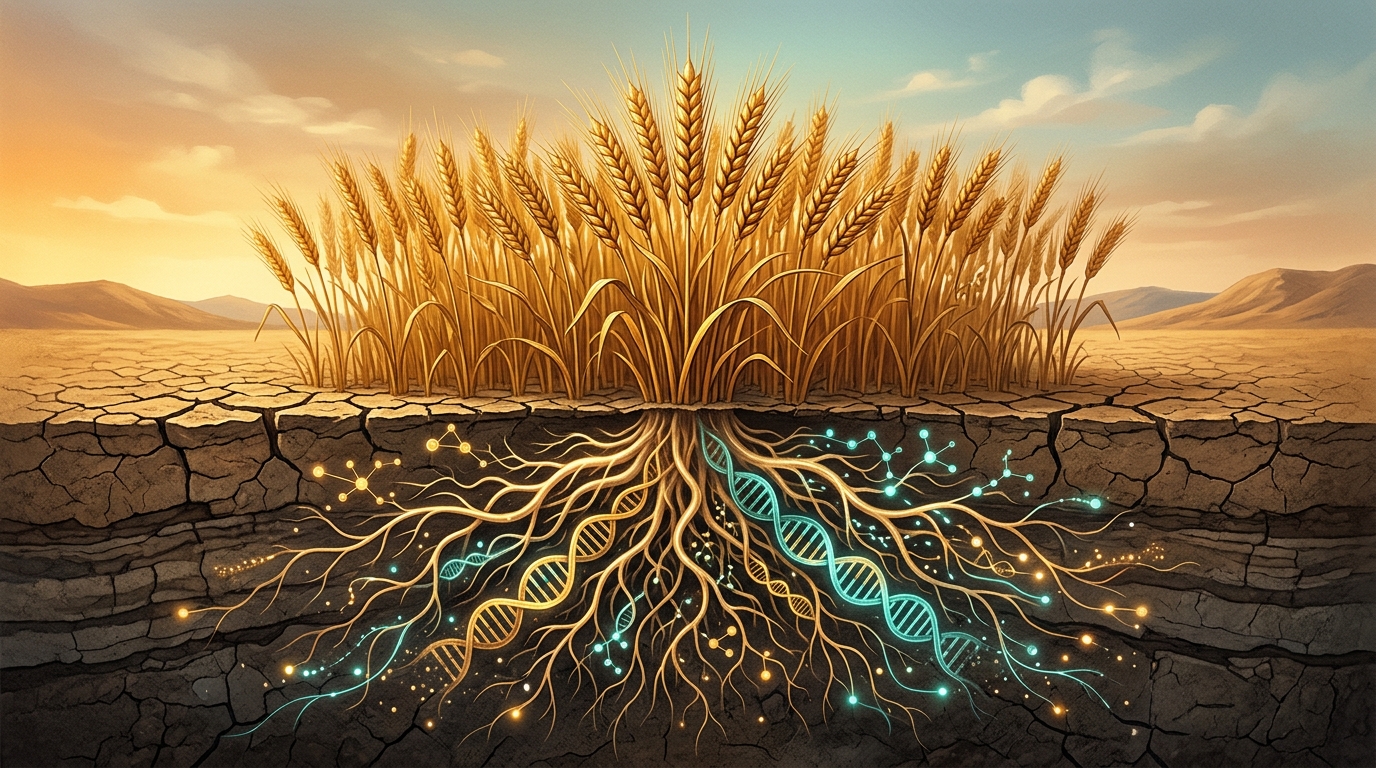
Chinese researchers have pinpointed 20 genetic loci and seven candidate genes tied to drought tolerance in spring wheat, drawing on 257 breeding lines accumulated over five decades in the country’s cold and arid north. The study, published in Theoretical and Applied Genetics, combined genome-wide association studies with transcriptome sequencing to dissect how this staple crop copes with water stress, a constraint that severely limits wheat yields worldwide.
Seven yield-related agronomic traits were measured across both environments, and from these the researchers calculated three drought tolerance indices that capture how each line’s performance shifts when water becomes scarce.
Genome-wide association studies were run for all seven traits and all three indices using three different analytical models, an approach designed to filter out statistical artifacts and isolate signals that hold up regardless of method. This triangulation identified 20 stable loci significantly associated with drought response, meaning the same genomic regions appeared linked to drought tolerance traits across the modeling frameworks rather than emerging as one-off associations prone to false positives.
In parallel, the researchers performed RNA sequencing on drought-tolerant and drought-sensitive lines from the same panel, profiling gene expression under both well-watered and stressed conditions. The comparison revealed 4,411 drought-responsive genes whose activity changes when plants face water limitation.
The integrative step crossed the two datasets: candidate genes had to sit within GWAS-identified loci and show drought-responsive expression. This convergence narrowed the field to seven candidate genes. One of them, associated with plant height, also overlapped with hub modules detected through weighted gene co-expression network analysis, a method that clusters genes by correlated expression patterns and flags the most connected members as potential regulatory centers.
Plant height emerged as a particularly tractable trait in the analysis. When the researchers tested how well the identified loci could predict trait values using Bayesian ridge regression, a genomic prediction approach that estimates breeding values from marker data, plant height reached an accuracy of 85.4 percent. The paper reports that accuracies were high but trait-specific, so predictive power varied across the seven measured characteristics rather than applying uniformly.
The germplasm resource underlying the work is itself notable. The 257 spring wheat lines represent half a century of breeding activity in a region where cold and aridity jointly shape selection pressures, making the panel a reservoir of alleles adapted to marginal conditions.
For breeders, the practical payoff is molecular resources for marker-assisted selection.
The authors frame the findings as novel insight into the genetic architecture of drought tolerance in wheat and as a step toward drought-resilient cultivar development. As with any association and expression study, the candidate genes remain candidates until functional experiments confirm their roles, and the prediction accuracies reflect the specific panel and environments tested. Still, the convergence of genetic mapping, transcriptomics and co-expression analysis on a small set of loci and genes provides a focused starting point for the next round of validation work in a crop where drought remains one of the largest yield constraints.
Subject of Research: Genetic basis of drought tolerance in spring wheat from China's cold and arid region
Article Title: Integrated GWAS and RNA-Seq analyses identify candidate genes for drought tolerance in spring wheat (Triticum aestivum L.) from the cold and arid region of China
Article References: Lyu, X., Xie, X., Meng, X., Cui, Y., Zhang, W., Ren, K., Ni, J., Yang, F., Dai, X., Zeng, J., Liu, W., Li, J., Mu, L., Ma, W., & Xu, D. (2026). Integrated GWAS and RNA-Seq analyses identify candidate genes for drought tolerance in spring wheat (Triticum aestivum L.) from the cold and arid region of China. Theoretical and Applied Genetics, 139(11), Article 323. https://doi.org/10.1007/s00122-026-05437-w
Image Credits: AI Generated
DOI: 10.1007/s00122-026-05437-w
Keywords: wheat, drought tolerance, GWAS, RNA-Seq, candidate genes, genomic prediction, marker-assisted selection, plant height, water stress, quantitative genetics, Integrated, analyses
News Source: Juliet Wilcox. (November 4, 2026). Wheat Drought Tolerance Genes Revealed by Combined GWAS and RNA-Seq Study. Scienmag.