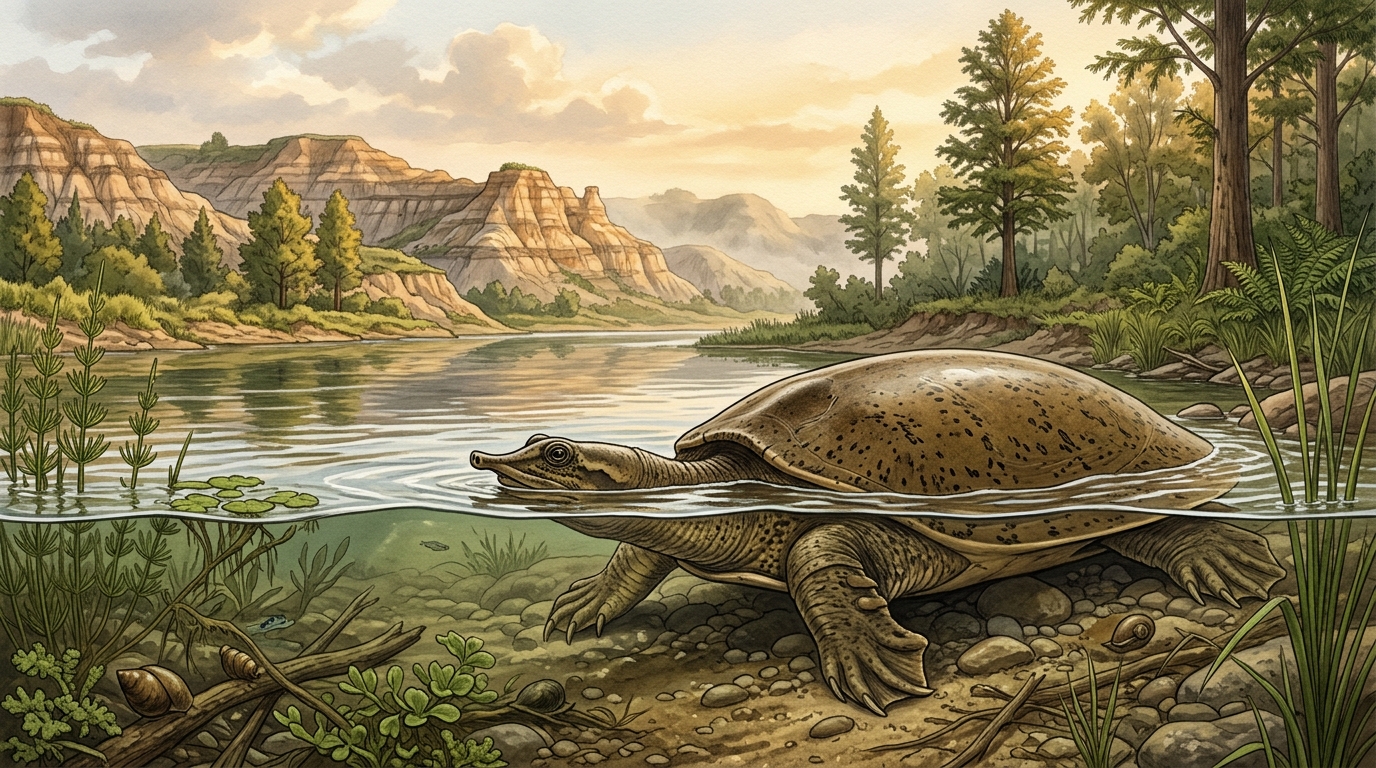
A nearly complete skull, a mandible, and three partial shells collected over decades from the Brule Formation of southwestern North Dakota represent a previously unknown species of softshell turtle, according to a new study published in the Swiss Journal of Palaeontology. The animal, named Rafetus lysoni, is the first valid trionychid species to be described from the Oligocene of the entire North American continent, filling a gap in a fossil record that had previously yielded only two figured shell fragments from that period.
Softshell turtles are a diverse clade of reptiles with a fossil record stretching back to the Early Cretaceous. Their shells carry a distinctive surface texture that allows researchers to identify even small fossil fragments in the field. In North America, the group has a particularly rich record from the Campanian through the Eocene, followed by what the authors describe as a sudden hiatus, likely caused by regional drying. Only a handful of fragmentary remains had been reported from the Oligocene of the continent, and the entire previously figured record consisted of just two shell fragments, which the study notes insufficiently document the evolution of the clade during this key interval.
The new species is based on five specimens housed at the American Museum of Natural History and the North Dakota State Fossil Collection. The holotype, NDGS 112, is a near complete cranium recovered from locality NDGS L28, a sublocality within the Fitterer Ranch area of Stark County, in strata assigned to the Brule Formation, White River Group, of early Whitneyan North American Land Mammal Age, Oligocene. Referred material includes a mandible, AMNH 12422, collected in 1951 from the capping channel at White Butte in Slope County, along with three shells: NDGS 111, a nearly complete shell; NDGS 551, a partial carapace; and NDGS 35, the damaged anterior half of a large carapace from West Rainy Butte. All referred specimens come from the type stratum, but their stratigraphic placements within the Orellan to Whitneyan Brule Formation vary.
The skull measures about 9 centimeters from the anterior tip of the snout to the basioccipital process and about 12 centimeters from the snout tip to the tip of the supraoccipital crest, dimensions comparable to the large-bodied extant species Apalone ferox and Rafetus euphraticus. The presence of the premaxilla, a bone easily lost after death, suggests the individual was likely buried fully intact. The skull was only lightly crushed dorsoventrally, and a large transverse crack separating it into two halves is suspected to be the plane along which it split during collecting. Bones adjacent to the crack, including the left jugal, quadratojugal, and squamosal, suffered some damage, but the authors state this scarcely affects their anatomical interpretations.
Visualization of the material combined digital photography with advanced scanning. The only available skull, NDGS 112, underwent micro-computed tomography at North Star Imaging in Rogers, Minnesota, using a X5000 scanner at 150 kV and 150 microamps, producing an image stack of 2847 slices with an effective voxel size of 43.8 micrometers. Bone-by-bone semi-automatic segmentation yielded individual models of each cranial element. The shells were documented with structured light scanners, and the slice data, image stacks, cranium model, individual bone models, and surface scan models are publicly available on MorphoSource, allowing other researchers to examine the internal anatomy in three dimensions.
The diagnosis rests on a combination of shell and skull features. As a trionychid, Rafetus lysoni shows a reduced quadratojugal that does not contact the postorbital or maxilla, exclusion of the fused premaxillae from the external nares, visible separation of metaplastic bone from the rest of the shell, absence of peripherals, pygals, suprapygals, and shell scutes, and a boomerang-shaped entoplastron. Among North American trionychids, the species stands out by lacking a preneural while reaching large size, with a carapace disk length exceeding 50 centimeters in the largest specimen, and by showing mediolaterally narrow costal callosities, a greatly reduced nuchal callosity, a reduced count of medial hyo- and hypoplastral processes, two lateral hyoplastral processes, and a reduced hyo-hypoplastral callosity that barely covers its processes.
The three shells represent differently sized individuals, which the authors interpret as an ontogenetic series of a large-bodied species. The smallest, NDGS 111, has a carapace midline length of about 18.5 centimeters; NDGS 551 is estimated at about 24 centimeters; and NDGS 35, preserved at about 26 centimeters, is estimated to have reached about 52 centimeters. All lack a preneural and show narrow, neotenic costal callosities that only partially cover the ribs. The two smaller shells share a reversal toward the posterior of the neural column and only seven pairs of costals. The large specimen has a relatively narrow nuchal, roughly 45 percent of carapace width, bearing an unusually minute nuchal callosity, and its sutural contact with the first costal, producing paired suprascapular fontanelles, is consistent with ontogenetic change. The near complete reduction of the nuchal callosity is described as relatively unique among trionychids, also seen in some species of Axestemys.
The study also revisits two old names long linked to the Oligocene. Trionyx punctiger, named by Cope in 1891 on the basis of two unfigured fragments from the White River of the Dakotas, cannot be located in the Cope collections and appears to be lost, and its diagnosing characters are judged meaningless for trionychid taxonomy; the authors agree it is a nomen dubium. Trionyx leucopotamicus, based on a small shell fragment from Swift Current Creek in Saskatchewan, was long believed Oligocene and then late Eocene, but the type locality is now known to be middle Eocene in age, and the holotype is undiagnostic. The authors conclude that this name should likewise be viewed as a nomen dubium, and that Chadronian material once assigned to it might represent an unnamed species.
Comparisons with named Eocene and Neogene taxa support the new species’ distinctiveness. Rafetus lysoni differs from all named Neogene and extant species of Apalone by its highly reduced nuchal callosity, small hyo-hypoplastral callosity, relatively elongate anterior epiplastral processes, and two lateral hyoplastral processes. It resembles extant Rafetus species but differs from the Eocene Rafetus bohemicus in possessing two lateral hyoplastral processes, and differs from all currently recognized Rafetus species by the reduced nuchal callosity. Among Eocene taxa, it contrasts Axestemys species and Plastomenus thomasii by lacking a preneural, and differs from the Bridgerian taxa Trionyx scutumantiquum and Trionyx mira in a suite of nuchal, costal, and plastral characters. It shares some features with the Bridgerian Trionyx uintaensis but differs starkly in callosity development. The authors refer the species to Rafetus to avoid propagating a monotypic genus, while noting that if future phylogenetic work places it closer to extant Apalone, referral to that genus would be appropriate.
The paleoecological context helps explain why these turtles persisted where their relatives vanished. Previous work documented a decline in aquatically adapted reptiles, including trionychids, across the western interior from the middle Eocene into the Early Oligocene, attributed to regional aridification rather than global extinction. Extant apalonines are mostly restricted to riverine habitats, so their near absence in Chadronian to Orellan deposits may signal a scarcity of suitable rivers. At Fitterer Ranch, however, screen washing produced a diverse amphibian fauna including fossorial, arboreal, and semiaquatic taxa indicative of a more mesic environment than typical Oligocene Great Plains sites, and a sirenid specimen points to a year-round water source. A partial alligatorine skeleton from a nearby locality in a similar stratigraphic position adds further support for persistent water. Sandstone deposits at White Butte and West Rainy Butte, lithologically similar to those at Fitterer Ranch, suggest streams or rivers were present there as well. These local conditions, the authors conclude, allowed trionychids to thrive in southwestern North Dakota during the Whitneyan despite their absence from contemporaneous faunae elsewhere in the Great Plains, where more arid conditions prevailed.
Subject of Research: Description of a new extinct softshell turtle species, Rafetus lysoni, from the Early Oligocene Brule Formation of North Dakota
Article Title: A new species of extinct trionychid from the Early Oligocene (Orellan–Whitneyan NALMA) Brule Formation of North Dakota, USA
Article References: Joyce, W. G., Boyd, C. A., & Girard, L. C. (2026). A new species of extinct trionychid from the Early Oligocene (Orellan–Whitneyan NALMA) Brule Formation of North Dakota, USA. Swiss Journal of Palaeontology, 145, 1111-1127. https://doi.org/10.3897/sjp.145.203398
Image Credits: AI Generated
Keywords: Rafetus lysoni, Trionychidae, softshell turtles, Oligocene, Brule Formation, North Dakota, paleontology, fossil turtle, Apalonini, nomen dubium, Fitterer Ranch, paleoecology
News Source: Drew Townsend. (November 4, 2026). Extinct Softshell Turtle Species Named From North Dakota’s Oligocene Badlands. Scienmag.