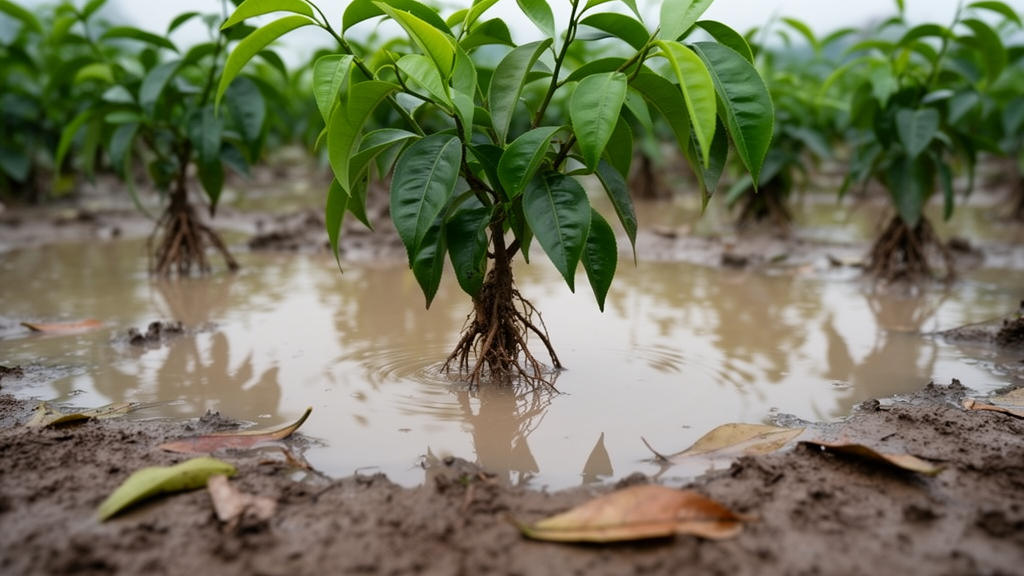
Waterlogging is emerging as one of the most serious climate-linked threats to sustainable tea production, and a new open-access review published in Discover Plants on 28 October 2026 brings together what is currently known about how the tea plant, Camellia sinensis, copes with saturated soils. Written by Pradeep Kumar Patel, Boby Gogoi, Shobhit Kumar Singh, Namita Handique and Venkatesan Selvaraj, the review synthesizes physiological, transcriptomic and metabolomic evidence on hypoxia signaling and metabolic reprogramming in tea, and proposes integrated management strategies for flood-prone plantations.
The problem begins in the root zone. Tea is a shallow-rooted perennial that depends on well-drained, well-aerated acidic soils, and because oxygen diffuses far more slowly through water than through air, prolonged soil saturation rapidly creates hypoxic or anoxic conditions around the roots. Oxygen deprivation suppresses mitochondrial respiration and oxidative phosphorylation, cutting ATP generation and forcing root cells to shift toward anaerobic glycolysis and fermentative metabolism. Pyruvate is redirected into ethanol and lactate production, which partially regenerates NAD+ and sustains limited glycolytic flux, but fermentation is energetically inefficient. Prolonged accumulation of ethanol, acetaldehyde and lactate leads to cytoplasmic acidification, membrane destabilization and, ultimately, progressive metabolic collapse.
At the molecular level, the review highlights the group VII Ethylene Response Factor (ERF-VII) transcription factors, whose stability is controlled by the oxygen-dependent N-end rule pathway, as central components of plant hypoxia sensing. In the model plant Arabidopsis, five ERF-VII proteins have been functionally characterized, but in tea the family remains poorly resolved. Recent evidence has established CsRAP2.12 (Cs1g16690) as an ERF-VII member that physically interacts with CsATG8f and influences antioxidant defense and submergence tolerance, while CsHRE1 and CsHRE2 have been identified as hypoxia-responsive ERF genes. The authors stress, however, that the complete complement of ERF-VII homologs in the tea genome and their individual contributions to oxygen sensing remain insufficiently characterized, and they present their signaling model as conceptual rather than a fully validated tea-specific network.
Hypoxia also triggers extensive metabolic reconfiguration. Metabolomic analyses have documented accumulation of alanine, gamma-aminobutyric acid (GABA), soluble sugars and fermentative intermediates during flooding, alongside increased expression of glycolytic enzymes such as hexokinase, phosphofructokinase, pyruvate kinase and sucrose synthase. Meanwhile, ATP-intensive processes, including protein synthesis, secondary metabolism and active ion transport, are markedly suppressed. Severe ATP depletion undermines plasma membrane H+-ATPase activity, causing membrane depolarization, ionic imbalance and impaired nutrient uptake, while disrupted mitochondrial electron transport promotes leakage of electrons and excessive generation of reactive oxygen species, including superoxide, hydrogen peroxide and hydroxyl radicals.
That oxidative burst damages membranes, proteins, nucleic acids and chloroplasts. Lipid peroxidation generates malondialdehyde, a standard biochemical marker of membrane injury, and flooding in tea is associated with elevated MDA, increased electrolyte leakage and reduced membrane stability. Tea plants respond by activating enzymatic antioxidants, including superoxide dismutase, catalase, peroxidase, ascorbate peroxidase and glutathione reductase, together with non-enzymatic antioxidants such as glutathione, ascorbate, flavonoids and catechins. But prolonged hypoxia can overwhelm these defenses, leading to protein carbonylation, DNA oxidation, chloroplast disintegration and tissue necrosis.
Photosynthesis is among the most severely affected processes. Root hypoxia impairs hydraulic conductivity through ATP depletion, aquaporin inhibition and membrane damage, so flooded tea plants show symptoms analogous to drought despite saturated soil. Abscisic acid-mediated stomatal closure restricts CO2 diffusion, lowering stomatal conductance and net photosynthetic rate. Chloroplasts swell, thylakoid membranes dilate and photosystem II suffers photoinhibitory damage, reducing the maximum quantum efficiency of PSII (Fv/Fm) and electron transport rates. Proteomic and transcriptomic studies have documented reduced abundance of Rubisco subunits, Rubisco activase and other Calvin cycle enzymes, and chronic flooding can drive severe carbon starvation, with reduced bud break, slower leaf expansion and lower harvestable biomass.
A striking consequence of this metabolic shift is a trade-off between survival and quality. Tea quality rests on catechins, caffeine, theanine, flavonoids and volatile aroma compounds, and the review assembles evidence that waterlogging suppresses their biosynthesis. Downregulation of phenylalanine ammonia-lyase, chalcone synthase, chalcone isomerase and downstream flavonoid-pathway enzymes reduces accumulation of major catechin fractions such as EGCG, ECG, EGC and EC. Inhibition of nitrate reductase and glutamine synthetase restricts theanine biosynthesis, the amino acid responsible for sweetness and umami, while disruption of plastidial and mitochondrial metabolism impairs volatile terpenoids and other aroma compounds. The authors frame this as a physiological trade-off in which diverting carbon and energy toward survival enhances short-term tolerance but constrains the metabolites that define liquor briskness, aroma complexity and commercial value.
The review also grounds the problem geographically. Assam, which contributes nearly half of India’s tea production, sits within the floodplains of the Brahmaputra and Barak rivers, where intense monsoonal rainfall exceeding 2,000 to 3,000 millimeters annually, unstable alluvial soils and poor natural drainage combine with recurrent riverine flooding. Field assessments across Assam and Barak Valley tea estates reported roughly 20 to 40 percent crop productivity reductions during peak monsoon flush periods after severe flooding, and national statistics recorded a decline in Assam tea production from 688.33 million kilograms in 2023 to 649.84 million kilograms in 2024, attributed to recurrent flooding, erratic rainfall and thermal stress. Geospatial analyses based on satellite-derived inundation datasets and historical flood records show substantial overlap between high-frequency flood zones and major tea plantation belts.
On the adaptation side, the authors argue that no single intervention suffices. Drainage engineering and root-zone aeration form the foundation: evidence from Tocklai and a survey of Dooars and Terai gardens showed yield improvements of up to approximately 18 percent in well-drained areas, along with better nitrogen-use efficiency. Post-flood rehabilitation should prioritize restoring aeration, temporarily reducing plucking intensity on severely affected bushes and resuming fertilization only as root function recovers. Breeding for flood tolerance is a longer-term strategy; genotypes including TV9, SNT-10, TRI-2023, MNPR/51/P2, GNGA/31/P3 and DFLGR/34/P8 have shown comparatively better physiological stability under flooding, though results are context-dependent. Root traits such as aerenchyma development, adventitious rooting and rapid post-flood regeneration are proposed as key screening targets, alongside genomics-assisted approaches including GWAS and, cautiously, CRISPR-based editing, which remains an emerging tool in tea.
Other strategies remain supportive or emerging rather than established. Biostimulants, silicon, potassium and calcium supplementation, and microbial approaches such as plant growth-promoting rhizobacteria and mycorrhizal associations show promise but require field validation in tea, and direct evidence linking them to preservation of quality compounds is limited. Precision agriculture tools, including soil-moisture sensors, satellite and drone monitoring, and AI-based flood prediction, could improve the timing of drainage and rehabilitation decisions, but the authors caution that such models need large, tea-specific datasets and long-term field validation before routine use. The review closes by calling for long-term field studies of repeated flooding and recovery cycles, cell- and tissue-specific omics approaches, and flood-resilient root ideotypes, arguing that translating mechanistic knowledge into reliable traits and practical management will be essential for sustaining tea productivity and quality under increasingly variable rainfall.
Subject of Research: Physiological and molecular mechanisms of waterlogging adaptation in tea plants
Article Title: Waterlogging adaptation in tea through hypoxia signaling and metabolic reprogramming
Article References: Patel, P. K., Gogoi, B., Singh, S. K., Handique, N., & Selvaraj, V. (2026). Waterlogging adaptation in tea through hypoxia signaling and metabolic reprogramming. Discover Plants, 3(1), Article 502. https://doi.org/10.1007/s44372-026-00991-5
Image Credits: AI Generated
DOI: 10.1007/s44372-026-00991-5
Keywords: tea, waterlogging, hypoxia, ERF-VII, metabolic reprogramming, flood resilience, Camellia sinensis, oxidative stress, tea quality, Assam, drainage management, plant breeding
News Source: Violet Maxwell. (October 30, 2026). Tea Plants Under Flood Stress: Hypoxia Signals and Metabolic Trade-offs Revealed. Scienmag.