In the rural Nouna region of western Burkina Faso, where most families depend on a single rainy season to feed themselves, researchers have been listening carefully to mothers and local experts about a simple idea: growing vegetables at home. A new qualitative study, published in Agriculture & Food Security, documents how caregivers of young children and project stakeholders view home gardening, and how their experiences are shaping the design of an intervention that combines kitchen gardens with nutrition counselling. The work is part of the ALIMUS project, which will eventually test the approach in a randomized controlled trial in rural Burkina Faso and Kenya.
The study team interviewed 32 caregivers of children under five years of age and 11 stakeholders from national and international organizations working on nutrition and gardening projects. All the caregivers were women, aged between 24 and 54 years, and all but one of the stakeholders were men. The interviews, conducted in October and November 2020 in the local languages Dioula and Bwamou, lasted between 20 and 80 minutes and were analysed using inductive content analysis. Recruitment continued until data saturation was reached, and a dissemination workshop in May 2021 served as a member-checking exercise in which stakeholders could reflect on and validate the preliminary findings.
The setting matters. The Nouna Health and Demographic Surveillance System area covers roughly 59 villages, more than 14,000 households and over 115,000 inhabitants, most of them subsistence farmers who rely on rainfed agriculture from June to October. Seasonal food insecurity is common, and the prevalence of stunting among children under five in the HDSS area stands at 25.6 percent, reaching 27.4 percent among boys. Against this backdrop, the researchers wanted to know what families already know about home gardens, what motivates them to grow food, what holds them back, and what they would want from an intervention.
Exposure to gardening varied widely. Half of the caregivers had previously owned or been exposed to a home garden, while the other half had never created or maintained one, although every participant was familiar with the concept. Interestingly, people did not agree on what a home garden actually is. Some defined it simply as any crops grown near the homestead, while others insisted that a true garden is a year-round undertaking, not a seasonal patch that is abandoned once the rains stop. Most of the experienced gardeners worked their plots seasonally, either in the dry season, when field work ends and gardening provides both occupation and income, or in the rainy season, when water is plentiful. Only a minority gardened throughout the year, and they reported that the two seasons posed very different challenges: rainy-season gardening was described as easier, yet some households found their gardens produced better during the dry months.
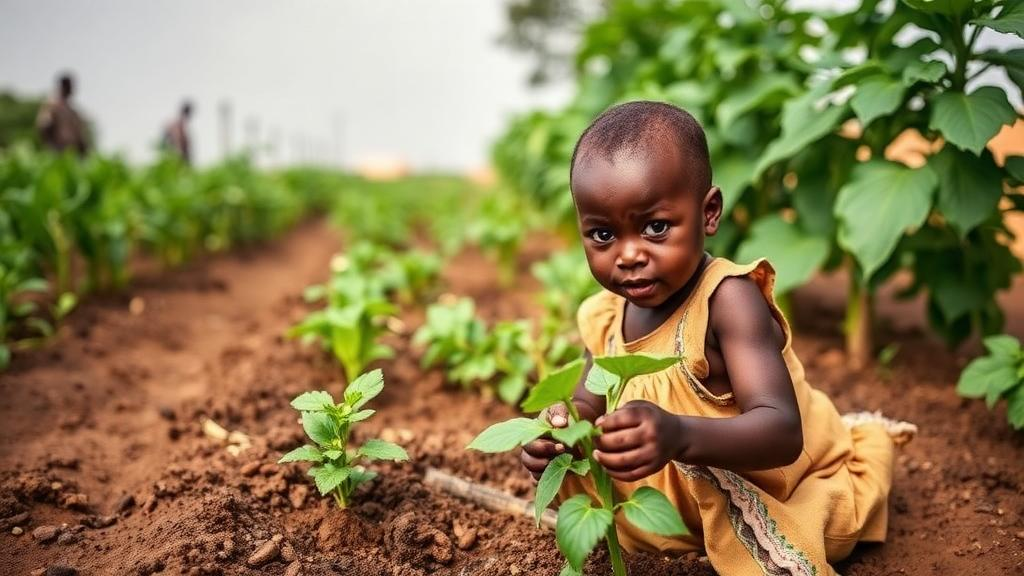
What emerged most clearly was enthusiasm. All the caregivers held a favourable view of home gardening, and their motivations clustered around two themes: food and health, and finances and choice. Gardens were prized above all as a source of fresh vegetables during the dry season, when condiments are scarce. Mothers described how the vegetables nourish their children and linked good nutrition to protection against malnutrition. Children were said to particularly enjoy moringa, tomato, cabbage, okra and eggplant. Garden produce could also be saved as a reserve to fill the hunger gap when the rains arrive and food stores run low. One mother captured the sentiment that gave the study its title: if you have a garden and it is successful, you can provide for your children.
The financial dimension was equally important. A garden reduces household expenses because families need not buy vegetables, and surplus produce can be sold to cover small costs. Participants described gardens as a source of possibility and choice, especially in difficult times: the day money is short for condiments, sales from the garden can pay for food, or the vegetables can simply be cooked into sauces and salads. Stakeholders confirmed this pattern, noting that in their own projects garden output was typically divided between household consumption, sale, and cooking demonstrations at local health centres, where women learned to prepare balanced meals.
Yet the same participants who praised gardening were candid about its burdens. Labour requirements were named as the primary dissuader across all ages, education levels and household sizes. Caregivers warned that without sufficient time for maintenance a garden fails and the effort is wasted, and that even well-tended gardens can end a season with disappointing yields. Some failures lay beyond the growers’ control: insects destroyed part of one household’s crop, and flooding wiped out another’s okra, sorrel, wild eggplant and tomato. The researchers grouped the challenges into three categories: environmental, including climate, livestock, pests and diseases; financial, including lack of income and unaffordable inputs; and sociocultural, including land access, lack of knowledge and gender norms. Participants perceived different degrees of control over these problems. Animals eating garden produce could be addressed with something as simple as fencing, but women’s lack of access to land felt far more abstract and resistant to individual solutions.
When asked what they would want from an intervention, the caregivers’ wishes were concrete: better access to water, equipment and seeds, and training in gardening techniques. All 32 caregivers expressed interest in learning and receiving assistance to establish or expand a garden, and 24 of the 32 households already had access to land. The stakeholders, for their part, stressed that knowledge alone is not enough. One pointed out that in the past, nutrition advice was given to women who understood it but lacked the means to act on it. They emphasized that a combined approach of nutrition counselling and home gardening, embedded in a community-centred process and involving not only mothers but also husbands, local leaders and the wider community, is key to success. Stakeholders also highlighted the practical timing of garden projects: fields must be prepared quickly so that production can begin in the dry season and continue seamlessly into the rains, because missing a season means waiting four to six months.
The researchers interpreted their findings through the SHIFT framework, a behavioural economics model describing five routes to sustainable behaviour change: social influence, habit formation, the individual self, feeling and cognition, and tangibility. On social influence, the universal familiarity with and approval of gardening suggests the practice is socially accepted, but gender norms remain a barrier in a context where women conduct over 70 percent of domestic labour yet men dominate household and agricultural decision-making. On habit formation, gardening demands high physical and cognitive effort, so training programs should make participation easy, provide feedback and offer incentives such as seed kits. On tangibility, the long wait between planting and harvest fuels uncertainty about productivity, so interventions should highlight both immediate and future benefits. Two earlier home gardening studies in Burkina Faso had shown improved dietary diversity and increased consumption of vitamin A-rich foods among children in intervention households, lending plausibility to the approach, though the authors note that scientific evidence on home gardens’ effectiveness for child nutrition in settings like Burkina Faso remains limited.
The study’s conclusions are directed at intervention design rather than immediate practice. The authors recommend that long-lasting home garden initiatives in rural Burkina Faso begin with external support backed by institutional and social structures, citing Kenya’s 2020 One-Million Kitchen Garden Plan as an example of national policy support. Sustained behaviour change, they argue, requires climate-friendly and affordable inputs such as natural fences, organic pesticides, composting and water conservation. Finally, they call for home gardening to be paired with the promotion of nutrition literacy, meaning knowledge, and nutrition fluency, meaning the ability to put that knowledge into practice, so that gardens can contribute to food and nutrition security at the household level. As a qualitative formative study, the work does not itself demonstrate that gardens improve child nutrition; that question will be answered by the upcoming randomized trial. What it does show is that in Nouna, the people such an intervention is meant to serve already understand its promise, and its pitfalls, remarkably well.
Subject of Research: Co-design of a home garden and nutrition counselling intervention for child nutrition in rural Burkina Faso
Article Title: “If you have a garden and it is successful, you can provide for your children”: co-designing a home garden intervention in rural Burkina Faso
Article References: Sorgho, R., Zerbo, F., Kagoné, M., Sié, A., Hansen, L.-S., & Danquah, I. (2026). “If you have a garden and it is successful, you can provide for your children”: co-designing a home garden intervention in rural Burkina Faso. Agriculture & Food Security, 15(1), Article 61. https://doi.org/10.1186/s40066-026-00648-2
Image Credits: AI Generated
DOI: 10.1186/s40066-026-00648-2
Keywords: home gardening, child undernutrition, Burkina Faso, food security, qualitative research, nutrition counselling, climate adaptation, sub-Saharan Africa, Nouna, ALIMUS, gender norms, intervention design
News Source: Daisy Hatcher. (October 30, 2026). Home gardens offer hope for child nutrition in rural Burkina Faso. Scienmag.