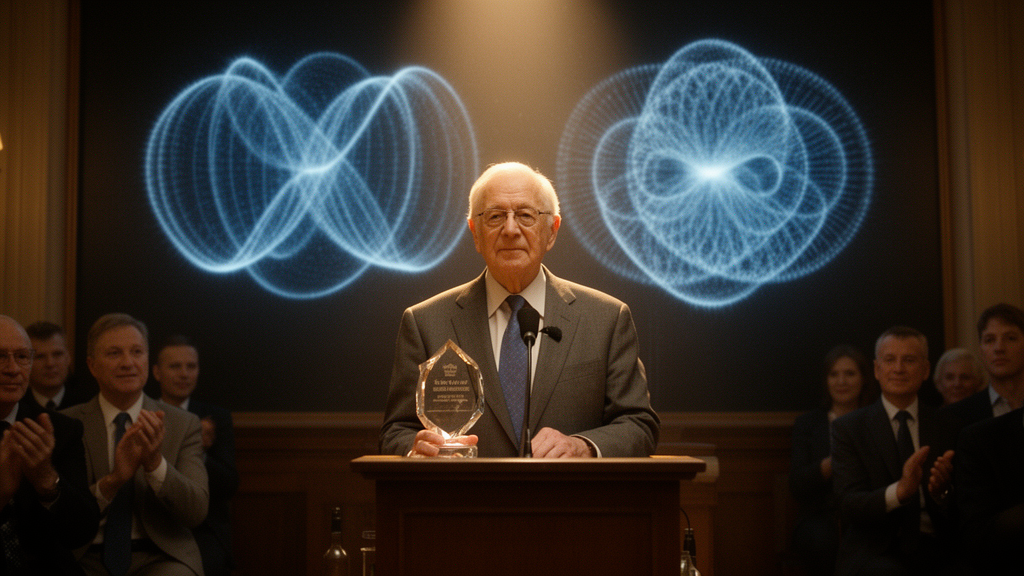
A new international prize celebrating the scientific legacy of Adolf W. Lohmann has been inaugurated, with Professor Joseph Rosen of Ben Gurion University of the Negev named as its first recipient. The Lohmann Holography Award, established as a joint initiative of the University of Tartu and Springer Nature, was presented for the first time during the International Conference on Applied Physics & Imaging (ICAPI 2025), hosted at the University of Tartu in Estonia. The award recognizes pioneering contributions that have fundamentally advanced holography and computational optics, and it is closely integrated with an annual topical collection in the journal Applied Physics B: Lasers and Optics.
The choice of Adolf W. Lohmann’s name for the distinction reflects his singular position in the history of modern optics. While Dennis Gabor established the foundations of holography, Lohmann played a pivotal role in expanding the field into the computational domain through his pioneering contributions to computer-generated holography, diffractive optics, Fourier optics, and optical information processing. His work helped transform the way optical information is generated, manipulated, and interpreted, laying conceptual foundations for many of today’s advances in computational holography, computational imaging, holographic displays, wavefront engineering, and optical information processing. The influence of his scientific vision continues to shape contemporary holography and computational optics.
According to the editorial announcing the award, published in Applied Physics B and authored by Vijayakumar Anand and Jacob I. Mackenzie, the prize was conceived at a moment when holography is evolving rapidly through advances in computational methods, artificial intelligence, advanced optical materials, and digital processing. The organizers argue that alongside celebrating current scientific achievements, there is a growing need to preserve the historical foundations upon which modern research continues to build. Scientific awards, they note, play an important role in that process by recognizing excellence, strengthening scientific communities, inspiring early-career researchers, and providing lasting recognition of ideas that continue to shape the field.
What distinguishes the Lohmann Holography Award from many other scientific prizes is its structural integration with scholarly publishing. Rather than solely recognizing past achievements, the award is tied to an annual topical collection in Applied Physics B that aims to showcase recent advances across the broad spectrum of holography and computational optics. Contributions are welcomed in areas including digital and computational holography, computational imaging, optical information processing, diffractive optics, wavefront engineering, holographic microscopy, quantitative phase imaging, artificial intelligence in optics, optical metrology, and emerging photonic technologies. By bringing together fundamental developments and practical applications, the collection is intended to provide an international forum reflecting the continuing evolution of holography from classical optical techniques to modern computational imaging, while simultaneously recognizing exceptional scientific contributions.
The inaugural presentation took place at ICAPI 2025, a conference organized by the ERA Chair CIPHR Research Group at the Institute of Physics, University of Tartu, in association with Springer Nature, the University of Southampton, and the Vilnius University Laser Research Center. The conference brought together researchers from across the international optics community, and the organizers describe its setting as an ideal stage for inaugurating the award. The decision to launch the prize during ICAPI was described as both deliberate and symbolic: the conference was founded on the vision of fostering interdisciplinary research by connecting photonics with computational methods, an approach that closely mirrors the scientific philosophy championed by Lohmann himself.
One of the most personal dimensions of the inauguration involved locating members of the Lohmann family. Although the scientist’s legacy is widely recognized throughout the optics community, finding his family more than a decade after his passing proved unexpectedly challenging. An extensive search through professional contacts, archival resources, and personal networks across Germany eventually led to a reply from his granddaughter, Franka Rademacher. Her presence at the ceremony, the editorial recounts, transformed the occasion into something far more meaningful than a conventional award presentation, creating a tangible bridge between one of the pioneers whose ideas shaped modern computational optics and the international community of researchers continuing to advance the field today. The inauguration ceremony itself drew participants from across Europe, Asia, North America, and Australia, reflecting the international character of the holography community.
The selection of the first laureate carried particular weight, since the inaugural recipient was seen as helping to define the scientific vision and aspirations of the new award. Because the inaugural edition preceded the establishment of a formal international selection committee, the recipient was identified based on the founding vision of the prize and its objective of recognizing pioneering contributions that have fundamentally advanced holography and computational optics. Professor Joseph Rosen was chosen in recognition of his pioneering and sustained contributions to digital holography, computational imaging, and optical information processing. Over several decades, his research has transformed holographic imaging through the introduction of innovative computational concepts and imaging methodologies that have significantly expanded the capabilities of holography under spatially incoherent illumination.
Rosen’s body of work, the editorial explains, has consistently demonstrated how rigorous optical theory can be combined with computational techniques to create entirely new imaging paradigms, influencing applications ranging from microscopy and biomedical imaging to three-dimensional imaging, optical metrology, and astronomical imaging. The selection was described as particularly fitting given the philosophy underpinning the award: where Lohmann’s pioneering work established the foundations of computer-generated holography and demonstrated how computation could fundamentally transform optical imaging, Rosen’s research has continued that evolution by developing computational methods that have redefined modern holography, illustrating how numerical techniques and optical design together can overcome longstanding limitations of conventional imaging systems. In this sense, his achievements are presented as embodying the continuing evolution of the vision Lohmann pioneered decades ago, and as the first recipient he is credited with establishing the scientific benchmark upon which future editions of the award will build.
Looking forward, the award enters a new phase with the establishment of an International Steering and Selection Committee. The committee includes previous award recipients together with internationally recognized experts in holography and computational optics, including Professors Wolfgang Osten, Joseph Rosen, and Chao Zuo, as well as the editorial leadership of Applied Physics B. By combining the expertise of internationally recognized scientists with the experience of previous laureates, the selection process is designed to uphold high standards of scientific excellence while reflecting the breadth and diversity of contemporary holography. The annual Applied Physics B topical collection will continue alongside the prize, providing an international platform for disseminating advances in holography, computational imaging, optical information processing, and emerging photonic technologies, and the editorial extends an open invitation to the international optics and photonics community to contribute to the collection, with submission details and author guidelines available on its official webpage.
Beyond the immediate celebration of its first laureate, the editorial frames the inauguration as the beginning of a long-term commitment rather than a culmination. As holography continues to evolve through computational methods, artificial intelligence, advanced photonic devices, and novel imaging paradigms, the scientific questions confronting the community will change, yet the qualities that define transformative research—creativity, originality, intellectual curiosity, and scientific rigor—are described as remaining unchanged. These are the values exemplified by Adolf W. Lohmann throughout his career, and they are presented as the guiding principles upon which the award has been established. The organizers express the hope that in the years ahead the prize will inspire researchers around the world to pursue bold ideas, challenge established boundaries, and contribute to the next generation of discoveries in holography and computational imaging, serving not only as a distinction for scientific excellence but also as a lasting symbol of the international holography community’s shared commitment to advancing optical science.
Subject of Research: Establishment and inauguration of the Lohmann Holography Award for holography and computational optics
Article Title: The Lohmann Holography Award: honoring scientific legacy and inspiring the future of holography
Article References: Anand, V., & I. Mackenzie, J. (2026). The Lohmann Holography Award: honoring scientific legacy and inspiring the future of holography. Applied Physics B, 132(10), Article 103. https://doi.org/10.1007/s00340-026-08720-2
Image Credits: AI Generated
DOI: 10.1007/s00340-026-08720-2
Keywords: Lohmann Holography Award, Adolf W. Lohmann, holography, computational imaging, Joseph Rosen, Applied Physics B, University of Tartu, Springer Nature, ICAPI 2025, digital holography, optical information processing, topical collection
News Source: Denise Maddox. (October 29, 2026). New Lohmann Holography Award Honors a Pioneer and Names Joseph Rosen as First Laureate. Scienmag.