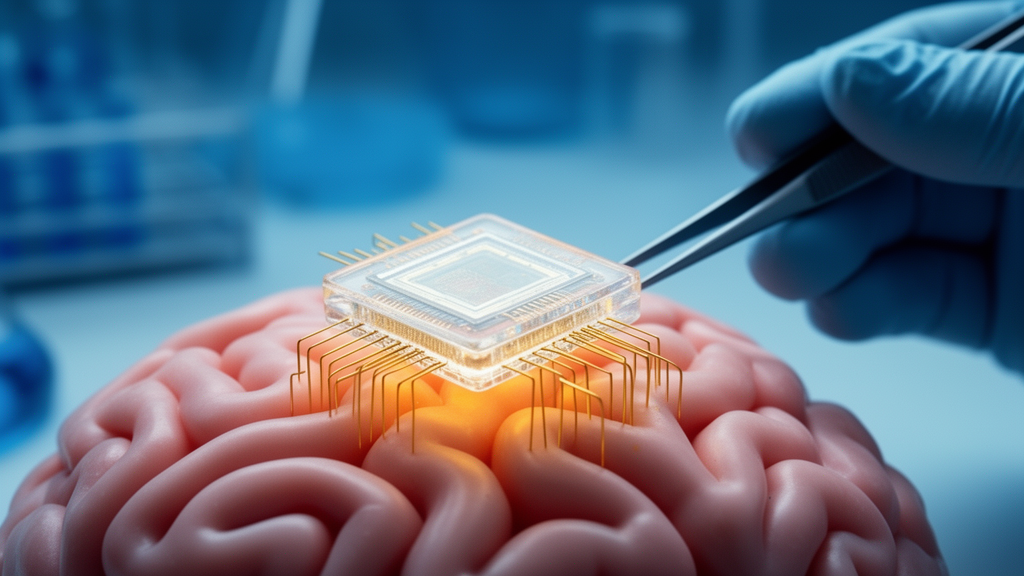
Engineers at EPFL have built an implantable chip that can track how different regions of the brain talk to each other and use those signals to identify cognitive and emotional states in real time. The system, called LogSync, is described in a paper published in the IEEE Journal of Solid-State Circuits and was developed with support from a CHF 6.6 million grant from the US National Institute of Mental Health aimed at implantable systems that can measure and control oscillatory brain networks in severe psychiatric illnesses, particularly mood and anxiety disorders.
The motivation comes from a view increasingly shared in neuroscience: psychiatric disorders may arise less from the failure of any single brain region than from disruptions in the communication between regions. Mahsa Shoaran, who heads the Integrated Neurotechnologies Lab in EPFL’s School of Engineering and Neuro-X Institute, explains that this network-level perspective underpins the team’s approach. Most existing deep brain stimulation devices, however, are not built to see networks. Many operate in an open-loop fashion, delivering stimulation according to predefined settings rather than adapting to what the brain is doing, and even among closed-loop, adaptive systems, many rely on signals recorded from a single region.
LogSync attacks that limitation directly. The low-power implantable system-on-chip records brain activity and extracts biomarkers describing two things at once: the strength of brain waves, or oscillations, and the synchrony between signals arriving from different brain regions. A machine-learning algorithm then analyzes these network-level biomarkers to distinguish cognitive and emotional states and to generate stimulation triggers when specific states are detected. In other words, the chip is designed to close the loop not on one electrode’s view of the brain, but on the conversation happening across it.
Shoaran says the major hurdle was achieving the functionality within the very limited power budget of an implantable system. Her team’s answer was co-design: the algorithms and the hardware were developed together, each shaped by the constraints of the implant. That approach allowed network-level neural signal processing and decoding on a single chip while keeping power consumption under 200 microwatts, which the researchers describe as a fraction of what many implantable neural-interface systems typically require.
A second innovation is mathematical rather than architectural. LogSync relies on logarithmic computations, which simplify the complex operations needed for brain-network analysis, real-time biomarker extraction and decoding.
The chip measures roughly 4 by 2 millimeters. Its initial validation did not involve implanted human patients. Instead, the researchers evaluated LogSync using human brain recordings from previous psychiatric experiments. One dataset captured changes in cognitive engagement while people performed a mental task; another captured emotional arousal as participants viewed video clips. The algorithm was able to distinguish these cognitive and emotional states from the neural recordings alone, without invasive testing in new subjects.
To test the implant itself, the team turned to animal work. In experiments conducted in rats at the University of Minnesota, the implant tracked ongoing oscillations and generated stimulation triggers at predefined phases of brain activity.
Deep brain stimulation itself is well established for movement disorders such as Parkinson’s disease, and researchers are increasingly exploring its potential for severe psychiatric illnesses including major depression, post-traumatic stress disorder and obsessive-compulsive disorder. LogSync’s initial validation focused on psychiatric applications, but the researchers argue the underlying capability, extracting brain-network biomarkers to trigger precisely timed stimulation, is broadly applicable across next-generation neurotechnology, including adaptive DBS for movement disorders, closed-loop non-invasive stimulation and emerging focused-ultrasound interfaces.
The work builds on the lab’s previous efforts in brain-to-text decoding and closed-loop neuromodulation, extending those concepts to network-level biomarkers and adaptive decoding for future psychiatric therapies. In parallel, the laboratory is developing machine-learning methods that learn directly from neural recordings rather than predefined biomarkers. Its recent ICML 2026 work uses self-supervised learning to capture neural activity across regions, channels and time, part of a broader effort to bring intelligent neural interfaces closer to clinical use, including through Infera Neuro, an EPFL spin-off co-founded by Shoaran.
For now, the results are early-stage: state classification demonstrated on previously recorded human data, and stimulation triggering demonstrated in rats. But the chip demonstrates that network-level brain monitoring and machine-learning-based state decoding can fit within the power envelope of an implant, a prerequisite for closed-loop psychiatric devices that respond to the brain’s own communication patterns rather than a fixed schedule.
Subject of Research: An implantable neural system-on-chip that decodes cross-regional brain synchrony to identify cognitive and emotional states for adaptive psychiatric neuromodulation.
Article Title: Neural chip decodes interactions between brain regions
Article References: Neural chip decodes interactions between brain regions. Original publication (Bibliographic details unavailable.)
Image Credits: AI Generated
DOI: Not provided
Keywords: LogSync, EPFL, deep brain stimulation, neural implant, brain synchrony, psychiatric disorders, neuromodulation, system-on-chip, machine learning, biomarkers, closed-loop stimulation, neurotechnology
News Source: Cassandra Pierce. (October 29, 2026). Implantable chip reads cross-brain synchrony to flag mental states in real time. Scienmag.