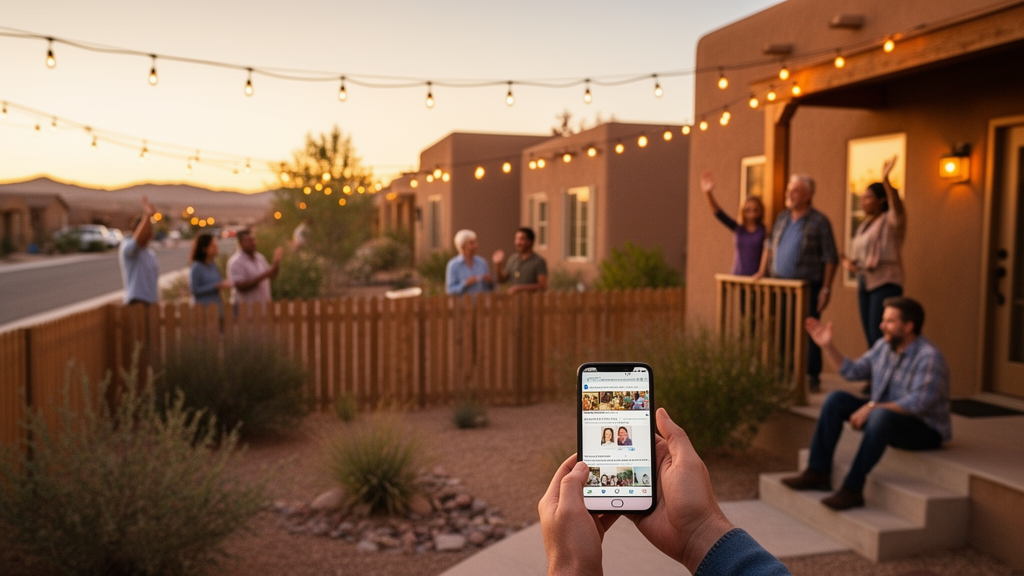
Adults in Nevada who used neighborhood-focused social media reported stronger feelings of social cohesion and a greater sense of community than non-users, according to a cross-sectional survey conducted in December 2020, during the COVID-19 pandemic. The study, published in BMC Public Health, surveyed 1,000 Nevada adults aged 18 years or older by telephone.
Neighborhood social media use was measured with a simple yes-or-no question, and 38 percent of respondents reported using such platforms.
After adjusting for sociodemographic characteristics and perceived neighborhood safety, social media users scored higher on both outcomes. Users reported a greater sense of community (B = 1.36, β = 0.142, p < 0.001) and higher social cohesion (B = 0.63, β = 0.130, p < 0.001) compared with non-users. Social cohesion was measured with a four-item composite score, while sense of community used an eight-item composite.
Perceived neighborhood safety emerged as the strongest predictor of both outcomes. It was associated with sense of community (B = 2.76, β = 0.403, p < 0.001) and with social cohesion (B = 1.40, β = 0.402, p < 0.001), dwarfing the coefficients observed for social media use.
The analysis also revealed a step-wise increase in associations between sense of community and social cohesion as income increased, suggesting that feelings of neighborhood connectedness were not evenly distributed across socioeconomic groups in the sample.
The researchers note that social cohesion and sense of community are neighborhood social factors that play critical roles in psychological health and overall well-being. Despite significant growth in neighborhood social media use, evidence examining its effects on these neighborhood social factors has remained sparse, particularly during community-level emergencies.
Based on their findings, the authors conclude that digital neighborhood social media platforms may help local engagement and social connectedness, and may help preserve a sense of community and social cohesion during emergencies. However, they caution that efforts must also address the socioeconomic and safety-related inequities that limit feelings of community connectedness.
The survey was limited to Nevada adults and relied on self-reported measures collected by phone during a single month of the pandemic, so the results may not generalize to other regions or periods. As an open-access article published on 26 September 2026, the study adds to a small but growing body of evidence on how digital neighborhood platforms relate to the social fabric of communities during public health crises.
Subject of Research: Associations between neighborhood social media use and social cohesion and sense of community among Nevada adults during the COVID-19 pandemic
Article Title: The association of neighborhood social media use on social cohesion and sense of community in Nevada adults during the COVID-19 pandemic
Article References: Coughenour, C., Tahir, N., Kahale, M., Adkins, S., Dantam, C. R., Gakh, M., Labus, B., & Assoumou, B. (2026). The association of neighborhood social media use on social cohesion and sense of community in Nevada adults during the COVID-19 pandemic. BMC Public Health. https://doi.org/10.1186/s12889-026-29628-8
Image Credits: AI Generated
DOI: 10.1186/s12889-026-29628-8
Keywords: social media, social cohesion, sense of community, neighborhoods, COVID-19, Nevada, cross-sectional survey, public health, community connectedness, perceived safety, association, neighborhood
News Source: Ophelia Keating. (October 28, 2026). Neighborhood social media use linked to stronger community ties in Nevada during COVID-19. Scienmag.